
Gannon Costello
CX Technology Analyst
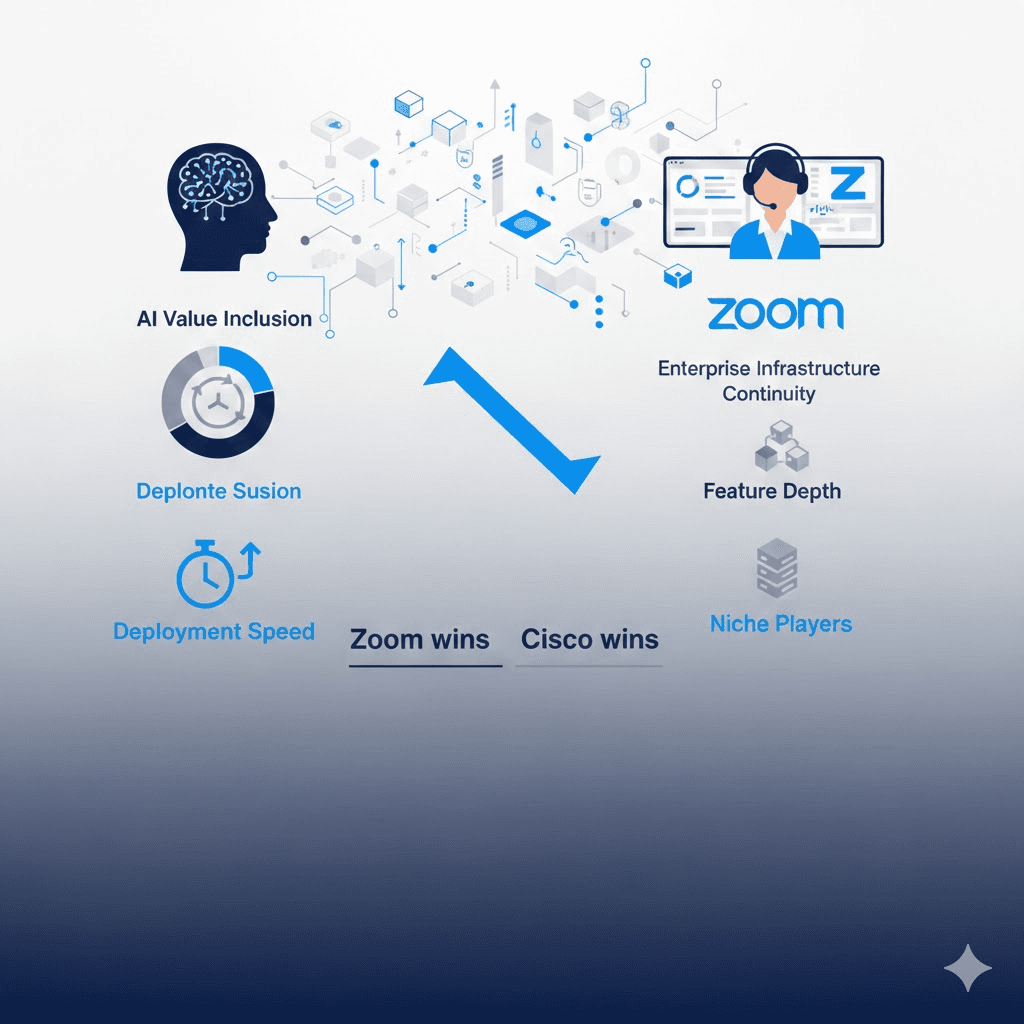
Zoom wins on deployment speed, pricing clarity, and AI value inclusion. Cisco wins on enterprise infrastructure continuity and feature depth for complex requirements. Both platforms landed as Gartner Niche Players in 2025, but their trajectories diverge: Zoom climbed into that position through rapid growth, while Cisco descended from Challenger status. Organizations prioritizing fast deployment and modern user experience should favor Zoom. Organizations with deep Cisco infrastructure investments and complex compliance requirements may find Webex Contact Center's vendor continuity worth the administrative overhead. Neither platform eliminates migration work.
InflectionCX analyzed both platforms across deployment evidence, pricing structure, AI architecture, analyst positioning, and migration realities. The findings point to a governance question that sits above the feature comparison: which platform makes it easier to implement consistent quality standards across channels, and which platform's administrative experience actually gets used by the supervisors who need it?
At a Glance
Capability | Zoom Contact Center | Cisco Webex Contact Center | Verdict |
|---|---|---|---|
Deployment Speed | Days to weeks (verified at 3,000-seat scale) | 3–6 months for migrations | Zoom |
Pricing Transparency | Published tiers: $69–$149/user/month | Sales quote required | Zoom |
AI Nativeness | AI Companion included, no extra charge | AI features available, pricing undisclosed | Zoom |
Ease of Use | Single interface, meeting-familiar UX | Multiple admin interfaces, steeper curve | Zoom |
Enterprise Voice Heritage | Modern WebRTC architecture | Decades of telephony infrastructure | Cisco |
Existing Cisco Shop Fit | Competitive displacement | Natural migration path | Cisco |
Cisco's Analyst Trajectory Signals Deeper Challenges
Cisco Webex Contact Center's descent from Challenger (2024) to Niche Player (2025) in Gartner's Magic Quadrant represents a significant repositioning in analyst perception. Gartner cited two specific cautions: multiple administrative interfaces and limited third-party integrations.
The Forrester Wave (Q2 2025) evaluation reinforced these concerns. Cisco earned Strong Performer status with the highest strategy score among peers, but also the lowest Strength of Offering score in that tier. Forrester's customer references were direct: the full Webex Contact Center suite was frequently described as clunky to administer and felt like working with four different products, with separate development environments required for voice and digital self-service applications.
Analyst Zeus Kerravala of ZK Research pushed back on Gartner's positioning, noting that Cisco CCaaS has shown robust growth and earned a Gartner Peer Insights Customer Choice designation for 2025. The IDC MarketScape (2024) named Cisco a Leader, noting that midmarket organizations will find the breadth of Webex Contact Center capabilities a strong fit. This analyst divergence creates a mixed-signal environment for enterprise buyers and warrants evaluation against production evidence rather than quadrant positioning alone.
Pricing Opacity Is a Persistent Cisco Weakness
Cisco does not publicly disclose Webex Contact Center pricing. Nextiva's competitive analysis documented the friction: prospective buyers must complete demo request forms and engage the sales team before any hard numbers are disclosed. CloudTalk's analysis identified the structural concern: Webex's extensive feature set may lead to unexpected expenses as additional functionalities and integrations are added. Workforce management, translations, and Webex Calling on the contact center plan all carry additional costs.
Zoom's pricing is publicly published: Essentials at $69/user/month, Premium at $99, and Elite at $149. A TrustRadius reviewer put the value differential plainly: Zoom was less than half the cost with many features included rather than sold as add-ons. The pricing transparency gap affects procurement efficiency as much as total cost. Organizations that cannot compare costs without a sales cycle face longer evaluation timelines and reduced negotiating leverage.
Migration from Cisco On-Premises Systems Carries Documented Risk
Organizations migrating from Cisco's legacy UCCX or UCCE platforms to Webex Contact Center face well-documented obstacles. A Telcion case study covering a contact center handling 5,000 calls per day found that the transition took three to six months depending on the number of scripts requiring conversion and the size of the existing environment. Technical issues included softphone compatibility problems with Cisco Jabber triggering ReRoute On No Answer and making agents unavailable despite being ready, SIP trunk configurations causing 10-plus-second silence delays with certain carriers, and training attendance gaps that caused cutover-day confusion when only about half of scheduled agents participated.
Cisco's own documentation acknowledges that historical data cannot be directly transferred from UCCX to Webex Contact Center Analyzer because the schemas are completely different. The Analyzer retains only 13 months of data, requiring external warehousing for longer-term retention. Organizations with compliance obligations around historical interaction data should plan for that infrastructure burden before the migration begins.
Gartner Peer Insights reviews confirmed feature parity gaps between UCCX and Webex CC. The skills translation also proves incomplete: UCCE expertise takes years to develop, and Webex Contact Center uses different tools and interfaces. The institutional knowledge embedded in existing Cisco teams may not transfer cleanly to the cloud platform.
Zoom's Deployment Speed Is Customer-Verified at Scale
Vensure, a global payroll company, documented one of the more aggressive Zoom Contact Center rollouts on record: Zoom's professional services team helped move 3,000 people in a single day without service interruptions. A U.S. government agency reviewer on Gartner Peer Insights validated the platform's production reliability, noting that multiple contact center teams had collectively received over 100,000 calls in six months with continuous successful operation. Spain's National Tax Agency deployed 20,000 seats on the platform, representing one of the largest documented CCaaS deployments in a single vendor relationship.
Cisco's five-day deployment claim applies only to implementations without customizations and caps at 1,000 concurrent agents. The enterprise quick deployment promise of ten business days explicitly excludes interconnection with existing on-premises systems. For organizations evaluating migration timelines as part of their business case, the difference between days and months carries real operational and financial weight.
AI Capabilities Favor Zoom's Inclusive Model
Zoom includes AI Companion for Contact Center at no additional cost across eligible plans. Included capabilities cover conversation summaries, real-time sentiment analysis, follow-up task generation, response suggestions, and agent talk metrics. The Elite tier adds AI Expert Assist for real-time knowledge base retrieval and dynamic agent guides. Customer-documented results include one organization reducing after-call work from 4.5 minutes to under 30 seconds and decreasing call handle time by 3 minutes. Acceleraate's partner review estimated that most CCaaS providers charge an additional $20 to $30 per seat for comparable AI features.
Cisco offers AI capabilities through its AI Assistant, but specific pricing for contact center AI features is not publicly disclosed. The pricing opacity issue applies to the AI layer as much as to the base platform. Organizations evaluating AI-first contact center strategies should model the total cost of AI inclusion across both platforms, accounting for Zoom's bundled approach against Cisco's undisclosed incremental charges.
At InflectionCX, the reason we built Atlas with a fully auditable QA layer is that AI scoring and coaching decisions require a defined accountability chain. When an automated model scores 100% of agent interactions, the governance structure around that model matters as much as the model's capabilities. Buyers should evaluate both the AI feature set and the governance controls around how scores are calibrated, audited, and disputed.
Customer Reviews Reveal Divergent User Experience Patterns
Gartner Peer Insights reviews for Zoom Contact Center consistently highlight usability as the platform's strongest characteristic. Reviewers describe Zoom as among the easiest platforms on the market to use, with agents able to operate effectively with minimal training. The Flow Editor for IVR and routing design draws favorable comparisons to standard low-code tooling. Former Cisco on-premises customers specifically noted that Zoom's administration is substantially easier and cleaner than CUCM. Zoom's TrustRadius score is 8.8 out of 10, with strong vendor relationship feedback from enterprise accounts.
Cisco's interface drew more criticism across review platforms. G2 reviewers noted that Webex Contact Center lacks some of the advanced features and flexibility that modern contact centers often require and that the user interface can feel less intuitive relative to competitors like Genesys Cloud. Crazy Egg's independent review characterized the interface as clunky and described the analytics as notably poor. Nextiva's analysis summarized the training implication: the learning curve is steep, especially for nontechnical staff, with too many features buried in layers of menus.
The user experience gap compounds over time. Platforms that supervisors cannot navigate comfortably deliver less operational value regardless of their theoretical feature depth. Organizations with high agent turnover or limited training budgets should weight usability evidence heavily in their evaluation.
Market Momentum Favors Zoom's Growth Trajectory
Synergy Research Group identified both Zoom and Cisco as top performers for growth in the cloud contact center market, which reached $6.2 billion in 2024, up 16% year over year. Their growth stories differ qualitatively.
Zoom's Q3 FY2025 metrics included 100%+ year-over-year growth in customers with over $100,000 ARR, 700-plus clients by Q3 (up from 500 the prior quarter), and triple-digit growth in the enterprise-focused Elite tier. CEO Eric Yuan noted in CX Today reporting that all top ten contact center deals were competitive displacements of existing providers, and that customers were actively choosing Zoom because of dissatisfaction with incumbent solutions. Displacement patterns differ from early-stage adoption: enterprise buyers who evaluate both options before choosing Zoom represent a stronger signal than greenfield wins against no incumbent.
Cisco reported a 75% surge in CCaaS seat activations in late 2024 and received the Gartner Peer Insights Customers' Choice designation for 2025, demonstrating strong satisfaction within its installed base. Analyst Sheila McGee-Smith of McGee-Smith Analytics observed that by 2025, Zoom Contact Center is not only competing with CCaaS market leaders but sometimes replacing them based on ease of use. Cisco's growth story is largely an install base conversion story, which is legitimate and large, but architecturally different from Zoom's competitive displacement pattern.
Integration Ecosystems Reflect Different Architectural Approaches
Zoom positions turnkey integrations as a competitive advantage. CRM connectors for Salesforce, ServiceNow, Zendesk, Microsoft Dynamics, and HubSpot are configured to save engagement data into CRM by default. The ServiceNow partnership was characterized by CX Today as the deepest CCaaS-CRM integration available, embedding voice, digital channels, and workforce management natively inside ServiceNow CSM. Zoom's marketplace includes 3,000-plus applications.
Cisco's integration approach requires more technical configuration. Setting up the Salesforce integration involves downloading Call Center Definition files from GitHub, embedding the Webex CC Desktop in iFrames, and managing multiple SDKs, with a documented limitation that the CRM connector does not support multiple open tabs. Gartner specifically cited limited third-party integrations as a caution. Cisco's Webex App Hub includes approximately 400 enterprise-focused applications, fewer in total but more targeted toward regulated industries and complex enterprise environments.
Feature Depth and Platform Fit
TrustRadius head-to-head comparison data shows aggregate scores that mask important nuances. G2 feature ratings reflect the relative strengths clearly:
Feature | Zoom | Cisco Webex |
|---|---|---|
Deployment Speed | Verified days to weeks | 3–6 months documented |
Admin Interface | Single unified environment | Multiple environments |
AI Inclusion | Bundled, no extra charge | Undisclosed pricing |
CRM Integration | Default data sync, 3,000+ apps | GitHub configuration, 400 apps |
Video Architecture | Native, built-in | Extended from voice-first |
Enterprise Voice Heritage | Modern WebRTC | Decades of telephony depth |
Compliance Infrastructure | SOC 2 Type II, HIPAA, GDPR, PCI DSS | Full Cisco security portfolio |
WFM Maturity | Functional, less mature | Broader enterprise WFM depth |
Zoom Contact Center fits organizations where deployment speed is a priority, agents already use Zoom and interface familiarity will accelerate adoption, AI cost predictability is part of the business case, video customer service is a strategic channel, or the organization is actively displacing a first-generation CCaaS solution.
Cisco Webex Contact Center fits organizations where existing Cisco infrastructure creates a natural migration path, complex compliance requirements benefit from Cisco's established regulatory certifications, advanced workforce management depth is a hard requirement, or the organization needs Cisco's global telephony network for multi-carrier enterprise voice operations.
Reporting and Analytics
Zoom Contact Center provides native dashboards for real-time monitoring and historical reporting, with AI Companion extending analytics into qualitative dimensions: sentiment analysis, topic detection, and interaction scoring across all interactions without sampling. Data export supports integration with external analytics platforms and data warehouses for organizations with established business intelligence infrastructure.
Webex Contact Center Analyzer provides historical and real-time reporting with custom report capabilities, but the historical data migration limitation deserves specific attention. Organizations transitioning from UCCX cannot directly import historical data due to schema differences, and the Analyzer retains only 13 months of data. Organizations with compliance obligations around interaction data retention or those wanting extended trend analysis need to plan for external data warehousing as a separate infrastructure investment.
The operational test for analytics is practical rather than theoretical: reports that supervisors cannot navigate deliver no value. Organizations should evaluate reporting through hands-on testing with actual supervisors, accounting for the multiple administrative interface issue documented by Forrester and Gartner when assessing Cisco's analytical depth.
Total Cost of Ownership
Headline per-seat pricing comparisons obscure the full cost picture. Zoom's published tiers create a transparent starting point, with AI Companion included and volume discounts applied for larger deployments. Implementation costs for straightforward deployments favor Zoom's configuration-first model, though complex integrations still require professional services. Training costs are measurably lower given interface familiarity, and new-hire onboarding benefits from agents' baseline comfort with the Zoom interface paradigm.
Cisco's undisclosed pricing creates procurement friction and extended evaluation timelines. Implementation costs for on-premises migrations run higher due to 3-to-6-month timelines, parallel operation periods, and extended training requirements. Workforce management, AI capabilities, and specific integrations may carry incremental charges that are difficult to model without sales engagement. For organizations requiring detailed business case support before a procurement decision, Cisco's pricing opacity is itself a cost.
The TCO calculation is organization-specific. Organizations prioritizing deployment velocity, bundled AI, and administrative simplicity will find Zoom's total cost lower. Organizations with complex compliance requirements, specialized WFM needs, or deep Cisco infrastructure dependencies may find that Cisco's feature breadth justifies the premium and the overhead.
Enterprise Readiness
Enterprise buyers evaluating Zoom Contact Center frequently raise the same concern: can a company known for video meetings handle complex contact center operations? The production evidence answers that question directly. Spain's National Tax Agency deployed 20,000 seats. Vensure migrated 3,000 agents in one day without service interruption. A U.S. government agency processed over 100,000 calls across multiple contact centers in six months. These are production-grade deployments at scale, not pilots.
Zoom's security documentation confirms explicit data governance controls: customer data is not used to train models, transcripts can be disabled, and regional data residency options are available. Certifications include SOC 2 Type II, HIPAA eligibility, GDPR compliance, and PCI DSS attestation.
The enterprise readiness question increasingly inverts. Modern workforces expect consumer-grade interfaces. Training costs and adoption friction compound over the platform lifecycle. The assumption that legacy platform complexity signals enterprise-grade capability is worth examining carefully against the operational evidence from Zoom's largest deployments.
The Unified CX Lens
Unified CX is the integration of AI agents and human operations under a single governance model, quality standards, and analytics infrastructure. Platform selection serves that integration. Neither Zoom nor Cisco delivers it on its own, but the platforms create different paths toward it.
Zoom's architecture advantages for Unified CX include single-vendor technology ownership enabling coordinated roadmap development, bundled AI reducing the governance complexity of managing separate AI contracts, video-native design supporting visual engagement channels, and administrative simplicity enabling broader adoption of quality management tools across supervisory roles.
Cisco's architecture challenges for Unified CX include multiple administrative interfaces creating governance fragmentation, undisclosed AI pricing making total cost governance difficult, and the historical data migration limitation interrupting continuity of quality measurement during platform transitions.
Both platforms require supplementary capabilities for true Unified CX: 100% interaction analysis across all channels, AI-powered coaching spanning human and automated interactions, quality standards that apply equally to bot and agent conversations, and unified analytics consolidating the full customer journey.
Frequently Asked Questions
Is Zoom Contact Center ready for enterprise deployments? Production evidence supports enterprise readiness. Spain's National Tax Agency runs 20,000 seats on the platform. Vensure migrated 3,000 agents in a single day without service disruption. A U.S. government agency processed over 100,000 calls in six months. Security certifications cover SOC 2 Type II, HIPAA, GDPR, and PCI DSS. Feature gaps remain in advanced workforce management compared to mature platforms, but core enterprise capabilities are proven at scale.
How long does migration from Cisco UCCX to Webex Contact Center take? Documented timelines range from three to six months depending on environment complexity and script conversion requirements. Cisco's documentation acknowledges that historical data cannot be directly migrated due to schema differences, and the Webex Contact Center Analyzer retains only 13 months of data. Organizations should plan for parallel operation periods, extended training windows, and external data warehousing if compliance or trend analysis requires longer data retention.
Does Zoom Contact Center include AI features without additional cost? Zoom includes AI Companion for Contact Center at no additional charge across eligible plans. Included capabilities cover conversation summaries, real-time sentiment analysis, follow-up task generation, response suggestions, and agent talk metrics. Partner analyses estimate competitors charge $20 to $30 per seat for comparable features. One documented customer reduced after-call work from 4.5 minutes to under 30 seconds using AI Companion and AI Expert Assist.
Why did Cisco drop from Challenger to Niche Player in Gartner's 2025 Magic Quadrant? Gartner cited two specific cautions: multiple administrative interfaces and limited third-party integrations. Forrester customer references described the suite as clunky to administer and requiring separate development environments for voice and digital self-service. Analyst Zeus Kerravala disputed the positioning, noting strong growth metrics and Gartner Peer Insights Customer Choice recognition. Cisco's 75% surge in CCaaS seat activations reflects real market traction despite the repositioning. Buyers should weigh operational experience evidence alongside analyst positioning rather than treating either as determinative.
Which platform offers better CRM integration? Zoom's ServiceNow integration embeds voice, digital channels, and workforce management natively inside ServiceNow CSM. Zoom also provides default data-sync connectors for Salesforce, Zendesk, Microsoft Dynamics, and HubSpot. Cisco's Salesforce integration requires downloading configuration files from GitHub, embedding desktop components via iFrame, and managing multiple SDKs. Gartner cited limited third-party integrations as a specific Cisco caution. Cisco's Webex App Hub includes approximately 400 enterprise-focused applications. Organizations should evaluate specific connector depth against their technical capacity and customization requirements.
The Bottom Line
Zoom Contact Center is the stronger choice for organizations prioritizing deployment speed, interface simplicity, bundled AI, and transparent pricing. Its Gartner Magic Quadrant inclusion and documented enterprise deployments validate production readiness at scale. The primary limitations are WFM feature maturity for complex scheduling requirements and metered PSTN pricing for high-volume voice operations.
Cisco Webex Contact Center delivers enterprise infrastructure depth for organizations already embedded in the Cisco ecosystem, with established compliance certifications and global telephony capabilities for multi-carr
More in Analysis


Ready for Better CX?

Whether you're selecting your CX technology stack or evaluating outsourcing options, InflectionCX is your go-to-partner. Contact us today.
AI Readiness Assessment
We map where AI fits in your operation. What's working, what's hype, what's actually worth doing.

Unified CX Outsourcing
InflectionCX runs contact centers where humans and AI operate as one system.