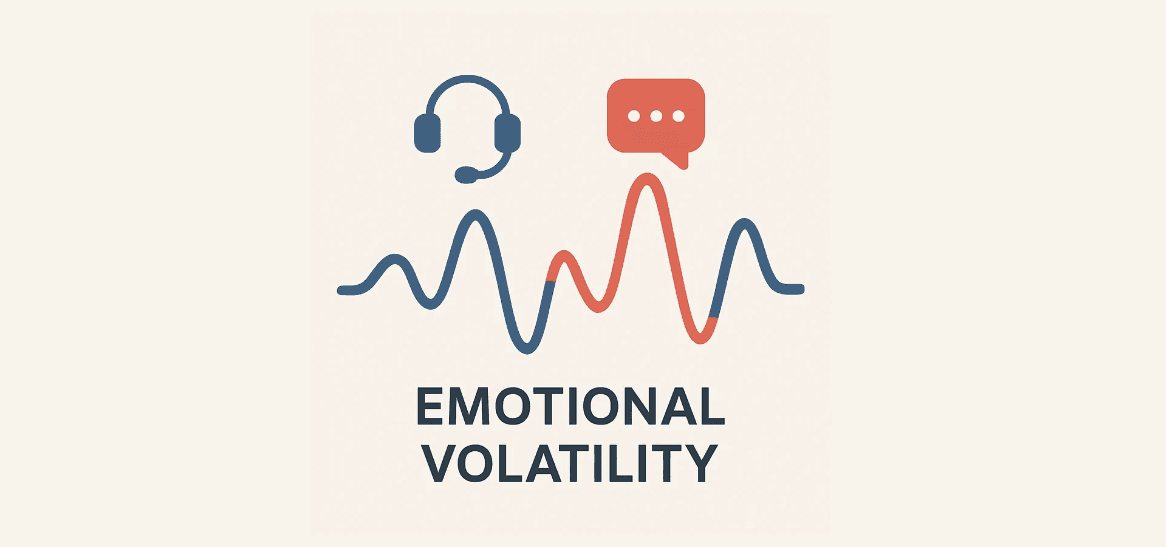
Emotional Volatility: The Predictive Signal Hidden Inside Every Conversation
What Emotional Volatility Actually Measures
Sentiment analysis asks: what is the customer feeling right now? Volatility analysis asks: how much is the customer's emotional state changing, and how erratically?
Stable negative describes a customer who is upset and remains consistently upset. Their emotional trajectory is flat, even if the level is low. These customers often have clear problems that, when addressed, resolve their emotional state predictably.
Volatile negative describes a customer whose emotional state swings—angry, then seemingly calmed, then more angry, then momentarily neutral, then escalating again. Their trajectory is erratic. These customers are harder to help because their emotional state doesn't respond predictably to resolution efforts.
Stable positive describes a customer whose emotional state remains consistently positive throughout the interaction. Low volatility, high level.
Volatile positive describes a customer who swings between very positive and neutral or mildly negative, even during ostensibly successful interactions. This pattern may indicate underlying uncertainty or unresolved concerns that haven't surfaced explicitly.
The volatility dimension provides information that sentiment alone cannot. Two customers with identical average sentiment scores might have completely different volatility patterns—and completely different likelihoods of escalation, complaint, or churn.
Why Volatility Predicts Outcomes
Emotional volatility correlates with customer experience outcomes for reasons that make intuitive sense once the pattern is visible.
Volatility Signals Unresolved Concerns
Customers whose emotions stabilize during a conversation are typically experiencing resolution. Their initial frustration decreases as the agent addresses their issue. The emotional trajectory moves from negative toward neutral or positive and stays there.
Customers whose emotions continue fluctuating often have concerns that aren't being addressed. They may calm momentarily when the agent seems to understand, then become frustrated again when the proposed solution doesn't fit. The volatility reflects ongoing mismatch between customer need and agent response.
High volatility during what appears to be a successful interaction often predicts post-call dissatisfaction or repeat contact. The customer didn't voice remaining concerns, but the emotional pattern revealed them.
Volatility Indicates Escalation Risk
Escalation—to supervisor, complaint channel, or public forum—rarely comes from stable emotional states. Customers who are consistently mildly annoyed may accept imperfect resolution. Customers whose emotions are swinging unpredictably are more likely to hit a threshold that triggers escalation behavior.
Volatility measurement provides early warning. A conversation showing increasing volatility, even if average sentiment isn't extremely negative, may be heading toward escalation. The pattern change precedes the outcome, enabling intervention.
Volatility Reflects Interaction Quality
When agents handle interactions well, customer emotions typically stabilize. Effective listening reduces emotional intensity. Appropriate acknowledgment calms frustration. Clear solutions resolve uncertainty. The conversational skill of the agent appears in the customer's emotional trajectory.
Volatile customer emotions during an interaction often indicate something isn't working—even when the transcript looks acceptable. The agent might be saying the right words while missing emotional cues. The process might be addressing the stated issue while ignoring underlying concerns. Volatility reveals interaction quality dimensions that transcript review alone would miss.
Volatility Affects Memory and Perception
How customers remember experiences affects their future behavior more than what actually happened. Emotionally volatile experiences tend to be remembered negatively even when they ended well. The stress of the swings persists in memory more than the eventual resolution.
A customer whose interaction was emotionally smooth, even if initially negative, often recalls the experience more favorably than one who experienced repeated emotional swings before reaching the same outcome. Volatility during the experience affects perception after it.
Agent Volatility Matters Too
Emotional volatility isn't only a customer signal. Agent emotional patterns matter equally—and measuring them reveals operational dynamics that individual call review cannot see.
Within-Call Agent Volatility
Agents experience emotional variation during conversations. Patient, calm handling might shift to rushed frustration after a difficult customer segment. Confident explanation might waver when customers push back. These within-call patterns affect interaction outcomes.
Agent volatility within calls correlates with customer volatility. When agents become emotionally erratic, customers often follow. When agents maintain emotional stability, customers' emotional swings often dampen. The agent's pattern influences the customer's experience.
Across-Call Agent Volatility
Some agents maintain consistent emotional patterns across their shift. Others show increasing volatility as difficult calls accumulate. The agent who handles early calls with patience and stability might show erratic patterns by mid-afternoon after absorbing customer frustration repeatedly.
Across-call volatility measurement identifies agents who are struggling—often before they're aware of it themselves. The emotional pattern degrades before performance metrics show problems. Early detection enables support intervention that post-hoc quality review cannot provide.
Scenario-Specific Agent Patterns
Agent emotional patterns often vary by scenario. An agent might maintain stability during routine inquiries but show volatility during complaint handling. Another might be steady with technical issues but erratic with emotionally distressed customers.
Scenario-specific volatility analysis reveals development needs that aggregate metrics hide. The agent doesn't need general emotional regulation training—they need support with specific scenario types that trigger their volatility.
What Volatility Analysis Enables
Measuring emotional volatility creates operational capability that sentiment analysis alone cannot provide.
Real-Time Escalation Prevention
Volatility patterns that predict escalation can be detected during live conversations. When a call shows escalating volatility patterns, real-time intervention becomes possible: supervisor alert, agent assistance, or preemptive service recovery.
This shifts escalation management from reactive to predictive. Instead of waiting for customers to demand supervisors, organizations can identify and address escalation risk before the demand occurs.
Proactive Customer Follow-Up
Conversations that ended with resolution but showed high volatility throughout indicate customers who may not remain satisfied. These customers are candidates for proactive follow-up—checking that the resolution held, addressing any remaining concerns, and demonstrating care that the volatile interaction may have made them doubt.
Volatility-based follow-up targeting reaches customers who need attention that satisfaction surveys might not identify. The survey might show satisfaction because the issue was technically resolved. The volatility pattern reveals that the experience may have damaged the relationship despite technical success.
Agent Support and Development
Agents showing within-call or across-call volatility patterns need support, not just performance management. Volatility often indicates stress, skill gaps with specific scenario types, or accumulated fatigue from difficult interactions.
Volatility measurement enables supportive intervention: coaching on emotional regulation, temporary routing adjustments to reduce exposure to triggering scenarios, or simply checking in with agents whose patterns suggest they're struggling. This support prevents burnout and turnover that punitive approaches to similar patterns might accelerate.
Quality Dimension That Transcript Review Misses
Quality evaluation based on transcript review can assess what was said. It cannot easily assess the emotional dynamics of how the conversation unfolded. Two transcripts might look similar while one represented smooth emotional resolution and the other represented volatile swings that happened to end at the same place.
Volatility adds a quality dimension that traditional QA cannot capture efficiently. The emotional trajectory of the conversation becomes evaluable alongside the content and compliance dimensions.
Outcome Correlation and Driver Analysis
When volatility is measured across conversations, patterns emerge connecting volatility to outcomes. Which scenarios generate highest customer volatility? Which agents show highest agent volatility in which conditions? Which volatility patterns predict which outcome changes?
These correlations reveal operational improvement opportunities. High customer volatility in specific scenarios suggests process or training issues worth investigating. High agent volatility in specific conditions suggests support needs worth addressing. The volatility signal points toward underlying causes that outcome metrics alone cannot identify.
The Distinction That Changes Interpretation
Understanding volatility requires distinguishing it from related concepts it's often confused with.
Volatility is not intensity. High emotional intensity (very angry, very happy) differs from high volatility (rapidly changing emotional states). A customer who is very angry but stably very angry has high intensity but low volatility. A customer who swings between mildly frustrated and mildly relieved repeatedly has lower intensity but higher volatility. Both dimensions matter; they measure different things.
Volatility is not negativity. Negative sentiment is a position on an emotional scale. Volatility is movement along that scale. Volatile positive—swinging between positive states and neutral—indicates something different than stable positive, even though both might have positive average sentiment.
Volatility must be context-aware. Emotional change that matches conversational stimulus isn't volatility in the problematic sense. A customer who becomes upset when told about a charge, then calms when it's waived, shows appropriate emotional response to context. A customer who becomes upset, calms when charges are waived, becomes upset again about something new, calms again, then becomes upset about the original issue that was resolved—that's volatility that indicates something beyond appropriate emotional response.
Volatility is a pattern, not a moment. Single emotional swings happen in most conversations. Volatility as a signal emerges from the pattern of swings across the conversation. Measuring volatility requires analyzing the complete emotional trajectory, not flagging individual transition points.
From Gut Feel to Measured Signal
Contact center professionals have always recognized emotional volatility. The feeling of a call that's swinging wildly is unmistakable to experienced agents and supervisors. What's changed is the ability to measure that feeling systematically.
Measurement transforms volatility from impression to data:
Subjective recognition becomes objective identification. Instead of noting that a call "felt volatile," the system identifies specific volatility patterns across the conversation with specific metrics attached.
Sampling becomes comprehensive. Instead of recognizing volatility in the handful of calls someone happened to review, volatility is measured in every conversation, revealing patterns across the operation.
Implicit knowledge becomes coachable signal. Instead of hoping agents develop intuition for emotional dynamics, specific volatility patterns become trainable—here's what volatility looks like, here's how to respond, here's your pattern compared to peers.
Post-hoc observation becomes real-time awareness. Instead of noting in quality review that a call was volatile, volatility detection during live conversations enables intervention while outcomes remain influenceable.
The signal was always there. The measurement capability to capture it systematically is what's new.
The Operational Integration
Volatility measurement provides value when integrated into operational workflows rather than accumulated in reports.
Real-time alerting notifies supervisors when conversations cross volatility thresholds that predict escalation or complaint risk.
Agent assistance can adapt to volatility patterns, surfacing de-escalation guidance when customer volatility increases or check-in prompts when agent volatility patterns suggest stress.
Quality integration adds volatility as an evaluation dimension alongside content and compliance, providing complete picture of interaction quality.
Coaching workflows route volatility-based development opportunities to supervisors with specific behavioral patterns and suggested interventions.
Outcome analysis connects volatility patterns to satisfaction, retention, and complaint metrics, validating which patterns matter for which results.
Integration ensures that volatility intelligence produces action. Without integration, volatility becomes another metric on another dashboard that nobody has time to watch. With integration, volatility becomes a signal that triggers appropriate response throughout operational systems.
Emotional Intelligence from InflectionCX
InflectionCX measures emotional volatility across every customer interaction, providing the pattern analysis that sentiment snapshots cannot deliver. Our platform detects emotional trajectory changes throughout conversations, distinguishing stable emotional states from volatile patterns that predict escalation, complaint, and churn.
We measure both customer and agent volatility, identifying real-time intervention opportunities and development needs that traditional quality review misses. Our integration connects volatility signals to alerting, agent assistance, coaching, and quality workflows—ensuring intelligence produces action.
For organizations seeking to understand the emotional dynamics that determine customer experience outcomes, we provide the measurement capability that transforms gut feel into operational signal.
Contact InflectionCX to discuss how emotional volatility analysis can transform your contact center operations.
Ready for Better CX?

Whether you're selecting your CX technology stack or evaluating outsourcing options, InflectionCX is your go-to-partner. Contact us today.
AI Readiness Assessment
We map where AI fits in your operation. What's working, what's hype, what's actually worth doing.

Unified CX Outsourcing
InflectionCX runs contact centers where humans and AI operate as one system.