Five9's Bet on a PE Operator Signals More Than a CEO Swap
The Avalara Playbook that Impressed the Board
Mathradas spent four years at Avalara as President and COO, joining in early 2019 when the tax automation company had just gone public. His mandate was operational: overseeing sales, marketing, customer success, and professional services while CEO Scott McFarlane focused on strategy. The results were substantial. Revenue grew from $272 million to approximately $826 million on his watch, roughly tripling the business. When Vista Equity Partners came knocking with an all-cash offer at $93.50 per share a 27% premium to the depressed 2022 tech market Avalara's board accepted.
What matters for Five9 isn't just the growth trajectory but what Mathradas learned navigating a take-private transaction. Vista is notoriously hands-on, and any executive who survives its due diligence understands how private equity evaluates software businesses: net revenue retention, gross margin expansion, sales efficiency, and the ever-present question of whether R&D spending actually produces differentiated products. Mathradas emerged from that process with relationships at Vista and visibility into how PE firms restructure software companies for value creation.
His subsequent move to Nintex deepened those credentials. TPG acquired a majority stake in Nintex in 2021 at a valuation exceeding $2 billion, with Thoma Bravo retaining a significant stake. Mathradas joined as CEO in April 2023, inheriting a workflow automation platform serving over 7,000 organizations across 90 countries. The company is privately held, so performance data is limited, but Mathradas's own characterization—"a healthy, profitable business"—and his public statements about AI strategy offer clues.
At Nintex, he led a strategic pivot toward what the company calls "agentic business orchestration," announcing an AI Agent Designer and generative AI workflow tools in 2024. His philosophy, articulated in a July 2025 interview: "If your processes are broken and you're using multiple, disconnected platforms, you can't get a clear view... throwing AI at the problem is just wasting money." That pragmatic, infrastructure-first approach to AI may explain why Five9's board, facing pressure to prove its AI investments generate returns, saw him as the right fit.
What "Trouble" Looks like at a Billion-Dollar CCaaS Company
Five9 crossed the $1 billion revenue threshold in 2024 a milestone 17 years in the making but the celebration was muted. The stock spent 2024 and 2025 in freefall, dropping from a 52-week high of $49.90 to lows below $18. Analysts who once projected a path to $5 billion in revenue now debate whether Five9 can sustain double-digit growth. The disconnect between operational performance and market valuation reflects several converging pressures.
Revenue growth decelerated sharply: 17% year-over-year in Q4 2024 slowed to just 8% by Q3 2025. Dollar-based net retention, a crucial SaaS metric, declined from 109% in early 2024 to 107% by late 2025, still healthy, but no longer expanding. The company reduced its 2024 guidance by 3.8% mid-year, citing "softer new logo bookings," a warning sign that enterprise sales cycles were lengthening. Five9 responded with layoffs: 7% of the workforce in August 2024 and another 4% in May 2025, the first significant headcount reductions in the company's history.
The margin story is more encouraging. GAAP profitability arrived in late 2024, with Q4 delivering $11.6 million in net income, the first profitable fourth quarter ever. Adjusted EBITDA margins expanded to 25% by Q3 2025, and management targets a "Rule of 40" (revenue growth plus profit margin exceeding 40%) by 2027. The $50 million accelerated share repurchase announced in November 2025 signals confidence in the business, or at least a belief that the stock is undervalued. But buybacks don't fix growth deceleration.
The competitive landscape explains much of the pressure. Five9 ranks fourth globally in CCaaS market share by seats, behind NICE, Genesys, and Amazon Connect. Gartner still names it a Leader, for the eighth consecutive year. Still, Forrester's 2025 CCaaS Wave classified Five9 as merely a "Strong Performer," specifically citing its workforce management solution's lack of enterprise scalability. Amazon Connect's consumption-based pricing model is pulling customers away from traditional per-seat licensing, while NICE and Genesys continue adding AI capabilities at an aggressive pace.
Burkland's 18-Year Run Ends Under Activist Watch.
Mike Burkland joined Five9 in January 2008, when the company had 80 employees and $10 million in revenue. Over nearly two decades, he built it into a category leader, taking it public in 2014 at a valuation of roughly $330 million and growing revenue more than a hundredfold. His legacy includes the strategic decision to go cloud-native before "cloud" was industry consensus, the pivot from SMB to enterprise customers (now 90% of revenue), and the cultivation of a Salesforce partnership that remains central to Five9's go-to-market strategy.
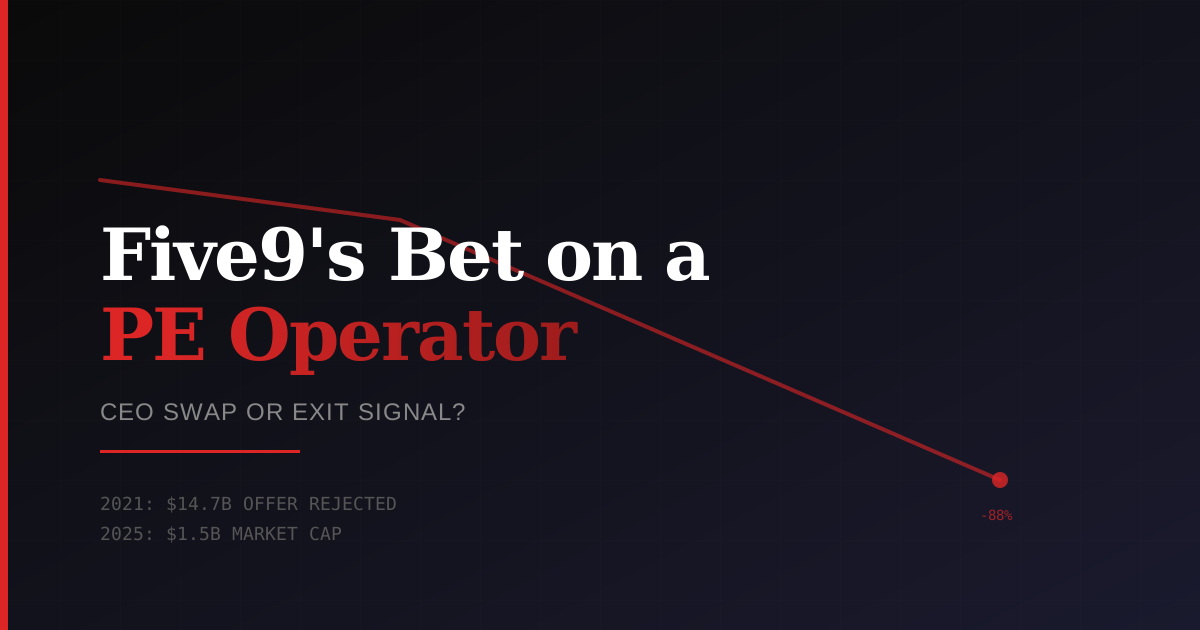
The Zoom deal that wasn't defined his final act as CEO. When Zoom offered $14.7 billion in stock in July 2021, Five9's board approved the transaction. But shareholders balked at the 13% premium, far below comparable deals, and the U.S. Department of Justice raised national security concerns about Zoom's China operations. Proxy advisor ISS recommended voting against. Shareholders rejected the merger in September 2021, just as Zoom's stock began its post-pandemic collapse. Five9 shares traded at roughly $166 the day the deal died; they now trade near $20.
Burkland's July 2025 retirement announcement cited ongoing cancer treatment, a health battle that first forced him to step aside in late 2017 before returning in November 2022. The timing, however, coincided with activist investors circling. Anson Funds and Legion Partners had accumulated stakes throughout 2024, pushing for cost cuts and strategic alternatives. By December 2024, Sagar Gupta, an Anson portfolio manager, had secured a board seat as part of a settlement. The company announced plans to declassify its board and remove supermajority voting requirements, governance changes that activists often demand.
Whether Burkland's departure was purely health-driven or influenced by activist pressure is ultimately unknowable. What's clear is that his successor inherits a board with an activist director, a stock trading at a fraction of its peak, and market speculation about potential acquirers ranging from Salesforce to ServiceNow to private equity.
The $26.5 Million Package Designed for Optionality
Mathradas's compensation structure reveals the board's priorities. His $600,000 base salary slightly exceeds Burkland's, but the real story is in equity. He receives $12.5 million in time-based restricted stock units vesting over four years, plus $14.0 million in performance-based RSUs tied to relative total stockholder return against the S&P Software and Services Select Index. The performance shares can pay out anywhere from 0% to 200% of target, with a cap at 100% if Five9's absolute TSR is negative.
That relative TSR structure has teeth. Five9's 2024 performance ranked in approximately the 1.5th percentile of its benchmark index, resulting in 0% payout for that performance period. The new CEO knows that paper equity can evaporate if the stock continues underperforming peers. But the structure also includes double-trigger change-in-control provisions: if Five9 is acquired and Mathradas is terminated, his unvested equity accelerates at target or actual performance levels. This is standard for public-company executives, but it ensures the incoming CEO is financially aligned with the transaction outcome, not opposed to it.
The $550,000 sign-on bonus (75% repayable if he leaves within 12 months) compensates for the equity he would have forfeited at Nintex. Combined with bonus targets, first-year compensation approaches $28 million. This isn't an unusually aggressive package for a billion-dollar software company, but it's structured to incentivize both operational improvement and openness to strategic alternatives.
Can Genius AI justify Five9's standalone case?
The bull case for Five9 as an independent company rests on AI. Enterprise AI revenue grew 42% year-over-year in Q2 2025 and now represents roughly 10% of subscription revenue, approximately $100 million annually. More than 20% of new enterprise deals include AI components, and virtually all deals exceeding $1 million in annual recurring revenue now attach AI solutions. The company's Genius AI platform includes genuine shipping products: Agent Assist with real-time transcription and AI summaries, GenAI Studio for prompt customization, AI-powered quality management, and virtual agents that launched in June 2025.
Five9's engine-agnostic approach, which supports OpenAI, Google Gemini, and open-source models, differentiates it from competitors locked into proprietary AI stacks. Customers can choose their preferred large language model rather than accepting vendor lock-in. The April 2025 Salesforce Fusion launch deepened CRM integration, streaming transcripts directly into Salesforce to power Einstein AI features. These are real capabilities generating real revenue.
But analyst assessments suggest the AI story isn't yet a competitive moat. Forrester described Five9's agentic AI ambitions as "conceptually powerful but still immature across the market." Cavell Group, an independent analyst firm, noted that "agentic AI and AI-driven routing remain aspirational" while automated quality management represents the "most immediately monetizable" use case. Customers at Five9's analyst summit acknowledged that initial AI deployments required "lengthy tuning cycles with low early containment rates before gradual improvement"—not the instant ROI that marketing materials suggest.
NICE, Genesys, and Amazon Connect are all shipping AI features at a similar pace. The question isn't whether Five9 has AI capabilities but whether those capabilities justify a premium valuation or merely represent table stakes in a rapidly commoditizing market.
The signals pointing toward strategic change
Several factors suggest Five9's trajectory may not be purely organic growth. Mathradas brings PE relationships from Avalara (Vista Equity) and Nintex (TPG, Thoma Bravo). Lead Independent Director Robert Zollars has M&A experience from his tenure at Cardinal Health and Vocera. Activist investor Anson Funds has a board seat. The company announced a 2026 Investor Day to detail its "long-term financial framework," a term often used to signal strategic repositioning.
The stock trades at roughly 2x forward revenue, a significant discount to historical averages and to high-growth software peers. Most analysts maintain Buy ratings with price targets implying 50-100% upside, but the gap between current prices and targets suggests the market is skeptical of execution or waiting for a catalyst. Industry analyst Zeus Kerravala observed that Five9's executive turnover in 2025, including departures of the CMO, EVP of Corporate Strategy, and Head of HR, "indicates some kind of company transaction will take place soon."
None of this guarantees a sale. Five9 could execute a successful AI-driven transformation under Mathradas, expand margins to the "Rule of 40" target by 2027, and gradually re-rate as growth stabilizes. The board clearly believes the standalone path is viable; otherwise, they wouldn't have conducted a six-month CEO search and recruited an external operator.
But the pieces are arranged for multiple outcomes. A CEO with take-private experience. A board with activist representation. A compensation structure aligned with both operational success and strategic alternatives. A platform with genuine AI capabilities that could command a premium from buyers seeking CCaaS assets.
Five9's next chapter will reveal whether Mathradas was hired to run a standalone AI transformation or to position the company for its final act as a public company. Either way, the contact center industry's original cloud pioneer is no longer setting the pace. It's responding to it.
Ready for Better CX?

Whether you're selecting your CX technology stack or evaluating outsourcing options, InflectionCX is your go-to-partner. Contact us today.
AI Readiness Assessment
We map where AI fits in your operation. What's working, what's hype, what's actually worth doing.

Unified CX Outsourcing
InflectionCX runs contact centers where humans and AI operate as one system.