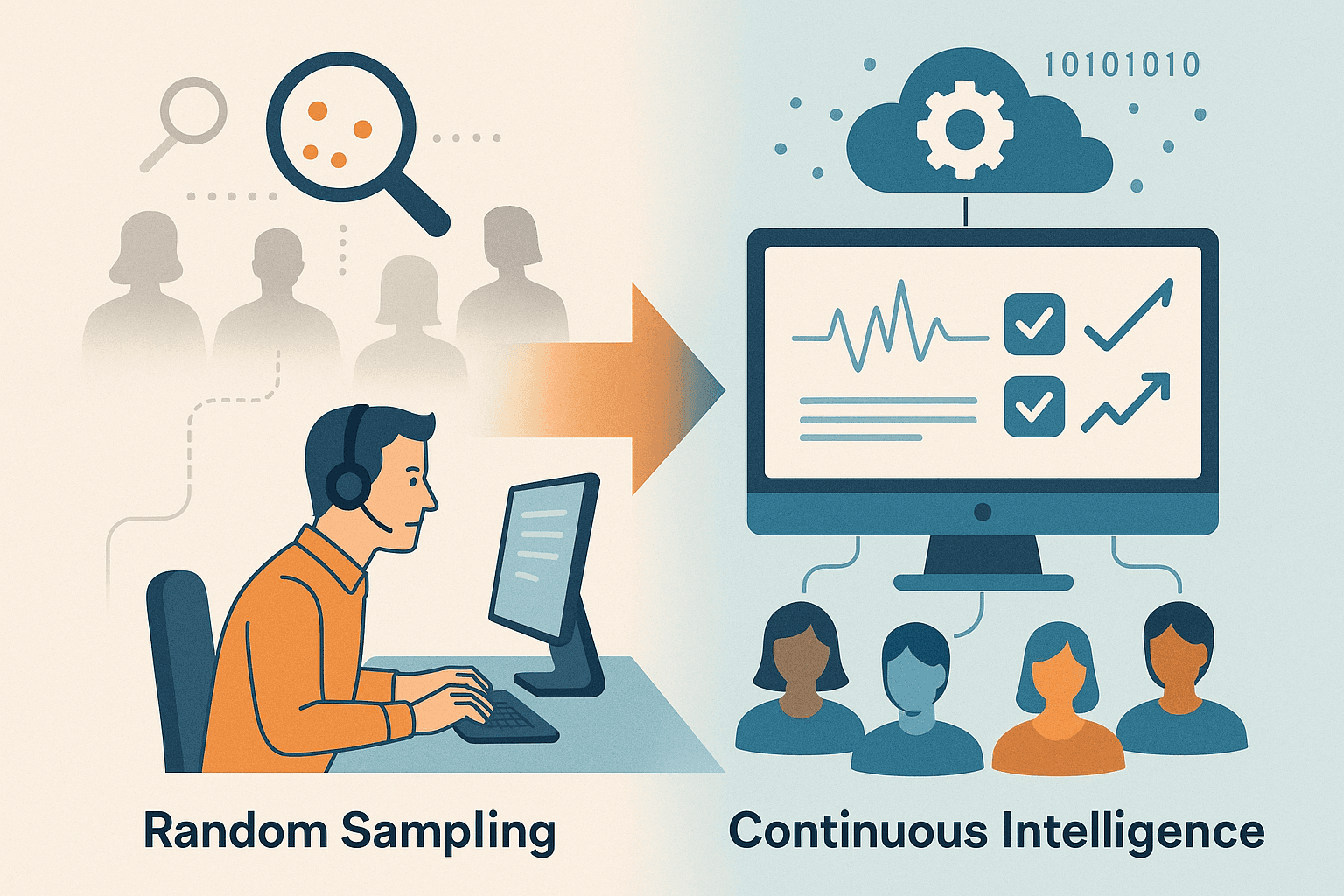
How Automated QA Transforms Customer Experience: From Random Sampling to Continuous Intelligence
The Operational Cost of Partial Visibility
Incomplete QA visibility creates cascading problems throughout contact center operations.
Compliance becomes probabilistic. Regulated industries face requirements that apply to every interaction. Sampling-based QA can only assert that compliance was observed in reviewed calls. The unreviewed majority might comply or might not—the organization doesn't know. Regulatory exposure hides in the gap between what's monitored and what's required.
Coaching lacks foundation. Agent development based on 3-5 reviewed calls per month rests on statistically meaningless data. Two agents with identical actual performance might show dramatically different sampled scores. Coaching addresses what samples happened to show rather than actual development needs. Agents correctly perceive that QA reflects luck as much as skill.
Process problems stay buried. A process that fails 10% of the time would rarely surface in a 3% sample. The failure exists, customers experience it, repeat contacts accumulate, but QA never sees enough instances to identify the pattern. Process improvement requires visibility that sampling cannot provide.
Root causes remain hidden. Customer satisfaction scores decline, but sampling-based QA can't explain why. The interactions that drove dissatisfaction probably weren't in the sample. Leaders see outcomes without understanding causes. Management becomes reactive because the data needed for proactive intervention doesn't exist.
Contact centers operating on sampled QA spend enormous effort managing symptoms because the systems that would reveal root causes don't see enough to find them.
What Automated Quality Assurance Actually Does
Automated QA isn't faster sampling. It's comprehensive evaluation that eliminates sampling entirely. Every interaction—voice, chat, email, messaging—receives quality assessment against defined criteria. The 97% that sampling-based QA never examined becomes visible.
This visibility enables capabilities that sampling cannot approach.
Complete Evaluation Across All Interactions
Automated systems evaluate every customer conversation as it occurs. Quality criteria, compliance requirements, and experience standards apply uniformly across 100% of volume. Nothing hides in unreviewed interactions because no interactions go unreviewed.
The evaluation captures dimensions that human review cannot scale to assess:
Conversational dynamics. How did talk-time balance between agent and customer? Where did the conversation's tone shift? What triggered escalation or de-escalation? These micro-patterns across thousands of interactions reveal insights invisible in sampled review.
Compliance adherence. Required disclosures, prohibited language, authentication protocols—checked on every applicable interaction rather than inferred from samples. Compliance gaps surface immediately rather than hiding until audits discover them.
Resolution effectiveness. Did the interaction actually resolve the customer's issue? Automated analysis can track whether customers contact again for the same reason, connecting quality evaluation to actual outcomes rather than just interaction-level assessment.
Sentiment trajectory. How did customer sentiment evolve through the conversation? Where did frustration build? Where did resolution occur? Sentiment analysis across complete interaction sets reveals experience patterns that sampling glimpses only accidentally.
Real-Time Detection Rather Than Retrospective Discovery
Sampling-based QA operates on delayed cycles. Calls are recorded, queued, sampled, reviewed, reported. Weeks pass between interaction and insight. Problems that emerge today appear in reports next month, after they've compounded into patterns.
Automated QA operates continuously. Quality issues surface within hours of occurring. Compliance violations flag immediately for remediation. Emerging patterns become visible as they develop rather than after they've caused damage.
This timing shift changes what quality assurance can accomplish. Instead of documenting what went wrong, automated QA enables intervention before problems compound. Instead of coaching agents on behaviors from weeks ago, supervisors address current performance patterns. Instead of discovering process failures through accumulated complaints, operations teams see failure signatures as they emerge.
Pattern Recognition Across Volume
Human reviewers examining samples cannot detect patterns that require volume to see. A quality issue affecting 5% of calls appears rarely in a 3% sample—but emerges clearly when every call is evaluated. Correlations between call attributes and quality outcomes require comprehensive data to identify.
Automated analysis across complete interaction sets reveals:
Process signatures. Which processes generate quality problems? Which knowledge base articles correlate with customer confusion? Which product issues drive repeat contacts? These questions require pattern recognition across volume that sampling cannot support.
Agent development patterns. Which skill gaps appear across multiple agents, suggesting training curriculum needs? Which agents struggle with specific call types while excelling at others, suggesting routing optimization opportunities? Individual agent development and systemic training needs both emerge from comprehensive data.
Customer segment insights. Do quality patterns differ by customer type, product, or channel? Which customer segments experience friction that others don't? Segmented analysis requires complete data to produce reliable conclusions.
Predictive indicators. Which interaction patterns predict escalation, complaint, or churn? Early identification of at-risk situations enables intervention before outcomes crystallize. Prediction requires the comprehensive data that sampling-based QA cannot provide.
From Evaluation to Operational Integration
Automated QA generates comprehensive quality intelligence. The value materializes when that intelligence integrates into operational workflows rather than accumulating in reports.
Automated Coaching Triggers
When quality evaluation identifies an agent development need, coaching should follow automatically. The system detects a pattern, flags the specific skill gap, and routes the coaching opportunity to the appropriate supervisor with the relevant interaction examples attached.
This integration eliminates the delays and handoff failures of traditional QA-to-coaching processes. Supervisors receive actionable coaching priorities rather than reports to interpret. Agents receive feedback on current patterns rather than historical samples. The connection between quality finding and development action becomes systematic rather than dependent on individual follow-through.
Real-Time Agent Assistance
Quality intelligence can inform agent assistance during live interactions, not just after them. When automated analysis detects conversation patterns associated with negative outcomes, real-time guidance can help agents adjust before problems materialize.
This represents quality assurance shifting from evaluation to enablement. Instead of scoring what happened and hoping agents improve, the system actively supports better outcomes as interactions unfold. Quality moves from retrospective judgment to real-time partnership.
Operational Alerting
Some quality findings require immediate operational attention. Compliance violations in regulated environments. Customer distress signals indicating potential escalation. Pattern shifts suggesting emerging issues. Automated systems should route these findings to appropriate responders through existing communication channels—not wait for someone to check a dashboard.
Integration with operational communication platforms ensures quality intelligence reaches decision-makers when it matters, in the tools they already use, with context sufficient for action.
Continuous Process Improvement
Quality patterns should inform process improvement systematically. When automated analysis identifies process-related quality issues—specific call types with elevated problems, knowledge gaps driving confusion, handoff failures creating friction—those findings should flow into improvement workflows.
This connection requires more than reporting. It requires integration between quality systems and process improvement mechanisms: issue tracking, knowledge management, training development. Quality intelligence becomes input to continuous improvement rather than standalone evaluation.
The Customer Experience Transformation
Automated QA transforms quality assurance operations. The larger impact is on customer experience itself.
From Reactive to Predictive
Sampling-based QA discovers problems after they've affected customers. Complaints arrive, churn data accumulates, satisfaction scores decline. QA then investigates what went wrong—weeks or months after customers experienced it.
Automated QA enables predictive intervention. Patterns that precede problems become visible in time to address them. Process failures can be corrected before they generate complaint volume. Agent struggles can be supported before they create customer friction. The relationship between quality intelligence and customer experience becomes anticipatory rather than forensic.
From Symptoms to Systems
When QA sees only fragments, problem-solving addresses symptoms. This agent made this mistake on this call. Without visibility into patterns, systemic issues appear as individual incidents.
Comprehensive quality data reveals systems. The mistake appears across multiple agents because the process is confusing. The customer friction concentrates in specific scenarios because the knowledge base is incomplete. The compliance gap clusters around certain call types because training didn't cover them adequately. Systemic understanding enables systemic solutions.
From Scores to Outcomes
Sampling-based QA produces quality scores that may or may not connect to customer outcomes. High scores might correlate with customer satisfaction—or might reflect criteria that don't actually matter to customers.
Automated QA enables outcome correlation. With comprehensive quality data, organizations can identify which quality dimensions actually predict customer behavior: satisfaction, retention, expansion, advocacy. Quality programs can then focus on criteria that drive outcomes rather than criteria that are merely measurable.
From Periodic to Continuous
Sampling-based QA operates in cycles. Monthly reports, quarterly reviews, annual calibration. Customer experience exists continuously, but quality visibility pulses periodically.
Automated QA provides continuous awareness. Quality state is always current, not lagging. Trends are visible as they develop, not after they've played out. The rhythm of quality management shifts from periodic assessment to continuous attention.
Quality Intelligence as Competitive Advantage
Contact centers have competed on cost for decades. Automation and global labor markets have compressed cost advantages. The remaining differentiation lies in experience quality—which requires quality intelligence that sampling cannot provide.
Organizations with comprehensive quality visibility can:
Improve faster. Problems surface sooner. Root causes become visible. Solutions can target actual issues rather than symptoms. The improvement cycle accelerates because the data to drive improvement is available.
Demonstrate compliance confidently. Regulatory requirements are verified across all interactions, not inferred from samples. Audit preparation becomes evidence assembly rather than anxious hope that samples were representative.
Develop agents effectively. Coaching addresses actual performance patterns with statistical validity. Development investments target real needs rather than artifacts of sampling randomness.
Optimize operations precisely. Process improvements address documented friction points. Routing decisions incorporate quality implications. Resource allocation reflects actual quality patterns rather than sampled approximations.
Connect quality to outcomes. Customer experience improvements can be traced to specific quality interventions. Quality program ROI becomes measurable rather than assumed.
These capabilities compound over time. Organizations that learn faster, improve continuously, and connect quality to outcomes pull ahead of those managing from sampled fragments. The gap widens as comprehensive intelligence enables better decisions that enable better outcomes that generate better data for even better decisions.
Moving Beyond Sampling
The transition from sampling-based QA to automated comprehensive evaluation is not incremental improvement. It's architectural change that enables fundamentally different capabilities.
Organizations considering this transition should evaluate:
Current blindness. What hides in the interactions you don't review? What problems might exist that sampling cannot detect? What decisions rest on statistically invalid foundations?
Outcome connections. Can you demonstrate that quality scores predict customer outcomes? If not, comprehensive data might reveal which quality dimensions actually matter.
Compliance confidence. Do you truly know your compliance state, or do you know your sampled compliance state? For regulated industries, this distinction has material consequences.
Improvement velocity. How quickly does your operation improve? If the answer is "slowly," limited quality visibility may be constraining improvement potential.
Automated QA doesn't replace quality programs—it enables them to accomplish what they were always meant to accomplish. Comprehensive visibility, real-time awareness, pattern recognition, outcome correlation. These were always the objectives. The technology to achieve them now exists.
Automated Quality Intelligence from InflectionCX
InflectionCX operates comprehensive automated quality assurance through our Atlas platform, evaluating 100% of customer interactions across voice, chat, email, and messaging channels. Our approach moves beyond sampling to provide the complete visibility that traditional QA cannot deliver.
Atlas provides automated scoring against quality and compliance criteria, real-time issue detection and alerting, pattern recognition across complete interaction data, and integration with coaching and operational workflows. For healthcare and financial services organizations, our comprehensive compliance monitoring provides the regulatory confidence that sampling-based approaches cannot.
Our quality methodology treats evaluation as the beginning of improvement, not the end. Quality intelligence flows into agent development, process optimization, and continuous experience enhancement.
Contact InflectionCX to discuss how automated quality assurance can transform your customer experience operations.
Ready for Better CX?

Whether you're selecting your CX technology stack or evaluating outsourcing options, InflectionCX is your go-to-partner. Contact us today.
AI Readiness Assessment
We map where AI fits in your operation. What's working, what's hype, what's actually worth doing.

Unified CX Outsourcing
InflectionCX runs contact centers where humans and AI operate as one system.