How to Actually Improve First Call Resolution
The Definition Problem
Before improving FCR, organizations need to confront an uncomfortable question: what does "resolved" actually mean?
Most FCR measurement relies on proxies that don't measure resolution at all. The customer didn't call back within 24 hours—resolved. The agent selected a "resolved" disposition code—resolved. The interaction ended without transfer—resolved.
None of these proxies actually verify resolution. A customer might not call back because they gave up, switched to a competitor, or found their answer elsewhere. An agent might select "resolved" because the call ended, not because the issue was actually fixed. A call might complete without transfer while leaving the customer's actual problem unaddressed.
This measurement weakness means most organizations don't know their actual FCR rate. They know their proxy-defined FCR rate, which may or may not correlate with whether customers' issues were genuinely resolved on first contact.
What Resolution Actually Requires
Genuine resolution means the customer's issue is actually fixed—not just addressed, not just explained, but resolved in a way that eliminates the need for further contact on that issue.
This requires:
Understanding the actual issue. Agents must identify what the customer actually needs, not what they initially say or what the agent assumes. The stated reason for contact often differs from the underlying issue. Resolution requires reaching the real problem.
Addressing the complete issue. Partial resolution isn't resolution. Fixing one aspect while leaving related aspects unaddressed guarantees return contact. Complete resolution anticipates and addresses connected issues, not just the presenting problem.
Confirming resolution with the customer. The agent's belief that the issue is resolved matters less than the customer's. Resolution confirmation—verifying that the customer agrees their need has been met—distinguishes genuine resolution from assumed resolution.
Enabling permanence. Some "resolutions" fix the immediate symptom while leaving the cause active. The issue will recur. Genuine resolution addresses underlying causes where possible, or at minimum accurately sets expectations about what will and won't recur.
The Measurement Implication
If resolution requires these elements, measurement must verify them—not just check whether customers called back.
Effective FCR measurement examines:
Was the stated goal achieved? Based on conversation content, did the outcome match what the customer contacted about?
Did the agent confirm resolution? Is there explicit confirmation that the customer's need was met, or did the call simply end?
Were there signals of incomplete resolution? Customer confusion, unaddressed questions, unacknowledged frustration, or trailing uncertainty suggest resolution may not have occurred despite the call ending.
Did the customer return for the same issue? Return contact is a lagging verification, but it's the ultimate test of whether first-contact resolution actually happened.
This measurement approach requires conversation analysis, not just disposition codes. It requires following customers across contacts, not just evaluating individual interactions. Most organizations lack the analytical infrastructure to measure FCR this rigorously—which is why they rely on proxies that don't reflect reality.
Why FCR Fails
Understanding why first-contact resolution fails reveals the intervention points where improvement is possible.
The Agent Didn't Understand the Issue
Resolution requires accurate diagnosis. When agents misunderstand what customers need—because they didn't listen fully, because customers explained poorly, because assumptions replaced inquiry—the "resolution" addresses the wrong problem.
This happens when:
Agents interrupt before customers finish explaining. The agent hears enough to form a hypothesis and stops listening. The hypothesis is wrong. The resolution doesn't fit.
Agents assume based on call type or history. "Billing call" or "previous contact about X" creates assumptions that override what the customer actually says. The assumed issue gets resolved; the actual issue doesn't.
Customers can't articulate their needs clearly. Some problems are hard to explain. Some customers aren't skilled at explanation. Agents who don't probe beyond initial statements miss the real issue.
Complexity exceeds initial appearance. What seems like a simple question has complicated underlying factors. Quick resolution addresses the surface; the depths remain unresolved.
The Agent Couldn't Access Needed Information
Resolution requires information: customer history, product details, policy specifics, procedure guidance. When agents can't access needed information efficiently, resolution fails or takes multiple contacts to achieve.
This happens when:
Knowledge systems are fragmented or incomplete. The answer exists somewhere, but the agent can't find it during the interaction. The customer gets transferred, placed on hold, or told to call back.
Customer context isn't visible. Previous interactions, account status, and relevant history would inform resolution, but the agent can't see them. Resolution attempt misses critical context.
Policies are ambiguous or inaccessible. The agent doesn't know what they're authorized to do. Conservative interpretation denies resolution that policy actually permits. Or incorrect interpretation creates resolution that will be reversed.
The Agent Lacked Authority to Resolve
Some issues require actions the agent isn't authorized to take. Credits, exceptions, escalation decisions, system changes—when resolution requires authority the agent lacks, first-contact resolution becomes impossible.
This happens when:
Authorization levels are set too conservatively. Agents capable of making good decisions aren't empowered to make them. Customers wait for supervisors or call back for decisions that could have happened immediately.
Processes require handoffs that delay resolution. Resolution depends on actions another team must take. The agent can initiate but not complete. The customer must wait for callback or follow-up.
Exceptions require approval chains that extend beyond the interaction. Reasonable exceptions exist, but the approval process can't complete during a call. The customer must call back for the answer.
The Process Itself Prevents Resolution
Some FCR failures trace to process design that makes first-contact resolution impossible regardless of agent skill or effort.
Multi-step processes span multiple contacts by design. The process requires waiting for system updates, document receipt, or sequential approvals. First-contact resolution is structurally impossible.
Information required for resolution isn't available at contact time. Resolution depends on data that hasn't been generated, decisions that haven't been made, or actions that haven't completed. The customer must wait.
Resolution authority is fragmented across teams. The complete resolution requires actions from multiple groups. No single contact can achieve resolution because no single agent has the complete picture or complete authority.
The Customer's Expectations Were Unrealistic
Sometimes first-contact resolution fails because what the customer wants isn't possible. The policy doesn't allow it. The system can't do it. The request exceeds what the organization offers.
In these cases, "resolution" means helping the customer understand and accept the limitation—which can succeed on first contact if handled well, or fail if the customer leaves unconvinced or still hoping for a different answer.
The Behavioral Drivers of FCR
FCR improves when the specific agent behaviors that drive resolution improve. These behaviors are measurable and coachable—unlike FCR itself, which is only observable after the fact.
How Agents Open Interactions
First-contact resolution often succeeds or fails in the first two minutes. How agents open determines whether they understand the actual issue or assume their way to the wrong conclusion.
Active listening without interruption. Agents who let customers fully explain before responding get more accurate issue understanding. Agents who interrupt with assumed understanding frequently diagnose incorrectly.
Clarifying questions that probe beyond surface statements. "You mentioned X—can you tell me more about that?" uncovers depth that initial statements omit. Agents who accept surface statements at face value miss underlying complexity.
Acknowledgment that demonstrates understanding. Reflecting the issue back—"So you're trying to accomplish X, and you're running into Y"—verifies understanding and gives customers opportunity to correct misunderstanding before resolution attempts begin.
How Agents Resolve Issues
The resolution process itself affects whether resolution actually occurs.
Complete resolution rather than partial. Addressing the stated issue while ignoring related issues that will generate follow-up contacts isn't resolution—it's deferral. Agents who anticipate related needs and address them preemptively achieve genuine FCR.
Verification that resolution worked. For technical issues, confirming that the solution actually fixed the problem. For informational issues, confirming that the customer understood. For process issues, confirming that next steps are clear. Verification catches incomplete resolution before the call ends.
Setting accurate expectations. When complete resolution isn't possible in a single contact, clearly explaining what will happen next, when, and what the customer should do if it doesn't. Accurate expectations reduce return contacts from customers who didn't understand the status.
How Agents Close Interactions
Call closure determines whether resolution sticks or unravels.
Summarizing what was accomplished. "So we've done X, which should address your issue with Y." Explicit summary confirms shared understanding of what resolution occurred.
Inviting additional questions. "Is there anything else I can help you with?" asked genuinely, with space for the customer to surface any lingering concerns. Rushed closures that discourage additional questions leave issues unaddressed.
Confirming resolution in the customer's terms. "Does that solve what you called about today?" gives the customer explicit opportunity to confirm resolution or surface remaining concerns. Closure without confirmation assumes resolution that may not have occurred.
Leading Indicators That Predict FCR
FCR is a lagging metric. By the time you measure it, the interaction is complete. Improving FCR requires monitoring the leading indicators that predict whether resolution will occur—and intervening when those indicators suggest it won't.
Behavioral Signals During Interactions
Interruption patterns. High agent interruption rates correlate with lower FCR. Agents who interrupt often misunderstand issues more frequently. Monitoring interruption patterns identifies FCR risk while intervention is possible.
Hold time and frequency. Extended or repeated holds often indicate the agent lacks information or authority to resolve. Calls with excessive holds are less likely to achieve first-contact resolution. Hold patterns signal process or knowledge gaps affecting FCR.
Sentiment trajectory. Customer sentiment that worsens through the interaction suggests resolution isn't occurring. Improving sentiment suggests progress toward resolution. Sentiment arc predicts resolution likelihood before the call ends.
Confusion indicators. Customer statements indicating confusion—requests for clarification, expressions of uncertainty, restated questions—suggest resolution isn't tracking. Confusion signals predict FCR failure.
Resolution Clarity Signals
Explicit resolution language. Did the agent clearly state what was resolved? Calls ending with clear resolution statements are more likely to represent genuine FCR than calls that simply end.
Customer acknowledgment. Did the customer confirm understanding and satisfaction? Explicit customer acknowledgment is a strong resolution signal. Absence of acknowledgment—call just ending—is weaker.
Next-steps clarity. When resolution requires follow-up action, was that action clearly communicated? Unclear next steps predict return contacts.
Post-Interaction Signals
Immediate callback. Customers who call back within hours almost certainly didn't achieve resolution on first contact. Immediate callbacks are FCR failures regardless of how the original call was coded.
Same-issue repeat contacts. Customers who return for the same issue within days reveal FCR failure even when original resolution coding suggested success. Tracking issue-level repeat contact measures actual FCR rather than proxy FCR.
Survey responses. Customers reporting unresolved issues in post-contact surveys reveal FCR failures that other measurement missed.
Learning From FCR Failures
Every FCR failure is an opportunity to understand what prevents resolution and address it systematically.
Identifying Failure Patterns
Individual FCR failures might reflect agent error, customer complexity, or random variation. Patterns across failures reveal systemic issues worth addressing.
Issue-type patterns. Certain issue types show consistently lower FCR. This may indicate knowledge gaps, process problems, or authorization limitations specific to those issues.
Agent-cohort patterns. Certain agents or agent groups show lower FCR. This may indicate training gaps, experience differences, or support needs for those agents.
Scenario patterns. FCR varies by scenario characteristics: customer type, time of day, channel, complexity indicators. Pattern analysis reveals where resolution breaks down.
Root cause categories. Classifying FCR failures by root cause—didn't understand issue, couldn't access information, lacked authority, process prevented resolution—reveals which failure types dominate and deserve priority attention.
Closing the Loop
Patterns should produce action:
Knowledge gaps drive knowledge improvement. When FCR failures trace to information agents couldn't access, improving knowledge systems directly addresses the cause.
Process barriers drive process redesign. When FCR failures trace to processes that prevent first-contact resolution, changing those processes removes the barrier.
Authority limitations drive empowerment evaluation. When FCR failures trace to agents lacking authority they could responsibly exercise, expanding authorization enables resolution.
Skill gaps drive training focus. When FCR failures trace to behaviors agents could improve—incomplete diagnosis, rushed closure, incomplete resolution—training can address the gap.
Systemic issues drive structural change. When FCR failures trace to fundamental structural issues—fragmented systems, misaligned incentives, impossible expectations—structural change is required.
Preventing Failures Proactively
The best FCR improvement prevents failures before they occur rather than learning from them after.
Real-time intervention during at-risk interactions. When leading indicators suggest FCR risk, real-time alerts to supervisors or agents enable intervention while resolution is still achievable.
Proactive follow-up after incomplete resolution signals. Interactions showing resolution uncertainty signals become candidates for proactive callback rather than waiting for customers to return dissatisfied.
Predictive routing based on resolution probability. Routing complex issues to agents with higher resolution rates for those issue types improves FCR through better matching.
The Infrastructure FCR Requires
Genuine FCR improvement requires capabilities that most contact centers lack.
Conversation analysis that reveals resolution quality. Evaluating whether resolution actually occurred—not just whether calls ended without callback—requires understanding conversation content, not just metadata.
Customer journey tracking across contacts. Identifying repeat contacts for the same issue requires linking interactions to customer journeys, not just counting contacts per customer.
Behavioral signal detection. Identifying the leading indicators that predict resolution during live interactions requires real-time analysis capabilities.
Pattern analysis at scale. Finding the failure patterns worth addressing requires analysis across thousands of interactions, not manual review of samples.
Closed-loop learning systems. Connecting failure patterns to improvement actions—and tracking whether those actions produce results—requires integration between analytics and operational systems.
This infrastructure exists. Organizations that build it can treat FCR improvement as an engineering problem with identifiable causes and addressable solutions. Organizations without it continue treating FCR as a mysterious number that rises and falls for unclear reasons.
The Outcome That Matters
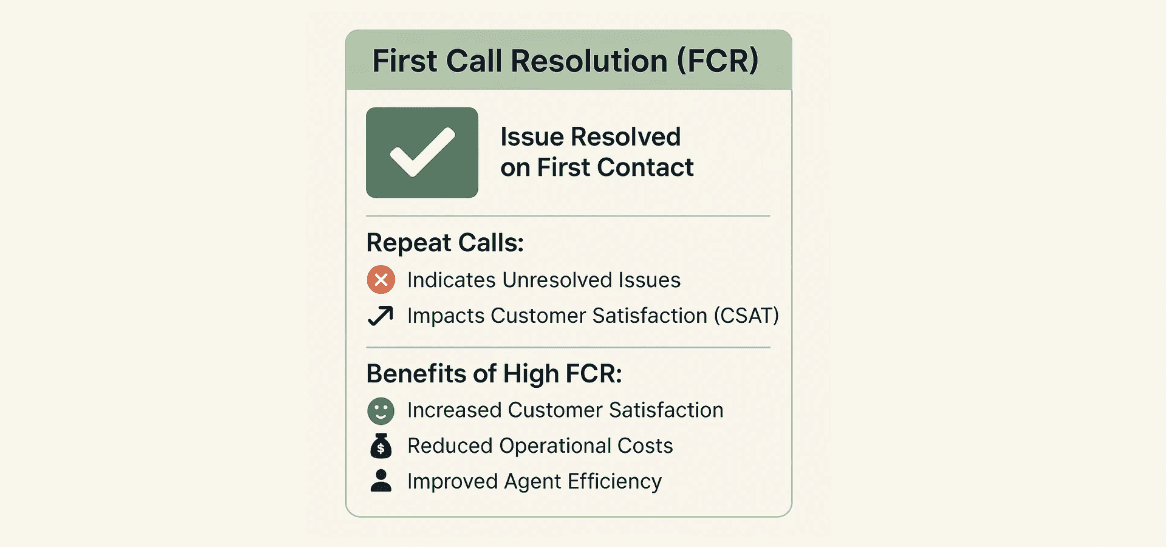
First call resolution matters because it reflects whether the contact center is actually doing its job. Customers contact with needs. Resolution means those needs were met. Failure to resolve means customers leave with unmet needs—to try again, to give up, or to leave for competitors who serve them better.
FCR improvement isn't about moving a number. It's about systematically ensuring that customers who contact the organization actually get what they need. The number reflects that reality; it doesn't create it.
Organizations that focus on the number often manipulate it—changing definitions, adjusting callbacks windows, pressuring agents toward resolution codes that don't reflect reality. The number improves; customer experience doesn't.
Organizations that focus on resolution—actually fixing the issues that prevent it—find the number improves as a byproduct. And more importantly, customers actually get served.
First Call Resolution from InflectionCX
InflectionCX provides the infrastructure that genuine FCR improvement requires. Our conversation analysis evaluates resolution quality based on interaction content, not just metadata proxies. Our customer journey tracking identifies repeat contacts for the same issues, measuring actual FCR rather than assumed FCR.
We detect leading indicators during live interactions that predict resolution success or failure, enabling intervention while outcomes remain influenceable. Our pattern analysis identifies the systemic issues driving FCR failures so improvement efforts address causes rather than symptoms.
For organizations seeking FCR improvement that reflects actual customer experience rather than metric manipulation, we provide the analytical foundation that makes genuine improvement possible.
Contact InflectionCX to discuss how resolution-focused operations can transform your first call resolution.
Ready for Better CX?

Whether you're selecting your CX technology stack or evaluating outsourcing options, InflectionCX is your go-to-partner. Contact us today.
AI Readiness Assessment
We map where AI fits in your operation. What's working, what's hype, what's actually worth doing.

Unified CX Outsourcing
InflectionCX runs contact centers where humans and AI operate as one system.