NICE Q3 2025 Earnings: Cloud Customer Experience Growth & AI Momentum
Q3 2025 Financial Performance Highlights
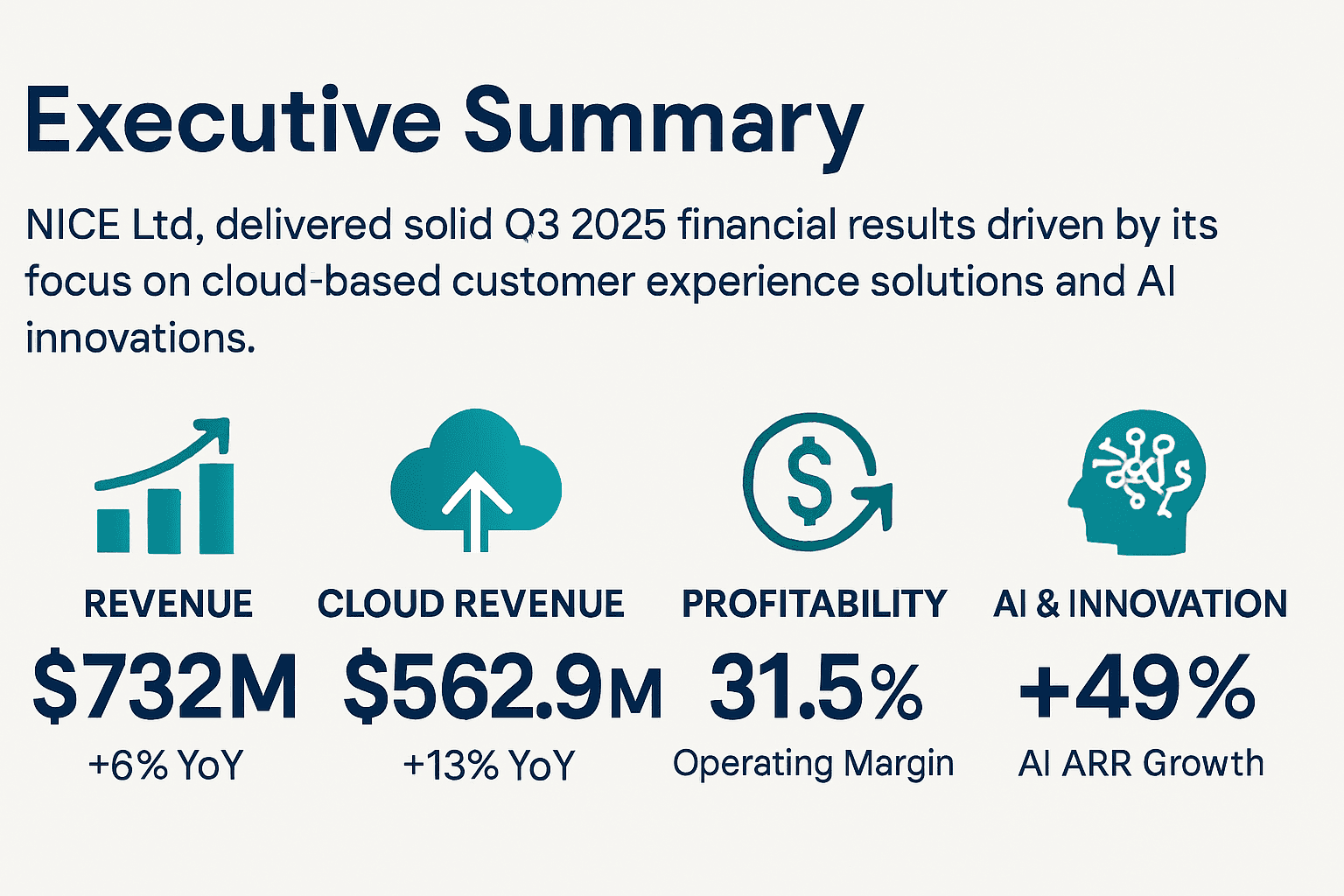
In the third quarter of 2025, NICE demonstrated resilient financial performance anchored by its cloud-centric strategy. Total revenues reached $732 million, growing 6% YoY. This growth, though moderate, was entirely driven by the cloud segment – which more than offset declines in on-premise product sales. The Americas region contributed the bulk of revenue at $618 million (+5% YoY), with EMEA $74 million (+7%) and APAC $40 million (+19%) showing strong international traction. Profit margins remained healthy. Gross profit was $489.1 million (66.8% margin) on a GAAP basis, roughly flat margin versus last year. Non-GAAP gross margin was higher at 69.9%, although down slightly from 71.1% a year ago due to a revenue mix shift. Operating expenses were well-controlled; R&D, sales, and G&A expense ratios all decreased or held steady YoY. As a result, non-GAAP operating margin was a robust 31.5% in Q3, only slightly below the prior year’s level. This indicates that even as NICE invests in cloud development and go-to-market expansion, it continues to drive efficiencies at scale. Table: Q3 2025 Revenue by Segment (millions USD)
Segment | Revenue (Q3 2025) | YoY Growth | % of Total Revenue (Q3’25) |
Cloud (SaaS & CXone) | $562.9 M | +13% | 76.9% |
Service (Support & Prof. Svcs) | $138.7 M | –7.4% | 18.9% |
Product (Licenses & Hardware) | $30.4 M | –24.1% | 4.1% |
Total | $732.0 M | +6% | 100% |
NICE’s cloud revenue has become the dominant driver, comprising ~77% of total sales in Q3 2025. Legacy product and on-premise service revenues now represent less than a quarter of the business, and are shrinking as customers transition to cloud CX platforms. Importantly, cloud subscriptions and recurring revenue now account for the vast majority of NICE’s business. Over the last 12 months (through Sept. 30, 2025), NICE generated ~$2.9 billion in total revenue, of which $2.2B was cloud revenue and $2.6B was recurring revenue (≈90% of total). This high mix of recurring SaaS revenue provides excellent visibility and stability for future results. It also means that growth going forward will be driven less by one-time license deals and more by expanding cloud usage (adding users, modules, and upselling AI add-ons to existing customers).
On the earnings front, non-GAAP net income was $200.8 million in Q3, up 7% YoY, reflecting solid profit flow-through from the revenue gains. GAAP net income rose faster (+20% YoY) to $144.9 million, aided by margin improvements and lower one-time costs. Non-GAAP diluted EPS of $3.18 beat consensus estimates and grew 10% YoY, continuing NICE’s trend of double-digit EPS growth each quarter this year. This earnings growth has been supported by share repurchases (reducing share count) and cost discipline, even as the company ramps investments in AI. Looking ahead, NICE raised its full-year 2025 outlook based on the Q3 results. It now expects FY 2025 revenue of $2.932–2.946 billion (around +7% YoY growth) and non-GAAP EPS of $12.18–$12.32 (around +10% YoY growth). This updated guidance factors in contributions from the Cognigy acquisition and implies a strong Q4 finish.
For context, achieving the midpoint of $2.94B revenue means accelerating slightly to ~8% growth in Q4 – an attainable target given seasonal year-end enterprise spending and NICE’s growing cloud backlog. Figure: NICE Ltd. Quarterly Revenues Q1–Q3 2025 vs 2024 (USD Millions). Each 2025 quarter showed solid YoY growth, with Q3 reaching $732M (+6% YoY). Q2 2025 saw the highest jump at +9% YoY. Cloud sales (not shown separately above) have driven these gains, consistently growing ~12–13% YoY each quarter, while legacy on-premise revenues declined, yielding mid-single-digit overall growth.
Cloud Customer Experience and AI-Powered Platform Growth
NICE’s cloud customer experience (CX) portfolio was the engine of growth in Q3 2025. As noted, cloud-based revenues jumped 13% YoY, reaching $563 million. This reflects the ongoing industry shift from traditional call center systems to cloud contact center (CCaaS) platforms. In fact, NICE’s CXone Mpower platform – its flagship cloud CX suite – has seen broad adoption among enterprises, fueling the company’s top-line gains. The CXone cloud platform delivers omnichannel contact center software with embedded AI, analytics, and automation, enabling organizations to modernize their customer service operations. Management highlighted that cloud momentum is being propelled by surging demand for AI and self-service solutions, which drove a 49% YoY increase in AI-related ARR in Q3. A telling statistic: 100% of NICE’s $1 million+ CX deals now include AI capabilities. In other words, every large enterprise client adopting CXone is also deploying NICE’s AI-powered CX features – such as AI virtual agents, intelligent routing, and real-time analytics. This indicates that AI has become a standard requirement for big customer experience transformations.
Businesses are seeking AI to automate routine inquiries, assist human agents, analyze customer sentiment, and personalize engagements at scale. NICE’s “agentic AI” technologies (branded under Enlighten AI and integrated in CXone) are designed to boost agent efficiency and improve customer satisfaction, giving it a competitive edge in the market. By infusing AI into its platform, NICE not only upsells new modules but also delivers superior outcomes – for example, faster resolution times and proactive service – which strengthens client ROI and loyalty.
The recent acquisition of Cognigy further bolsters NICE’s cloud AI capabilities. Completed in Q3, Cognigy is a leader in advanced conversational AI, providing an enterprise-grade platform for AI chatbots and “agent assist” automation. NICE is quickly integrating Cognigy’s conversational AI and contextual engagement data into CXone, aiming to deliver “truly human-like, AI-first customer experiences” on its cloud platform. According to CEO Scott Russell, combining Cognigy’s AI with CXone’s rich interaction data and workflow automation allows NICE to offer a unified, real-time CX platform that “brings AI, contextual engagement data, and automation together” to drive meaningful business outcomes.
In practical terms, this means contact centers can use NICE’s solutions to understand customer intent from past interactions (via customer engagement analytics), respond with AI-driven self-service, and seamlessly hand off to human agents with full context – all within one cloud environment. NICE’s focus on customer engagement analytics is also noteworthy. The company’s platform leverages AI to analyze 100% of customer interactions (calls, chats, etc.), extracting insights that help clients continuously improve service quality.
For instance, AI-powered interaction analytics can pinpoint common pain points or reasons for repeat contacts, enabling businesses to fix root causes and optimize the customer journey. By harnessing data and analytics across millions of interactions, NICE helps enterprises measure and enhance key CX metrics like First Contact Resolution, customer satisfaction (CSAT), and Net Promoter Score. These analytics capabilities are a critical differentiator as organizations embrace data-driven CX management. Crucially, NICE’s cloud CXone business now accounts for the vast majority of the company’s revenue – reflecting its successful transformation into a cloud-first CX provider. In Q1 2025, the CXone segment contributed roughly 75% of total revenue, and that share has likely grown further by Q3 given the faster cloud growth rate versus flat legacy segments. Management noted that on a trailing basis the business is “over 85% cloud” in revenue mix.
This means NICE’s fortunes are tightly linked to the cloud CX market, where it is a leading player. The good news is that market demand remains strong – organizations across industries (from banks to telecoms to government) are investing in cloud contact centers and AI to transform their customer service. With 25,000+ customers in over 150 countries and over 85% of the Fortune 100 as clients, NICE has a huge installed base to upsell and a global reach to win new deals. Its cloud customer experience solutions – spanning contact center software, workforce engagement, self-service AI, and customer analytics – position the company as an end-to-end provider for enterprises undergoing CX transformation.
Year-Over-Year Trends and Recent Quarter Comparisons
While Q3 2025 showed mid-single-digit revenue growth overall, it’s important to view this in the context of recent trends. Earlier in 2025, NICE actually achieved higher growth rates due to easier comparisons and strong cloud traction. For example:
Q1 2025: Total revenue was $700.2M, up 6% YoY, with cloud revenue up 12%. Non-GAAP EPS grew ~11% YoY to $2.87. This quarter saw some deceleration from the previous year’s pace (2024 had been a high-growth year), but still solid expansion driven by cloud CXone gains.
Q2 2025: Revenue accelerated to $726.7M, rising 9% YoY– the fastest quarterly growth of the year so far. Cloud revenue grew ~12% YoY in Q2 as well, and AI/self-service ARR was up 42% YoY. Non-GAAP EPS hit $3.01, up 14% YoY, representing a strong earnings beat and margin expansion. Q2 benefited from a couple of large cloud deals closing and marked an “above-guidance” performance for NICE.
Q3 2025: As discussed, revenue growth was 6% YoY and EPS +10% YoY. This was a return to a more normalized growth rate after the bump in Q2. Part of the moderation is due to tougher YoY comps (Q3 2024 had significant cloud growth) and some deal timing differences. Nonetheless, the underlying theme persists: double-digit cloud CX growth offset by declines in on-premise, yielding mid-single-digit net growth. Notably, the Americas region growth slowed in Q3 (to +5% YoY) compared to +10% in Q2, whereas EMEA and APAC picked up, indicating some geographic variability.
On a year-to-date basis, NICE’s revenues for the first three quarters of 2025 are up roughly 7–8% versus the same period in 2024 (averaging the 6%, 9%, 6% growth in Q1–Q3). This aligns with the company’s full-year guidance of ~7% growth. It’s evident that 2025 has been a year of steady, if not spectacular, growth for NICE, as the company laps the high growth rates of the prior year and focuses on transitioning the last cohort of on-prem customers to cloud. It’s also worth noting the trend in profitability over recent quarters. In Q2, GAAP net income jumped 62% YoY and GAAP EPS nearly +69% YoY– an outsized leap driven by one-time factors (likely a tax benefit or accounting gain). Excluding such items, the underlying non-GAAP operating margins have been relatively stable: ~30–32% range each quarter.
This consistency in margins, even as cloud becomes a bigger portion of the business, is a positive sign. Cloud SaaS businesses often enjoy improving gross margins with scale, but also incur high upfront sales and R&D expenses. NICE has managed to keep margins in check through cost control and efficiency gains (for instance, R&D expense ratio was down 90 bps YoY in Q3 despite aggressive AI product development). The company’s discipline in operating expenses (sales & marketing held flat as % of revenue, G&A down as %) indicates it is not sacrificing profitability for growth – a reassuring fact for investors and stakeholders. Sequentially, there is some seasonality in NICE’s business (Q4 is usually the strongest quarter for bookings, while Q1 can be softer after year-end spikes). In Q1 2025, revenue dipped ~3% sequentially from Q4 2024, which is normal seasonality.
We can expect a bounce in Q4 2025 given typical enterprise buying patterns and the backlog of cloud orders. Importantly, NICE’s Annual Recurring Revenue (ARR) continues to climb each quarter with new cloud deals. The company reported record cash collections and robust remaining performance obligations (backlog) in early 2025 suggesting a healthy pipeline of future revenue. Thus, the quarter-to-quarter fluctuations are less meaningful than the overall ARR growth trajectory, which remains strongly positive (bolstered by high customer retention and multi-year SaaS contracts). In summary, NICE’s quarterly trends in 2025 show a business in transition but on solid footing.
The growth is now primarily coming from recurring cloud subscriptions, and while that yields a somewhat lower growth percentage than the high-flying early cloud days, it provides stability and predictability. The headwind from declining legacy revenues will eventually annualize out; at that point, NICE’s reported growth could re-accelerate closer to its underlying cloud growth rate (low double-digits). For now, management’s strategy is clearly to keep executing on cloud CX wins and AI innovation, while prudently managing costs – a strategy that has delivered consistent earnings increases and cash flow.
CX Industry Implications and Competitive Outlook
NICE’s Q3 2025 results carry several key implications for the customer experience (CX) industry, especially for CX professionals and decision-makers in the U.S. and globally:
1. Cloud CX Adoption is Unstoppable: The continued rise of NICE’s cloud revenue (now ~77% of total, with on-premise product revenue dwindling to just 4%) highlights an industry-wide CX transformation. Organizations are rapidly moving contact center operations to the cloud to gain scalability, agility, and faster innovation cycles. This mirrors broader trends in the CX space – Cloud Customer Experience platforms (CCaaS) are becoming the default choice for new deployments and upgrades.
For CX leaders, the message is clear: legacy on-prem systems are fading out, and embracing cloud customer experience solutions is key to staying competitive. NICE’s success in migrating large enterprises (including many in regulated sectors like financial services and healthcare) shows that even the most complex contact centers can be successfully run in the cloud. The flexibility to integrate digital channels, remote agents, and frequent AI-driven updates via cloud is a game-changer for customer engagement strategies.
2. AI-Powered CX is the New Standard: A standout theme from NICE’s performance is the pervasiveness of AI in customer engagement. When every seven-figure deal includes AI, it signifies that businesses view AI-powered CX platforms not as optional add-ons, but as core components of their customer service strategy. This reflects a broader industry shift towards AI-first customer experience design. Conversational AI (chatbots/voicebots), customer engagement analytics, and agent-assist AI are enabling companies to deliver more personalized, efficient service at scale.
NICE is capitalizing on this with its Enlighten AI, Cognigy integration, and a suite of AI-driven analytics (e.g. interaction analytics, voice of the customer, predictive routing). For CX professionals, the implication is that investing in AI capabilities is no longer a “nice to have” – it’s imperative for keeping up with customer expectations and competitor offerings. AI can help deflect routine queries with self-service, reduce wait times, and provide agents with real-time guidance, all of which boost customer satisfaction (CSAT) and loyalty.
3. Data and Analytics Fuel CX Transformation: NICE’s approach underscores the importance of harnessing data across the customer journey. By gathering contextual engagement data and mining 100% of interactions for insights, companies can continuously improve experiences. This trend is echoed industry-wide as firms invest in customer engagement analytics – using speech/text analytics, journey mapping, and feedback management to identify pain points and optimize service processes.
CX stakeholders should prioritize solutions that provide deep analytics and actionable intelligence (for example, NICE’s Interaction Analytics offers AI-powered insights from every interaction to drive improvement). In practice, this means moving beyond basic KPIs to analyze sentiment, effort, and root causes in customer interactions. Those insights enable a proactive CX strategy, where issues are fixed before they escalate and customer needs are anticipated rather than reacted to.
4. Competitive Positioning – NICE Leads but Others Are Advancing: In the competitive landscape of CX technology, NICE’s strong results reinforce its leadership, but also highlight areas to watch. NICE has been recognized as a Leader in the Gartner Magic Quadrant for Contact Center as a Service for 11 consecutive years (most recently in 2025), reflecting its long-term vision and execution. Its closest competitors in cloud CX (e.g., Genesys, Cisco/Webex Contact Center, Five9, and emerging players like Talkdesk) are also investing heavily in AI and cloud capabilities.
The fact that NICE raised its revenue guidance and is seeing success with an AI-first strategy suggests it is effectively differentiating itself – likely through a more unified platform and broader product breadth (workforce engagement, analytics, compliance, etc. all under one roof). However, competitors are not standing still: for instance, Genesys has its own AI-powered CX platform and recently partnered or acquired AI startups, and Five9 is touting practical AI features for contact centers.
The implication for CX industry stakeholders is that the bar for innovation is rising. Vendors will compete on who can deliver the most seamless, intelligent customer and agent experiences. From an enterprise buyer perspective, this competition is beneficial – it means faster evolution of CX tools and more options – but it also requires diligence in choosing platforms that are truly integrated and future-proof.
5. CXone Ecosystem and Partnerships: Another subtle takeaway is how NICE is expanding its ecosystem to maintain an edge. The mention of “growing number of strategic partnerships” in prior quarters hints that NICE is aligning with CRM providers, telecom carriers, and perhaps cloud hyperscalers to broaden its reach. In Q3, NICE announced a brand ambassador partnership with a PGA golfer and cited continued partnerships, which, while a marketing angle, signals investment in brand visibility. More concretely, NICE’s CXexchange marketplace and developer APIs are facilitating third-party integrations (for CRM, AI, workforce tools), recognizing that customers demand open, extensible solutions.
For CX professionals, the ability to integrate contact center platforms with the rest of the tech stack (CRM, ERP, e-commerce, etc.) is crucial. NICE’s progress here suggests that leading CX platforms will act as hubs in a broader customer experience ecosystem, not as isolated applications. In conclusion, NICE Ltd.’s Q3 2025 performance not only demonstrates the company’s strength but also mirrors the broader CX industry trends: a decisive shift to cloud, the infusion of AI into every facet of customer engagement, and the rising importance of analytics and integration.
For U.S.-based CX professionals and stakeholders, the takeaways are clear. To deliver world-class customer experiences, organizations must leverage cloud customer experience platforms that are agile and scalable, adopt AI-powered CX tools to enhance both self-service and agent-assisted interactions, and use customer engagement analytics to continually refine their processes. NICE’s leadership and results provide a benchmark – and perhaps a roadmap – for how to navigate this CX transformation successfully.
Companies that follow a similar path of combining cloud agility, AI innovation, and data-driven insight are likely to see improved customer satisfaction, loyalty, and operational efficiency in their customer experience operations.
Ready for Better CX?

Whether you're selecting your CX technology stack or evaluating outsourcing options, InflectionCX is your go-to-partner. Contact us today.
AI Readiness Assessment
We map where AI fits in your operation. What's working, what's hype, what's actually worth doing.

Unified CX Outsourcing
InflectionCX runs contact centers where humans and AI operate as one system.