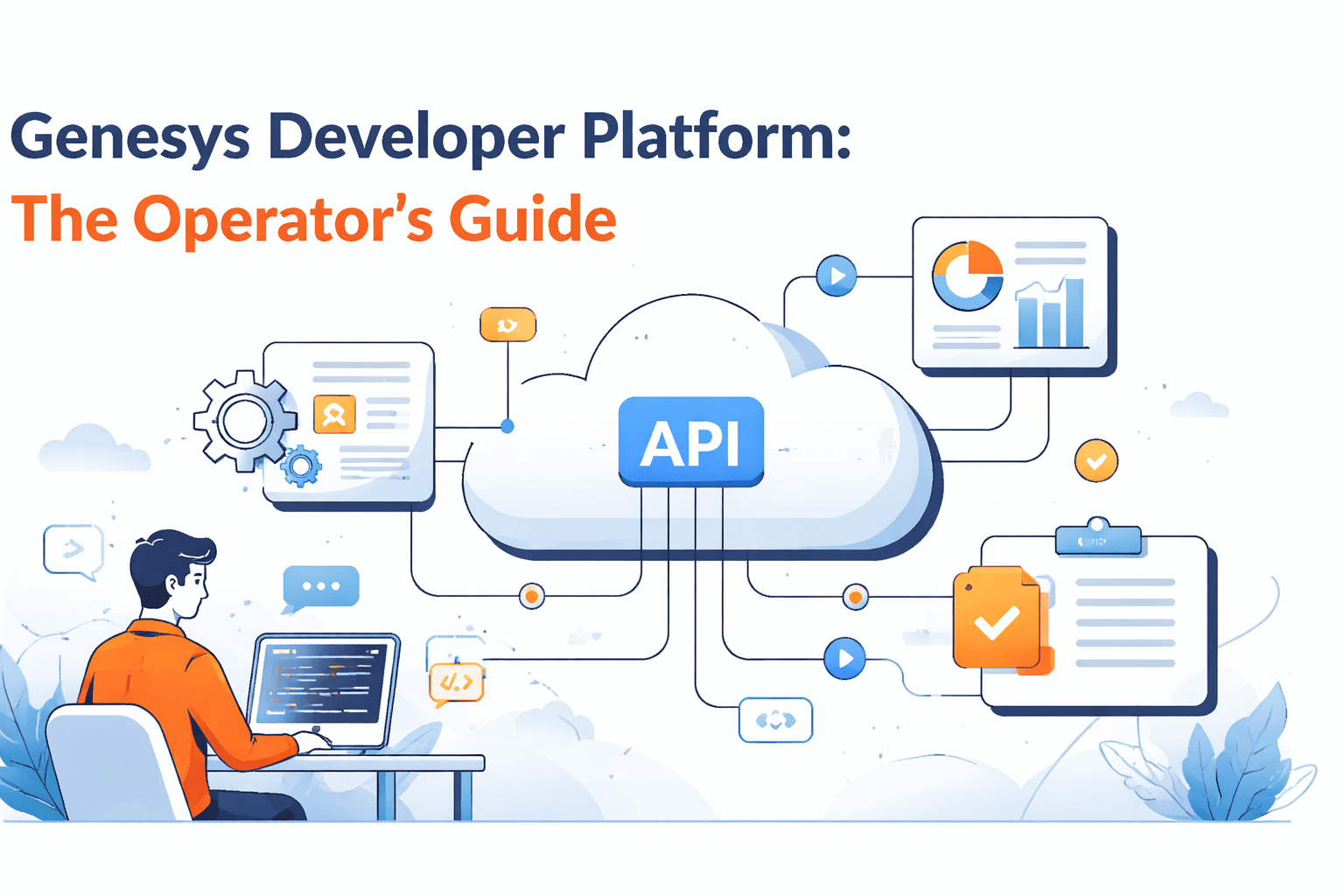
Genesys Developer Platform: The Operator's Guide
Platform Architecture: What You're Actually Building On
Genesys Cloud CX processes over eight billion API requests per week across hundreds of independent microservices. That number matters because it tells you something about failure behavior: when the analytics service hiccups, calls still connect. When a single microservice goes down, the platform routes around it. This is infrastructure designed to degrade gracefully rather than fail catastrophically.
The architecture runs on AWS as microservices. Every feature in the Genesys Cloud interface—every button, configuration screen, and report—hits the same APIs available to you. The UI is just one client among many.
That matters operationally. When Genesys releases a new feature, the API is available simultaneously. When you build a custom integration, you're extending the platform the same way Genesys does internally. You're not working around the system.
The flip side: you inherit the platform's constraints. AWS region limitations, microservice latency characteristics, and eventual consistency behaviors all become your problems.
Regional Deployment Reality
API calls hit regional endpoints. Pick the wrong one and your latency doubles:
Americas East: mypurecloud.com
Americas West: usw2.pure.cloud
Canada: cac1.pure.cloud
São Paulo: sae1.pure.cloud
Ireland: mypurecloud.ie
Germany: mypurecloud.de
London: euw2.pure.cloud
Australia: mypurecloud.com.au
Japan: mypurecloud.jp
Multi-region deployments require endpoint management in your integration code. This isn't optional complexity—it's the cost of data residency compliance and latency optimization. If you're running operations across geographies, budget for this in your architecture.
Authentication: The OAuth Reality
Every API call requires OAuth 2.0 authentication. No exceptions. You'll create OAuth clients in the admin console and choose from five grant types based on your integration pattern.
Client Credentials is your workhorse for backend services, scheduled jobs, and data synchronization—anything server-to-server. No user context required. The token authenticates as the OAuth client itself with the permissions you've granted it.
Authorization Code handles user-facing applications where you need to act on behalf of a specific agent or supervisor. The full OAuth dance with authorization codes, redirect URIs, and token exchanges. More complex, but necessary when permissions need to follow the logged-in user.
Implicit Grant exists for browser-based SPAs where you can't securely store client secrets. Tokens return directly in the URL. It works, but PKCE is better.
PKCE (Proof Key for Code Exchange) is for mobile and embedded clients that can't store secrets. The code verifier mechanism prevents authorization code interception attacks.
SAML2 Bearer lets you exchange existing SAML assertions for OAuth tokens. If your organization already has SSO infrastructure, this keeps authentication unified.
A practical consideration: OAuth client secrets are only retrievable at creation time. Lose them and you generate new credentials. Store them in a secrets manager from day one—not a shared document, not a Slack message, not "I'll remember it."
The Analytics API: Where Most Integrations Break
The Analytics API is the most sophisticated and most misunderstood component of the developer ecosystem. It offers three distinct data perspectives, and choosing wrong means your dashboards lie to you.
Observations: Real-Time Snapshots
Observation endpoints answer immediate questions: How many calls are waiting in this queue right now? Which agents are available? The data is current-state only—no history, no trending.
The trap: polling observations every few seconds to build a time series. You'll hit rate limits, your data will have gaps, and you'll have invented a worse version of what aggregates already provide. We see this pattern constantly in client environments. It never works the way teams expect.
Aggregates: Time-Series Analysis
Aggregate metrics let you query performance data at 15-minute, hourly, and daily intervals. This is where you build reports, trend analysis, and historical dashboards.
The concept you must understand: emit date. Metrics are calculated in real time but emitted to the analytics engine only when the qualifying activity concludes. The metric tAcd (time in queue) appears in your aggregates only after the ACD segment ends.
What this means operationally: a call spanning two 30-minute reporting intervals contributes its metrics to whichever interval the segment finished in, not to the one it started in. A call that begins at 10:28 and connects at 10:32 shows up in the 10:30–11:00 interval, not the 10:00–10:30 interval.
This behavior trips up every developer migrating from legacy systems that stream incremental data. If your real-time dashboard shows different numbers than your historical reports, emit date logic is usually why.
The operational implication nobody discusses: your real-time dashboards and WFM forecasts will never fully reconcile. Calls in progress don't exist in aggregates until they complete. Build processes that account for this gap rather than chasing phantom discrepancies. Train your supervisors to understand it. Otherwise you'll waste cycles investigating "data quality issues" that are actually platform behavior working as designed.
Detail Records: Audit-Level Granularity
When you need every millisecond of an interaction—for compliance, litigation, or root cause analysis—Detail Records provide it. Interactions break down into segments: alerting, holding, after-call work. Each segment carries timestamps precise to the millisecond.
The volume is massive. Standard synchronous queries choke on anything beyond a few thousand records. For production data extraction, use Conversation Detail Jobs—an asynchronous batch-processing system that handles millions of interactions. The five-year limit on these jobs has been removed; you can now pull historical data indefinitely.
Operational consideration: just because you can pull a decade of interaction data doesn't mean you should do it through the API. For large historical extractions, evaluate whether a data lake export or AWS S3 integration is more appropriate than hammering the API.
Query Performance: What Actually Matters
Analytics queries are resource-intensive. Poor query design doesn't just slow your dashboard—it can get your organization throttled.
Practical optimizations:
Avoid high-cardinality groupings. Grouping by userId across your entire organization is orders of magnitude slower than grouping by direction or mediaType.
Use neat intervals. Queries with start and end times on the half-hour perform better than arbitrary timestamps.
Filter before aggregating. If you only care about ten queues, specify them in your filter predicates. The system won't waste cycles aggregating data you'll throw away.
Respect the 1,000 measurement limit. A three-year interval with 30-minute granularity exceeds this and will be blocked.
Real-Time Events: Three Paths, Different Tradeoffs
Your integration needs to respond when things happen: a call arrives, an agent changes status, a queue threshold breaches. Genesys provides three mechanisms with different reliability guarantees. None is universally superior—the right choice depends on your failure tolerance.
WebSockets via the Notifications API
Open a WebSocket connection, subscribe to topics, receive events as they happen. Latency is low. The connection is direct.
The problem: WebSockets are fragile. If the connection drops as a message publishes, that event is lost. No retry, no recovery. For agent desktop applications where a human can see and recover from missed events, this is acceptable. For backend systems that need 100% data fidelity, it's not.
Use WebSockets for: custom agent UIs, supervisor dashboards, anything where a missed event results in slightly stale data rather than corrupted state.
Amazon EventBridge
For resilient server-to-server event processing, EventBridge publishes events to your AWS account's event bus in JSON format. Route them to Lambda functions, DynamoDB tables, SNS topics, or across to Azure via Event Grid.
EventBridge provides delivery guarantees that WebSockets don't. Events are stored and delivered with high reliability. If your Lambda fails, configure dead-letter queues and retry logic.
Use EventBridge for: data synchronization, compliance archiving, cross-system workflow automation—anything where missing an event corrupts downstream state.
The catch: you're adding AWS infrastructure to your operational footprint. If you're not already an AWS shop, evaluate whether the reliability benefits justify the additional platform dependency.
Process Automation Triggers
Triggers execute Architect flows when specific events occur: conversation starts, wrap-up codes apply, thresholds breach. Event handling without external infrastructure.
Send an SMS follow-up when a callback goes unanswered. Update a CRM record immediately after an interaction ends. Route a case to a specialist queue when sentiment analysis flags escalation risk.
Use Triggers for: internal automation that stays within Genesys, especially when you don't want to maintain external webhook receivers.
SDK Portfolio
Official SDKs exist for JavaScript/TypeScript, Python, Java, C# (.NET), Go, Ruby, and Swift. Genesys generates them from OpenAPI specifications and updates them with each platform release.
The SDKs handle authentication, retry logic, and pagination. Whether this abstraction helps or hurts depends on your team's preferences. Some engineers prefer working directly with REST APIs to understand exactly what's happening. Others want the SDK to handle boilerplate.
Operational note: SDK versions can lag platform releases. If you need a feature that shipped last week, check whether the SDK supports it before assuming you can use it.
The API Explorer in the Developer Center lets you test endpoints interactively before writing code—useful for understanding response structures and debugging authentication issues without writing throwaway code.
Integration Patterns That Actually Work
Data Actions: REST Middleware Without Code
Data Actions let Architect flows call external REST APIs during an interaction. When a call arrives, the IVR can fetch customer data from your CRM, check order status in your fulfillment system, or validate account information against your database—all before the call reaches an agent.
Genesys provides pre-built Data Actions for Salesforce, Zendesk, Microsoft Dynamics, AWS Lambda, and Google Cloud Functions. For anything else, you configure custom HTTP actions: endpoint, headers, request mapping, response parsing.
The operational value: agents stop toggling between systems to find information that should auto-populate. Screen pops arrive with context. Handle time drops because the lookup happened in the IVR, not during the conversation.
The operational risk: you've now made your IVR dependent on external system availability. If your CRM API goes down, does your IVR fail open (continue without data) or fail closed (can't route calls)? Design for the failure mode you can live with.
The Embeddable Framework
The Embeddable Framework embeds contact center controls—call handling, status management, interaction history—into your existing web applications. It's the same toolkit Genesys uses for its Salesforce and Zendesk integrations.
If you're building a custom CRM integration, start here. The framework handles WebRTC audio, station selection, and the interaction lifecycle. You focus on data integration between systems, not rebuilding telephony controls.
One constraint: don't run multiple embedded clients simultaneously. Running Genesys Cloud for Salesforce alongside a custom Embeddable Framework implementation causes interaction log conflicts and WebRTC phone failures. We've seen this break in subtle ways that take weeks to diagnose.
Client Apps: Extending the Native UI
Client Apps embed custom web applications directly in the Genesys Cloud interface. Agents stay in one window while accessing company-specific tools—policy lookups, troubleshooting wizards, custom knowledge bases.
The apps receive context about the current interaction. When a call arrives, your embedded app can automatically display relevant customer data without agent clicks.
DevOps: Configuration as Code
CX as Code with Terraform
CX as Code is a Terraform provider for Genesys Cloud. Define queues, skills, users, data actions, and routing configurations in declarative HCL files. Check them into Git. Deploy through your CI/CD pipeline.
The benefits compound:
Immutable configuration. The same Terraform definition deploys identically to dev, test, and production. No more "it works in my org" debugging sessions.
Declarative management. Describe the desired state. Terraform calculates dependencies and execution order.
Drift detection. Run terraform plan to see what's changed between your code and the live environment.
Consistency checking. The provider handles eventual consistency in cloud APIs, waiting until resources are truly ready before proceeding to dependent resources.
For organizations with existing manual configurations, an export utility generates Terraform files from current settings. You don't have to rebuild from scratch.
The discipline required: this only works if you commit to it. The moment someone makes a "quick fix" through the UI, you have drift. The next automated deployment overwrites their changes. That's not a bug—it's enforcement. But it requires organizational buy-in, not just technical implementation.
Archy: Flows as YAML
Archy processes Architect flows as YAML files. Your IVR logic lives in source control alongside your application code. Version it, review it, deploy it through automation.
The challenge Archy solves: moving flows between environments with different resource identifiers. A queue named "Sales" has different IDs in development and production. Archy's substitution feature lets you define variable placeholders in YAML that resolve to environment-specific values at deployment time:
No manual find-and-replace. No broken deployments from forgetting to update a queue reference.
CI/CD Practices
No infrastructure monoliths. Break configurations into logical modules that can be deployed independently. One massive Terraform file for your entire organization is a merge conflict waiting to happen.
Source control as truth. Changes happen in Git first. UI modifications get overwritten on the next deployment. Enforce this culturally, not just technically.
Automate everything. Manual file movement introduces human error. Commit triggers build. Build triggers test. Test triggers deploy.
Fix forward. Rolling back in cloud environments often causes more problems than deploying a fix. Tag your releases. If something breaks, deploy the previous tagged version as a new deployment.
Genesys Cloud Functions: Custom Code Without Servers
Functions let you run Node.js code directly on Genesys infrastructure. When Architect's native data actions can't handle your requirements—custom encryption, parallel API calls, complex data transformations—Functions fill the gap.
Scatter/Gather operations: A single customer inquiry might require data from three backend systems. Sequential data actions add latency. A Function queries all three in parallel and returns a combined response.
Custom encoding requirements: Your mainframe expects HMAC-signed requests or PBKDF2-encoded parameters. A Function handles the cryptography and returns clean JSON to the flow.
Current runtime support includes Node.js 18, 20, and 22. Memory limits are configurable per function.
Network limitation: Functions access the public internet but don't get static IP addresses. If your external API requires IP whitelisting, you'll need certificate-based authentication or mTLS instead.
Security consideration: Genesys doesn't scan uploaded code for vulnerabilities—that's your responsibility. And once uploaded, code can't be downloaded, so maintain your source externally.
Rate Limits and Fair Use
Every API request is subject to rate limiting. Exceed thresholds and you receive 429 errors. Limits apply per access token, per user, or per organization depending on the endpoint.
For 429 responses, read the Retry-After header. It tells you exactly how long to wait.
For transient errors (502, 503, 504), implement exponential backoff. Wait 3 seconds after the first failure, 9 seconds after the second, 27 seconds after the third. If errors persist beyond 10 minutes, something systemic is broken and retrying won't help.
The API Usage view in the admin console shows which OAuth clients consume the most requests. When you're rate-limited, this tells you which integration to optimize—add caching, switch polling to the Notifications API, or use batch operations where bulk endpoints exist.
The AppFoundry Ecosystem
The AppFoundry marketplace hosts certified integrations from Genesys partners. Before building a custom connector, check if someone's already solved your problem.
Evaluate carefully. Marketplace presence doesn't guarantee quality. Some AppFoundry integrations are mature products with dedicated support. Others are minimally viable implementations that will become your problem to maintain when the vendor loses interest. Check update frequency, support responsiveness, and whether the vendor's business model depends on the integration's success.
For ISVs building commercial applications, certification involves technical and commercial review. Installation must be fully automated. License enforcement must validate customer permissions.
Security and Compliance
Genesys Cloud maintains SOC 2 Type II, ISO 27001, HIPAA (with BAA), PCI DSS Level 1, GDPR compliance, and FedRAMP authorization for government use.
API communications require TLS 1.2 or higher. Access tokens expire after 24 hours by default. Role-based access control means API operations respect the same permissions as UI actions—if a user can't delete interactions through the interface, they can't do it through the API either.
For organizations requiring data residency, regional deployments keep data within designated geographic boundaries. Your API endpoints, recordings, and configuration data stay in the region you select.
The compliance reality: platform certifications cover Genesys infrastructure, not your integrations. If you're building custom integrations that handle PHI or PCI data, your code needs its own compliance review. Don't assume the platform's certifications extend to what you build on top of it.
Comparative Context: Platform Tradeoffs
Genesys Cloud competes primarily with Amazon Connect and Twilio Flex. Each represents a different philosophy with different operational implications.
Amazon Connect optimizes for cost and AWS-native integration. Deployment is fast if you're willing to work within Amazon's patterns. Native functionality gaps exist—voicemail required building your own solution until recently, and workforce management still requires third-party tools. If your infrastructure is already AWS and your requirements are straightforward, Connect integrates naturally. If you need sophisticated out-of-the-box features, you'll build them yourself or buy add-ons. The TCO calculation changes significantly once you factor in the build-versus-buy decisions Connect forces.
Twilio Flex is a builder's kit. The React-based UI is fully programmable—you can reshape every aspect of the agent experience. The tradeoff is governance. Without discipline, Flex environments become sprawling script collections that are difficult to maintain and harder to debug. If you have strong engineering practices and want maximum control, Flex rewards that investment. If you want a platform that enforces consistency, Flex won't do it for you.
Genesys Cloud bundles integrated workforce management, quality management, and analytics that competitors either lack or require third-party tools to match. The tradeoff is complexity—setup involves more configuration than Connect, and the platform's breadth means more surface area to learn. Whether that bundled functionality justifies the added complexity depends on your operational requirements. For organizations that would otherwise cobble together five vendors, the integration has value. For organizations with simple requirements, it's overhead.
None of these platforms is universally superior. The right choice depends on your existing infrastructure, engineering capacity, and operational complexity. Anyone who tells you otherwise is selling something.
What To Do Next
If you're evaluating Genesys Cloud for development: Start with the API Explorer. Test authentication flows against a development org before writing integration code. Understand the platform's behavior before committing to it.
If you're building your first integration: Begin with read operations. Query users, list queues, pull conversation records. Build confidence with GET requests before attempting modifications. The mistakes you make with reads are recoverable; the mistakes you make with writes sometimes aren't.
If you're scaling existing integrations: Audit your API usage. Identify polling patterns that should be notifications. Find repeated queries that should be cached. Batch operations where bulk endpoints exist. The patterns that worked for your pilot often don't survive production load.
If you're migrating from legacy Genesys platforms: Map your existing customizations to Genesys Cloud equivalents. PSDK-based integrations become REST API calls. Handler logic becomes Architect flows or Lambda functions. The concepts translate even when the implementations don't. Budget more time than you think—migrations always surface undocumented dependencies.
This guide reflects operational experience with Genesys Cloud deployments. Platform capabilities and limitations change over time. Verify current behavior against Genesys documentation for decisions that matter.
Ready for Better CX?

Whether you're selecting your CX technology stack or evaluating outsourcing options, InflectionCX is your go-to-partner. Contact us today.
AI Readiness Assessment
We map where AI fits in your operation. What's working, what's hype, what's actually worth doing.

Unified CX Outsourcing
InflectionCX runs contact centers where humans and AI operate as one system.