
Sarah Mitchell
CX Industry Analyst
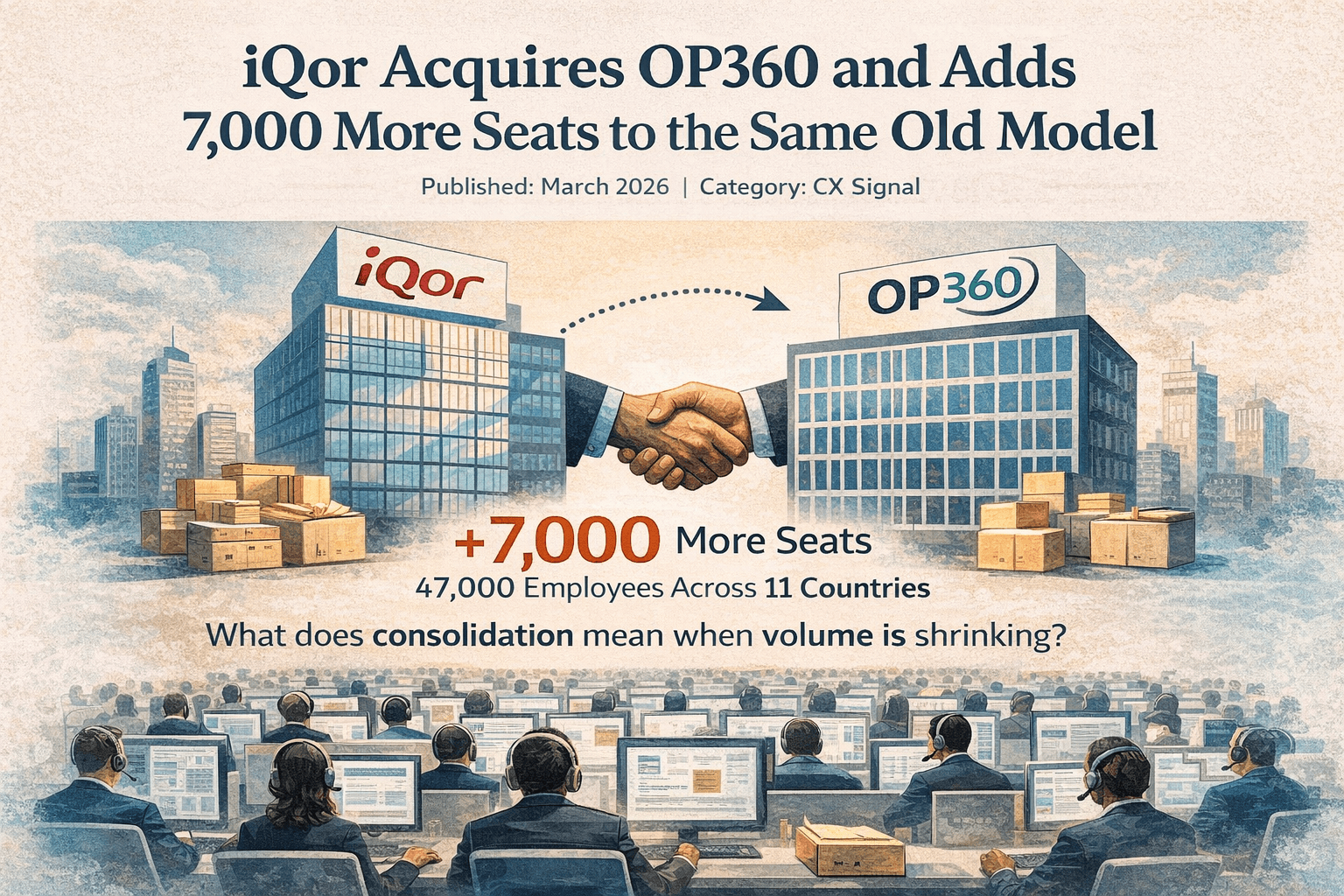
iQor announced its acquisition of OP360 on January 5, expanding to more than 47,000 employees across 11 countries. The deal adds workforce capacity in the Philippines, Colombia, India, and the United States, along with OP360's client relationships in customer support, back-office processing, sales, and content moderation. iQor, a portfolio company of Mill Point Capital, framed the acquisition as strengthening its delivery of "seamless, tech-enabled CX and back-office solutions."
Ryan Strategic Advisory predicted at least one BPO mega-consolidation in 2026. The iQor/OP360 deal is an early indicator that the prediction was right. But the more interesting question is not whether consolidation is happening. It is what the consolidation strategy reveals about how these companies think the market is moving.
The Scale Thesis in a Shrinking-Volume Market
iQor's acquisition logic is straightforward: more seats, more countries, more capacity. That has been the dominant growth model in CX BPO for two decades. Buy a competitor, absorb their headcount, integrate their clients onto your platform, and drive margin through labor arbitrage and operational leverage.
The problem is that the market conditions that made seat-count growth valuable are changing. The ISG Index reported that BPO annual contract value fell 14% in 2025, with the global total dropping to $7.3 billion, the lowest since 2020. Award counts remained relatively stable, but contract values are compressing. Automation and AI are reducing the volume of simple, repeatable interactions that historically justified large offshore staffing models. Enterprises are holding off on large BPO commitments while they assess how AI will reshape their operations.
In that environment, acquiring 7,000 more employees and adding four more delivery countries is a bet that volume will hold. It is a bet that the interactions flowing into contact centers next year will look roughly like the interactions flowing in last year, and that the competitive advantage will continue to rest on who can staff the most seats at the lowest cost per hour.
That bet is getting harder to win.
The AI Branding Problem
iQor has invested heavily in positioning itself as an AI-powered operation. Its infinityAiQ platform, launched in mid-2025, is described as "a unified intelligence platform that combines human expertise, AI, and analytics to optimize every stage of the customer experience." The company says it processes over 2.7 billion tokens per week through LLMs and applies predictive analytics to 100% of call volume.
Those are large numbers presented without much context about what they produce. Processing billions of tokens is an infrastructure metric, not an outcome metric. The relevant question for any CX operation is not how much data flows through the system but what decisions change as a result. How many interactions were evaluated against a client-specific quality framework? How many coaching interventions were triggered by an AI-identified performance pattern? How many process failures were surfaced and resolved before they affected member experience?
The infinityAiQ messaging leans heavily on language that has become standard across the BPO industry: "predictive decisioning," "continuous optimization," "real-time business intelligence," "actionable insights." These phrases appear in nearly identical form in the marketing materials of every large BPO that has stood up an AI initiative in the last 18 months. When every competitor claims the same capabilities using the same vocabulary, the differentiator is no longer the claim. It is the evidence.
iQor's published results include "saving an average of 1,000 customers weekly" through real-time interventions and "increasing retention by nearly 3x" through attrition prediction. Those are useful data points, but they describe internal operational improvements, not client-facing outcome data tied to specific quality, compliance, or resolution metrics. The gap between internal efficiency gains and measurable client outcomes is where AI branding separates from AI delivery.
What Consolidation Optimizes For
The iQor/OP360 deal optimizes for exactly what PE-backed BPO consolidation always optimizes for: scale efficiencies, geographic coverage, and EBITDA growth through headcount absorption. Mill Point Capital's portfolio strategy follows the standard playbook. Acquire operators with stable client relationships and engaged workforces. Integrate them onto a shared technology stack. Reduce duplicative overhead. Improve margin.
None of that is inherently wrong. It is a legitimate business strategy that has created several multi-billion-dollar BPO enterprises. The question is whether it creates value for the clients whose interactions are being handled, or primarily for the holding company's equity position.
When a BPO acquires another BPO, the integration conversation is almost always about platform migration, site consolidation, and reporting alignment. It is rarely about whether the combined operation produces better outcomes for the end customer or member. The client gets a larger vendor with more delivery options. They do not necessarily get a more intelligent operation.
That distinction matters more now than it did five years ago, because the interactions that remain in human-assisted channels are getting harder. The simple, scriptable volume is migrating to self-service and AI agents. What remains for human agents, and for the BPO operations that support them, is the complex work: navigating ambiguous eligibility questions, managing emotionally charged escalations, handling multi-system workflows that require judgment and documentation. Scale does not solve those problems. Operational intelligence does.
A Different Model
The alternative to scale-first consolidation is not necessarily staying small. It is building operations where the intelligence layer is the product, not the seat count.
When quality evaluation is embedded into every interaction rather than sampled across a fraction of calls, when AI and human agents operate under the same performance framework rather than in parallel tracks, and when the data produced by the operation feeds directly into client-specific coaching and process improvement rather than generic dashboards, the operation generates value that is proportional to its intelligence, not its headcount.
That is the model we built InflectionCX around. We combine AI agents, human agents, and intelligence systems into a unified operation where every interaction is evaluated, every evaluation produces structured data, and every data point connects to a specific client outcome. The competitive advantage is not how many people we employ or how many countries we operate in. It is the quality and specificity of the operational intelligence we produce for each client.
In a market where BPO contract values are declining and AI is absorbing simple volume, the operators that will hold and grow margin are the ones whose value proposition does not depend on how many seats they can fill. The iQor/OP360 deal is a significant transaction, and it gives iQor more capacity to serve large-scale clients. But capacity is increasingly a commodity. The scarce resource in CX operations is not labor. It is the ability to prove, interaction by interaction, that the work was done right.
InflectionCX is a unified CX operations company combining AI agents, human agents, and intelligence systems.
More in Analysis


About InflectionCX

Strategy, technology, and operations from a single partner.
InflectionCX runs contact centers with human agents and AI agents inside one operating system. We handle the technology, the people, and the operations. You get lower costs, tighter compliance, and better outcomes.