
Gannon Costello
CX Technology Analyst
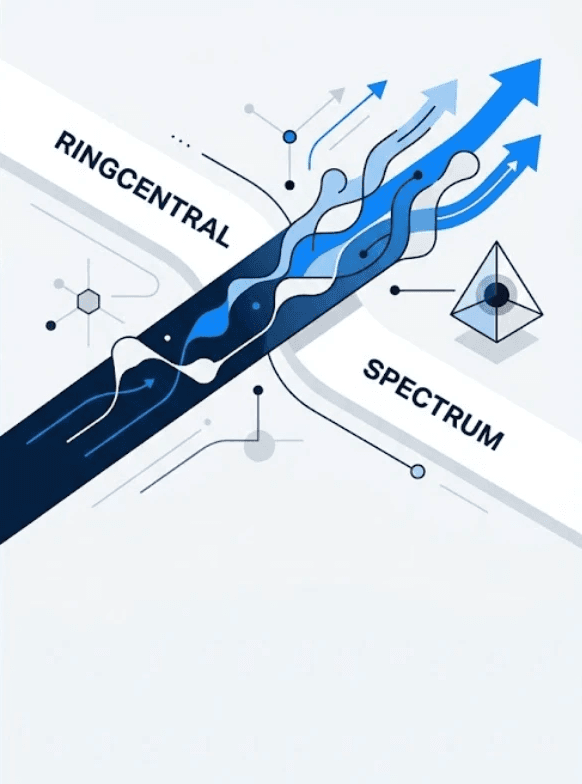
On March 12, 2026, Spectrum Business and RingCentral announced an expanded partnership
making RingCX and AI Conversation Expert (ACE) available to Spectrum Business customers
nationwide through a new Unified Customer Experience bundle, delivered over Spectrum's
managed network. The announcement landed at Enterprise Connect and HIMSS 2026, and it
was covered as an AI story. It is more accurately a distribution story with a governance
problem embedded in the fine print.
InflectionCX builds QA intelligence infrastructure and runs contact center operations.
We track these announcements because they reveal how vendors actually reach buyers — and
because we have seen firsthand what happens when AI scoring systems get deployed without
adequate governance architecture underneath them.
AI as Channel Packaging
RingCentral has been executing a deliberate channel pivot. The company plans to spend
approximately $250 million on R&D in 2026, with heavy emphasis on agentic voice AI,
according to its 10-K filing.
RingCX, launched roughly two years ago, recently added RingWEM for workforce engagement
management. ACE, formerly branded as RingSense, handles conversation intelligence and
CRM sync. Together with AIR, RingCentral's autonomous agent product, these form what the
company calls its "three As" strategy, as analyst Dave Michels noted
following RingCentral's March 2026 analyst summit.
Spectrum Business, a Charter Communications subsidiary, serves mid-market and enterprise
customers across 41 states. Bundling RingCX and ACE into a managed-network offering
gives RingCentral a physical sales channel with deep regional penetration into a buyer
segment it has historically underpenetrated. Keith Dardis, Executive Vice President at
Spectrum Business, framed the deal as a consolidation play, noting that mid-market
organizations using multiple tools face fragmented workflows and inconsistent service.
Multi-tool fragmentation is a genuine problem, and the consolidation framing will land
well with buyers exhausted by integration complexity. Bundling UCaaS and CCaaS through
a network provider is not the same as building a unified CX architecture, though, and
buyers evaluating what Unified CX actually means in practice need to separate the
packaging from the platform.
RingCentral's own research underscores the gap between stated strategy and operational
reality. The company's Agentic AI Trends 2026 report, based on a Q4 2025 survey of
2,000 IT, HR, and CX decision-makers, found that 86% of organizations say they have an
AI strategy, while only 39% have integrated AI company-wide and just 16% have deployed
AI at scale. Kira Makagon, RingCentral's President and COO, acknowledged
that making AI operational requires integrated systems and governed data. The Spectrum
deal does not explain how that governance works in practice.
Three Parties, One Accountability Gap
The press release details what RingCX and ACE do. RingCX auto-scores 100% of customer
interactions for sentiment and compliance. ACE transcribes and analyzes every sales call
and meeting, then syncs insights to the CRM automatically. Sandra Krief, SVP of Global
Service Providers at RingCentral, described the vision as embedding intelligence at the
core of every conversation.
That is a significant amount of scoring infrastructure, and the announcement is silent
on the questions that matter most to buyers who will actually operate it. Who owns the
interaction data across the three parties in this structure? Where does it reside, and
does Spectrum's managed network create additional data-handling layers? What happens to
AI-scored interaction records when a customer churns? How are employees notified that
100% of their conversations are being scored, and does that notification meet consent
requirements by jurisdiction?
At InflectionCX, we built Atlas partly because we needed a QA scoring system we could
actually audit. When an automated model scores 100% of agent interactions, someone has
to be responsible for calibrating what the model measures, identifying where it breaks
down, and providing recourse when a score is wrong. In regulated environments, that
accountability chain has to be documented before deployment — not resolved after the
first compliance incident.
In a standard CCaaS deployment, the buyer has a direct vendor relationship with a
defined escalation path. The Spectrum UCX model inserts a network provider between the
buyer and the platform vendor, adding contractual complexity to data governance, support
escalation, and SLA accountability. Buyers who have navigated CCaaS implementation
failures know how quickly multi-party accountability collapses when something breaks.
What to Isolate Before Signing
Conversation intelligence is no longer a differentiating feature. Nearly every major
CCaaS provider — from Five9 to NICE CXone to Genesys Cloud — offers automated QA and
post-interaction analytics. The differentiation is in governance architecture and
integration depth, and those are the variables a managed-network bundle tends to obscure.
Before evaluating UCX with RingCentral or any bundled CCaaS offering, buyers should
isolate three things.
Data ownership and portability. Get written documentation on who owns interaction
recordings, transcripts, AI-generated scores, and CRM-synced insights — and confirm
what happens to that data on contract termination. This matters in any CCaaS deal and
matters doubly when a network provider sits between you and the platform vendor.
AI governance structure. Auto-scoring 100% of agent interactions means algorithmic
decisions are shaping quality assessments for every call, every day. Ask who calibrates
the scoring model, how often it is audited, what recourse agents have when they disagree
with an automated score, and whether the model has been validated in your specific
operating environment. If the vendor cannot answer those questions with specifics, the
product is not ready for regulated environments.
Support and escalation clarity. Managed-network bundles create ambiguity around who
handles what when something breaks. Map the full escalation chain before signing.
Determine whether Spectrum or RingCentral owns Tier 2 and Tier 3 support for the
contact center platform, who is responsible for uptime SLAs on the AI components
specifically, and how disputes between parties get resolved when the failure sits at a
layer boundary.
The Inflection
CX Directors should request a data governance addendum from any vendor offering
AI-powered conversation intelligence, specifying data ownership, retention,
portability, and deletion timelines before contract execution.IT Leaders evaluating managed-network CCaaS bundles should map the full escalation
chain across all parties and require written SLA commitments for each layer
independently — not just the network layer.Compliance Officers should audit whether 100% auto-scoring of employee
interactions meets their organization's monitoring notification requirements and
consent laws by jurisdiction before deployment begins.
More in Analysis


About InflectionCX

Strategy, technology, and operations from a single partner.
InflectionCX runs contact centers with human agents and AI agents inside one operating system. We handle the technology, the people, and the operations. You get lower costs, tighter compliance, and better outcomes.