
Sarah Mitchell
CX Industry Analyst
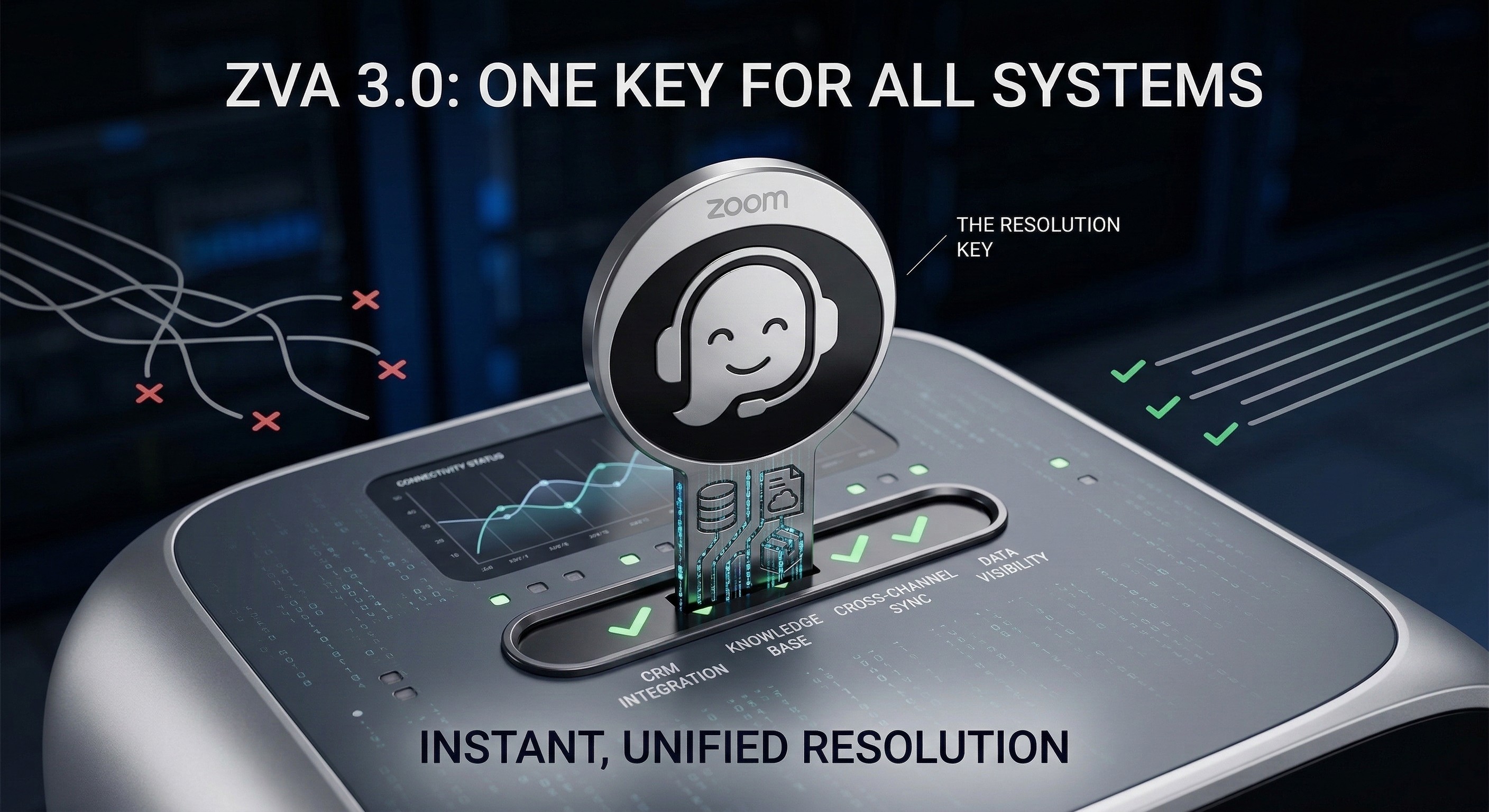
Zoom launched Virtual Agent 3.0 in late February, and the release deserves more attention than it has received from operations leaders. Where most virtual agent platforms still measure success by how many customers they keep away from a live agent, ZVA 3.0 is built around a different premise: whether the issue actually gets resolved.
Zoom is calling this the "resolution economy," and while the branding is new, the operational problem it describes is familiar to anyone who has run a contact center quality program. Containment rates have been the default success metric for self-service channels for years. A customer enters the bot, the bot handles the interaction, and the interaction never reaches a human. That counts as contained. Whether the customer's problem was solved, whether they called back two days later, whether they filed a complaint through a different channel, none of that shows up in the containment number.
ZVA 3.0 is designed to close that gap. Built on the Zoom AI Companion 3.0 architecture, the new execution framework supports multi-step workflows that run across CRM, billing, order management, and other enterprise systems. The virtual agent can execute actions, not just answer questions. And when escalation is necessary, the full workflow history transfers to the live agent so the customer never restarts from zero.
What Changed Operationally
The headline capabilities include an enhanced execution framework for cross-system workflow automation, admin-level visibility into the decision logic and data sources behind every automated action, and a governance layer that lets CX teams audit, troubleshoot, and refine automation policies without pulling in engineering resources.
Three additional features are planned for general availability in Spring 2026: multimodal LLM intelligence (allowing the virtual agent to interpret documents, images, and structured identifiers like serial numbers), expanded voice channel support, and learning loops that improve resolution patterns based on how human agents handle similar cases.
For contact center operations leaders evaluating Zoom Contact Center or already running ZCX, the governance enhancements matter as much as the AI capabilities. Scaling automation in regulated environments like healthcare and financial services requires the ability to trace every decision the virtual agent makes back to a source. ZVA 3.0 provides that traceability at the admin level, which is a meaningful step forward for organizations where audit trails and compliance documentation are operational requirements.
The Numbers Worth Examining
Zoom shared performance data from its own deployment of ZVA. On digital channels, ZVA resolved 98% of customer interactions without escalating to a live agent. When voice was added, the platform achieved a 76% containment rate and reduced the abandonment rate from 23% to 1% within a few months.
Those are strong numbers. They also reflect Zoom's own environment, where the support use cases skew toward account management, billing, and product configuration. In healthcare contact centers handling Medicaid eligibility questions, behavioral health intake, or prior authorization follow-up, the complexity profile is different. The same is true in financial services environments managing claims disputes, compliance-sensitive disclosures, or multi-party account servicing.
The resolution economy framework holds up as a design principle. The performance benchmarks will look different across verticals, and operations teams should plan their evaluation accordingly.
Where This Fits in the Zoom CX Trajectory
ZVA 3.0 arrives alongside a strong earnings signal. Zoom reported that Contact Center ARR accelerated in Q4, with high double-digit growth driven primarily by paid AI features. Every one of Zoom's top 10 CX deals in the quarter included paid AI components, and seven of those deals displaced incumbent CCaaS providers.
That displacement pattern is worth watching. Zoom Contact Center is still newer to the enterprise CCaaS market than Genesys, NICE, or Five9, but the combination of platform unification (UCaaS and CCaaS on one stack), aggressive AI investment, and a pricing model that bundles AI into CX deals is producing competitive wins that the established vendors will need to respond to.
For organizations already running Zoom Phone or Zoom Workplace, the integration path to Zoom Contact Center and ZVA is considerably smoother than bringing in a standalone CCaaS platform and wiring it into a separate communications stack. That operational simplicity carries real weight in mid-market healthcare and financial services environments where IT teams are lean and integration timelines directly affect time to value.
The Operator Perspective
We work with Zoom CX as a certified partner, and ZVA 3.0 reinforces what we have seen in our own deployments: the platform is maturing quickly, and the investment Zoom is making in governance, transparency, and cross-system execution reflects a genuine understanding of what enterprise CX operations require.
The resolution economy framing also aligns with how we think about quality assurance. Measuring whether a customer interaction produced a real outcome, whether the member got enrolled, whether the caller received accurate benefits information, whether the issue was documented and routed correctly, is the only way to evaluate whether AI-assisted service is working. Containment without resolution is just cost-shifting.
The organizations that will get the most value from ZVA 3.0 are those that pair the technology with operational discipline: well-defined escalation criteria, QA frameworks that evaluate AI interactions with the same rigor applied to human agents, and performance measurement systems that track resolution across channels rather than within them.
InflectionCX is a unified CX operations company combining AI agents, human agents, and intelligence systems for healthcare and financial services organizations. We are a certified Zoom CX partner.
Contact Us to learn more about our Zoom offerings.
More in Analysis


About InflectionCX

Strategy, technology, and operations from a single partner.
InflectionCX runs contact centers with human agents and AI agents inside one operating system. We handle the technology, the people, and the operations. You get lower costs, tighter compliance, and better outcomes.