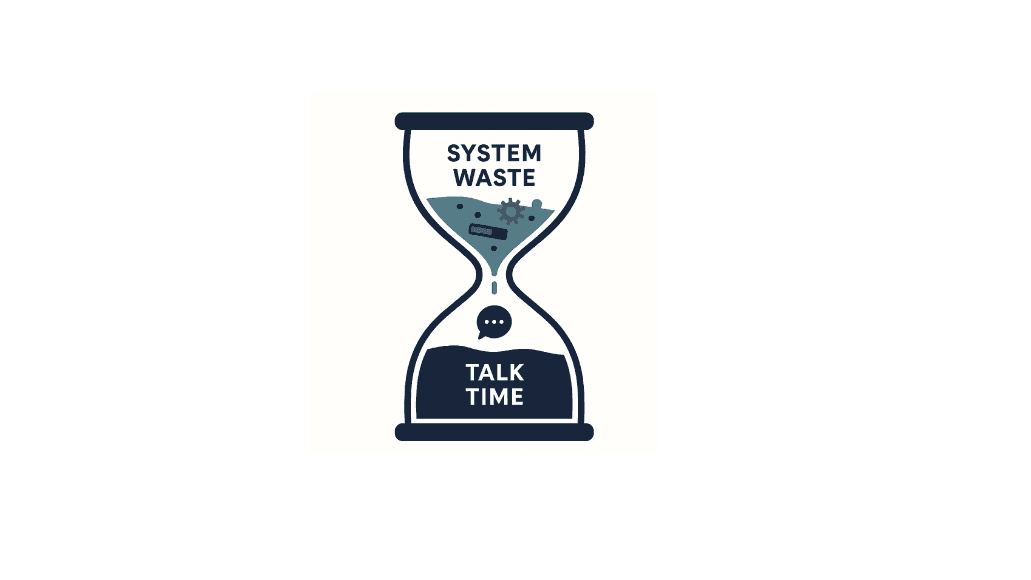
You Can't Fix AHT by Hurrying the Customer
What Handle Time Actually Contains
Average handle time measures the complete duration of customer interactions: talk time, hold time, and after-call work. The metric captures everything from the moment an agent engages until they're ready for the next interaction. Understanding what fills that time reveals why most reduction strategies fail.
Agent-Customer Conversation
The actual exchange between agent and customer—listening to the issue, asking clarifying questions, explaining solutions, confirming resolution. This is the work the contact center exists to do. It's also typically the smallest portion of handle time and the last place organizations should look for reduction.
Customers call with problems. Understanding those problems takes time. Explaining solutions takes time. Confirming resolution takes time. Attempts to compress this conversation sacrifice the quality that determines whether the interaction actually resolves the issue or generates a repeat contact.
System Navigation
Agents spend significant handle time navigating technology: pulling up customer records, accessing account history, opening applications, switching between screens, waiting for systems to respond. This time adds nothing to customer value. It's pure friction imposed by technology infrastructure.
In fragmented technology environments, agents may access five or more systems during a single interaction. Each system switch requires clicks, load time, and cognitive context-switching. The customer waits while the agent navigates. The handle time clock runs while nothing customer-relevant happens.
Information Search
Agents search for information: product details, policy specifics, procedure steps, troubleshooting guidance. In well-designed operations, this information surfaces automatically based on interaction context. In typical operations, agents hunt through knowledge bases, open documentation in separate windows, or ask colleagues via chat.
Search time varies dramatically based on knowledge management quality. Agents with AI-powered assistance that surfaces relevant information contextually spend seconds on information retrieval. Agents searching static knowledge bases with keyword queries spend minutes. The handle time difference is substantial.
Policy Interpretation
Ambiguous policies create handle time waste that compounds across thousands of interactions. When policy language is unclear, agents must interpret, ask supervisors, or make judgment calls. Each ambiguity adds time and creates inconsistency.
Policy ambiguity often reflects organizational decisions pushed to the front line without clear resolution. Can we waive this fee? What qualifies for this exception? How do we handle this edge case? Agents encountering these questions repeatedly add handle time while the ambiguity that creates those questions goes unaddressed.
Process Workarounds
When processes don't work, agents develop workarounds: copying information between systems that don't integrate, performing manual steps that should be automated, following unofficial procedures that evolved because official ones fail. These workarounds become invisible time sinks baked into standard operation.
Workarounds persist because they solve immediate problems. But each workaround adds handle time that better process design would eliminate. Organizations focused on agent speed miss the process failures that make speed impossible.
Hold and Transfer Time
Customers wait on hold while agents consult supervisors, transfer to other departments, or wait for system responses. Each hold adds handle time while the customer experiences friction. Transfers often result from routing that didn't place the customer with the right resource initially—or from agents lacking authority to resolve issues they're capable of handling.
After-Call Work
Agents complete documentation, update records, send follow-up communications, and prepare for the next interaction. This wrap-up time counts against handle time but happens after the customer departs. Extensive wrap-up requirements often reflect documentation obligations that automation could address or system limitations that require manual data entry.
Why Hurrying Customers Makes Things Worse
When organizations pressure agents to reduce handle time without addressing system waste, agents have limited options. They can't make the systems faster. They can't fix the processes. They can't clarify the policies. The only variable they control is the customer conversation—so that's what gets compressed.
This compression creates predictable problems.
Quality Degrades
Rushed agents skip verification steps, abbreviate explanations, and move to resolution before fully understanding issues. Quality scores decline. Compliance adherence suffers. The efficiency pressure that was supposed to improve operations actually degrades them.
Resolution Rates Fall
First-call resolution depends on actually resolving issues, which requires understanding them fully and addressing them completely. Rushed conversations produce incomplete resolution. Customers call back. The repeat contact consumes more total handle time than a properly handled first contact would have.
Organizations celebrating AHT reduction often miss the corresponding increase in repeat contacts. The efficiency gain in individual interactions disappears when customers require multiple interactions to achieve resolution.
Customer Satisfaction Drops
Customers perceive rushed interactions. They feel unheard, dismissed, or processed rather than helped. Satisfaction scores decline. In competitive markets, dissatisfied customers leave. The handle time savings cost more in customer lifetime value than they save in operational efficiency.
Agent Experience Suffers
Agents caught between customer needs and efficiency pressure experience stress. They know rushing hurts quality. They know the systems are the problem. Pressure to improve metrics they can't actually control creates frustration and burnout. Turnover increases. The cost of replacing departed agents dwarfs any handle time savings.
The Fundamental Contradiction
The customer interaction is what the contact center exists to deliver. Optimizing by minimizing it contradicts the operation's purpose. Organizations might as well optimize restaurants by minimizing time customers spend eating.
Handle time reduction that targets the customer conversation is solving the wrong problem. The waste that actually inflates handle time lives in system friction, not customer service.
Where Handle Time Waste Actually Lives
Genuine AHT improvement requires understanding where time goes. Analysis typically reveals that system waste—not conversation—drives handle time inflation.
Technology Fragmentation
Agents accessing multiple disconnected systems spend substantial time on navigation that adds no customer value. Each application switch requires clicks, load time, and mental context-switching. Customer context doesn't transfer between systems, so agents re-gather information already provided.
Organizations with unified platforms that consolidate customer information, interaction history, and resolution tools in single interfaces show measurably lower handle times than those requiring agents to navigate system archipelagos. The difference isn't agent speed—it's how much friction the infrastructure imposes.
Knowledge Access Friction
Time spent searching for information is pure waste from the customer's perspective. Static knowledge bases with keyword search require agents to formulate queries, scan results, and determine relevance. The customer waits while the agent hunts.
AI-powered assistance that surfaces relevant information based on conversation context eliminates search time. The system understands what the customer needs and presents relevant information automatically. Handle time decreases because the friction of manual search disappears.
Process Failures
Processes designed without efficiency consideration create handle time waste that becomes invisible through familiarity. Agents accept that this step takes three minutes because it always has. The process failure hides in "that's how it works."
Process analysis often reveals steps that could be automated, approvals that could be pre-authorized, and handoffs that could be eliminated. Each process improvement reduces handle time without touching the customer conversation.
Policy Ambiguity
Every time an agent must interpret unclear policy, handle time increases. Every supervisor consultation to resolve ambiguity adds hold time. Every inconsistent decision that generates customer pushback extends conversations.
Policy clarification—documenting clear guidance for common scenarios—reduces handle time by eliminating interpretation overhead. The investment in clarity pays returns across every interaction where that policy applies.
Authorization Gaps
Agents lacking authority to resolve issues they're capable of handling must escalate, consult, or transfer. Each escalation adds handle time. Empowering agents with appropriate authority enables single-contact resolution that escalation requirements prevent.
Authorization expansion requires trust and training. But organizations that invest in agent empowerment see handle time reductions because issues resolve at first contact rather than bouncing through escalation chains.
Documentation Burden
Extensive after-call work requirements add handle time after customers depart. When agents must manually document what happened, update multiple systems, or complete forms that should be auto-populated, wrap time inflates.
Automated documentation—AI-generated summaries, system updates triggered by interaction data, auto-completed fields—reduces wrap time without agent effort. The time savings accrue across every interaction.
The Unified Platform Advantage
System waste that inflates handle time traces largely to fragmented infrastructure. Multiple platforms that don't communicate. Data siloed in separate systems. Knowledge isolated from interaction context. Process steps spanning disconnected tools.
Unified platform architecture addresses these friction sources structurally:
Consolidated customer context. Customer information, interaction history, and account details in a single view. Agents don't navigate between systems to assemble context the customer has already provided.
Integrated knowledge delivery. AI-powered assistance surfaces relevant information based on conversation context. Agents receive what they need without searching.
Streamlined workflows. Processes designed within unified systems eliminate handoffs between disconnected tools. Steps that required manual data transfer between systems become automated.
Embedded policy guidance. Clear policy direction integrated into interaction workflows. Agents receive guidance in context rather than hunting through documentation.
Automated documentation. Interaction records populate automatically. After-call work shrinks to exception handling rather than standard documentation.
The handle time difference between agents operating on unified platforms versus fragmented infrastructure is substantial—often 20-30% or more. The difference isn't agent performance. It's how much friction the infrastructure imposes.
Measuring the Right Things
Organizations serious about handle time improvement should measure what actually drives handle time, not just the aggregate number.
System time tracking. How much handle time goes to system navigation, load times, and application switching? This is pure friction that infrastructure improvement can address.
Search time analysis. How often do agents search knowledge bases? How long do searches take? What's the success rate? Search time is a direct measure of knowledge access friction.
Hold and escalation patterns. What drives holds? What triggers escalations? These patterns reveal process gaps, authority limitations, and policy ambiguities that create handle time waste.
Wrap time composition. What are agents doing during after-call work? Which documentation requirements could be automated? Wrap time analysis reveals reduction opportunities that don't affect customer experience.
Repeat contact rates. AHT reduction that increases repeat contacts isn't efficiency—it's cost shifting. Track whether handle time changes correlate with resolution changes.
Quality correlation. Does handle time pressure correlate with quality score changes? If quality degrades as AHT decreases, the reduction is coming from the wrong source.
The Agent Perspective
Agents know where handle time waste lives. They navigate the systems daily. They experience the friction directly. They develop workarounds for process failures. They know which policies create confusion.
Organizations seeking genuine handle time improvement should engage agents as sources of insight rather than targets of pressure. Where do you spend time that doesn't help the customer? What systems slow you down? What information is hard to find? What policies create confusion?
This input identifies improvement opportunities that management can't see from dashboards. Agents experiencing friction know exactly where it is. The question is whether organizations ask and act on what they learn.
From Pressure to Enablement
The shift from hurrying customers to removing system waste requires different management orientation. Instead of pressuring agents to move faster through friction, enable them to operate without friction.
Infrastructure investment. Unified platforms, integrated knowledge systems, AI-powered assistance. The technology that removes friction requires investment. Organizations unwilling to invest will keep pressuring agents for gains that infrastructure could provide effortlessly.
Process improvement discipline. Continuous attention to process friction. Regular analysis of where time goes and why. Willingness to redesign processes rather than accepting inherited inefficiency.
Policy clarity commitment. Documenting clear guidance for common scenarios. Resolving ambiguities before they consume thousands of hours of interpretation overhead.
Agent empowerment. Authority to resolve issues. Trust to make decisions. Training to exercise judgment. Empowered agents resolve issues faster because they can actually resolve them.
Outcome-based measurement. Evaluating handle time alongside quality, resolution, and satisfaction. Celebrating efficiency gains that maintain quality while questioning those that sacrifice it.
The goal isn't faster interactions. It's effective interactions delivered efficiently. The path there runs through system improvement, not customer conversation compression.
Handle Time Optimization from InflectionCX
InflectionCX operates on unified platform architecture designed to eliminate the system waste that inflates handle time. Consolidated customer context, AI-powered knowledge delivery, streamlined workflows, and automated documentation remove friction that agents would otherwise navigate manually.
Our approach treats handle time as an outcome of operational design, not a target for agent pressure. We improve AHT by removing obstacles to efficient service, not by hurrying the customer interactions that contact centers exist to deliver.
For organizations seeking genuine handle time improvement without quality sacrifice, we provide the infrastructure and methodology that makes efficiency and experience compatible rather than competing.
Contact InflectionCX to discuss how unified operations can transform your handle time economics.
Ready for Better CX?

Whether you're selecting your CX technology stack or evaluating outsourcing options, InflectionCX is your go-to-partner. Contact us today.
AI Readiness Assessment
We map where AI fits in your operation. What's working, what's hype, what's actually worth doing.

Unified CX Outsourcing
InflectionCX runs contact centers where humans and AI operate as one system.