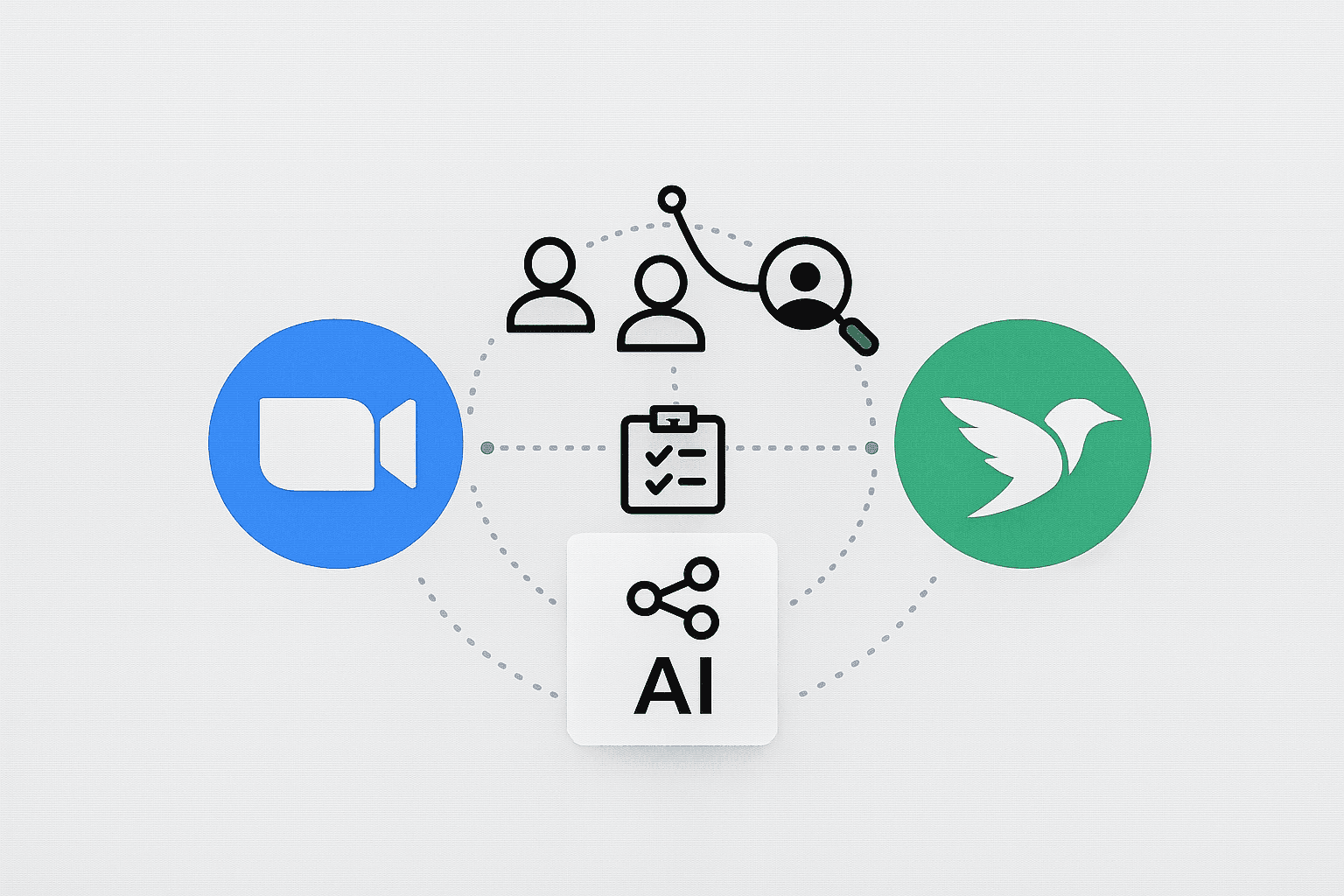
Zoom Acquires BrightHire: Strategic Entry Into Talent Intelligence
Acquisition overview: Deal structure and strategic rationale
Zoom Video Communications and BrightHire announced their definitive acquisition agreement on November 13, 2025 through coordinated blog posts from both companies. The transaction is expected to close "in the coming weeks" pending standard conditions, with BrightHire CEO Ben Sesser and the entire team joining Zoom upon closing.
Financial terms remain undisclosed, following Zoom's pattern for smaller strategic acquisitions. BrightHire had raised $36 million across three funding rounds: a $3 million seed in September 2020, $12.5 million Series A in May 2021 led by Index Ventures, and $20.5 million Series B in October 2021 led by 01 Advisors with participation from Index Ventures and Zoom Apps Fund. This prior investment relationship established a partnership foundation, with Zoom stating they had "worked closely together since 2021 to deliver top-tier integrations for customers."
Strategic rationale from leadership
Zoom Chief Strategy Officer Abhisht Arora articulated the acquisition's strategic logic: "Behind every successful organization are the people who power it. Yet hiring remains one of the most challenging and subjective parts of business, riddled with manual steps, scattered notes, and gut decisions that can miss great talent." He positioned BrightHire as addressing a critical gap where millions of interviews already occur on Zoom's platform annually but lack structured intelligence.
The acquisition completes Zoom's talent lifecycle strategy. Arora emphasized: "With BrightHire joining Zoom and Workvivo, we're creating a seamless talent journey from discovering and hiring the right people to inspiring and engaging them once they join. It's all part of our vision for a more connected, intelligent workplace." This connects hiring intelligence (BrightHire) with employee engagement (Workvivo, acquired 2023) and collaboration (Zoom Workplace) into an integrated platform.
BrightHire CEO Benjamin Sesser stated: "Together, BrightHire and Zoom are combining the best in hiring, communication, and workplace AI to transform how the world hires. Zoom shares our vision and values. This partnership gives us access to world-class technology, scale, and AI expertise — accelerating our roadmap and expanding our ability to give everyone the hiring experience they deserve."
Operating model and integration approach
BrightHire will continue as a standalone brand within Zoom, mirroring the Workvivo acquisition model. The platform will maintain cross-platform compatibility, continuing to support Google Meet, Microsoft Teams, and competing video conferencing solutions rather than becoming Zoom-exclusive. All existing customer data, integrations with applicant tracking systems (ATS), and workflows remain intact with no immediate pricing changes announced.
This approach balances independence with synergy: BrightHire maintains its separate identity and customer relationships while gaining access to Zoom's resources, AI capabilities, scale, and distribution. Future enhancements will include "new capabilities powered by Zoom's AI and communication technology" and "deeper integrations, especially with Zoom."
BrightHire background: The interview intelligence category creator
Company founding and leadership
BrightHire was founded in 2019 by childhood friends Benjamin (Ben) Sesser (CEO) and Theodore (Teddy) Chestnut, who grew up together in Montclair, New Jersey. The founding team identified a critical gap after extensive talent acquisition research: even at a 13,000-employee company, the head of talent acquisition didn't know what questions interviewers were asking. They recognized hiring decisions relied on "fuzzy memory, gut feelings, scattered notes, and bias" rather than rigorous data and analysis.
The company exited stealth mode in September 2020 with $3 million in seed funding from Flybridge Capital Partners, establishing itself as the pioneer of the "interview intelligence" category. By May 2021, BrightHire reported 70x year-over-year revenue growth and had 20,000+ interviews conducted on its platform. Just five months later in October 2021, the company secured its Series B with metrics showing 4x revenue run rate growth and 3x customer count growth in that short period.
BrightHire assembled a world-class advisory board including Adam Grant, Ph.D. (Wharton organizational psychology professor), Laszlo Bock (former Google SVP of People Operations, Humu founder), and investors including Dick Costolo (former Twitter CEO, 01 Advisors co-founder) and Jeff Weiner (former LinkedIn CEO) through Next Play Ventures.
Product platform and technology
BrightHire created the interview intelligence category as distinct from traditional applicant tracking systems, video interviewing tools, or general meeting assistants. The platform transforms the hiring process through several integrated capabilities:
AI-Powered Interview Planning: Automated job description creation with inclusive language scanning and bias detection; structured interview plan generation in minutes; AI copilot for end-to-end interview planning.
Interview Capture and Recording: Compliant recording and transcription across multiple video conferencing platforms; deep integration with Zoom, Google Meet, and Microsoft Teams; real-time interview guidance and prompts for interviewers.
AI Interview Notes and Highlights: Automatic transcription of all interviews; AI-generated interview summaries and notes; intelligent highlight creation of key moments; topic extraction and candidate answer compilation. BrightHire reports interviewers submit feedback 28% faster with these features.
BrightHire Screen (AI Interviewer): Automated two-way AI screening interviews using voice-based conversational AI; custom question generation with intelligent follow-ups; automated scoring using defined rubrics; candidates can complete interviews anytime on any device. This capability is built on insights from 3+ million real interviews conducted on the platform.
Analytics and Insights: Interview quality assessment and coaching; bias detection and DEI insights; interviewer performance analytics; data-driven hiring decision support; pattern identification across interviews.
ATS Integration: Seamless integration with major applicant tracking systems including Greenhouse, SmartRecruiters, Lever, Workday, and others; one-click scorecard completion directly in ATS; automated feedback workflows.
The platform achieved SOC 2 Type II certification in December 2021, demonstrating enterprise-grade security. BrightHire emphasizes "responsible AI" with an independent AI bias audit completed, Zero Data Retention programs with AI sub-processors, human-supervised quality assurance, and an AI Governance Committee overseeing development. The company's AI philosophy positions technology as augmenting rather than replacing human decision-making.
Customer base and market traction
BrightHire serves 300+ leading talent teams across "hundreds of enterprises" before the acquisition. Notable customers span multiple high-growth sectors:
Technology: Canva, Duolingo, Zapier, Lattice, Intercom, HubSpot, Greenhouse (also a partner), Rippling
Fintech: Ramp, SoFi, Array
Healthcare: HCA Healthcare, Devoted Health
Transportation/Logistics: Instacart, Lucid Group
Other enterprises: Toast, Justworks, Chainalysis, Better Mortgage, Handy, Scale.ai, Mural, InVision, Salesloft, Angi
The platform has processed over 3 million interviews with 10,000+ daily active users. Customer base quality is notable: at Series A, BrightHire counted 8 unicorn companies (valued over $1 billion) among its customers.
Funding history and growth trajectory
Total funding raised: $36 million across three primary rounds:
Seed Round (September 2020)
: $3 million led by Flybridge Capital Partners with 8 total investors including Bossa Invest and Ground Up Ventures
Series A (May 26, 2021)
: $12.5 million led by Index Ventures (Shardul Shah joined board) with participation from Next Play Ventures (Jeff Weiner's fund), Flybridge, Ground Up, and notable angels including Laszlo Bock and Gokul Rajaram; metrics at time: 70x YoY revenue growth, 25%+ month-over-month interview hour growth
Series B (October 7, 2021)
: $20.5 million led by 01 Advisors (Dick Costolo) with Index Ventures,
Zoom Apps Fund
, Ground Up Ventures, Haystack, and J Ventures; metrics at time: 4x revenue run rate growth since Series A (5 months prior), 3x customer count growth, 37% month-over-month interview volume growth
The Series B's inclusion of Zoom Apps Fund established the strategic relationship that ultimately led to the acquisition four years later.
Awards and market recognition
BrightHire won the 2022 HR Tech Awards as "Best Innovative Tech Solution" for Talent Acquisition by Lighthouse Research & Advisory, a designation given to approximately 1% of 5,000+ HR tech firms. The company established partnerships with major platforms including Greenhouse (recognized as innovative DEI solution) and SmartRecruiters (2022 interview intelligence integration announcement).
Customer impact metrics demonstrate strong value proposition: 35% increase in pipeline throughput, 28% increase in scorecards submitted, 27% fewer interviews needed per hire, 19% reduction in candidate withdrawals, 40% reduction in hiring time for some customers, and 75% reduction in recruiter ramp time for others.
Strategic analysis: Zoom's workplace platform transformation
Strategic fit and capability gaps addressed
The BrightHire acquisition fills a critical gap in Zoom's evolution from video conferencing tool to comprehensive workplace platform. Zoom CSO Arora stated: "BrightHire is a natural extension of Zoom's AI-first Workplace platform, expanding our offerings across mission-critical hiring and recruiting workflows."
The acquisition addresses several strategic imperatives:
Capitalizing on Existing Usage: Zoom hosts millions of interviews annually but captured no additional value from this usage. BrightHire monetizes and enhances these existing workflows rather than leaving value to third-party applications.
Completing the Employee Journey: The acquisition creates a comprehensive talent lifecycle suite spanning hiring (BrightHire) → onboarding/engagement (Workvivo) → collaboration (Zoom Workplace) → customer service (Zoom Contact Center). This positions Zoom as an end-to-end platform for the entire employee experience.
AI-First Platform Strategy Alignment: Both companies emphasize responsible AI with human-centric approaches. Arora noted: "Like Zoom, BrightHire is grounded in a responsible approach to AI. One of BrightHire's core values is to put candidates first — with AI designed to augment hiring, not replace human decision-making." This philosophical alignment facilitates integration with Zoom's AI Companion capabilities across products.
Addressing Critical Business Workflow: Hiring represents "one of the most challenging and subjective parts of business" according to Zoom, with manual processes, scattered notes, and subjective decisions. BrightHire transforms this with structured, data-driven approaches while maintaining the human element.
Zoom's M&A strategy evolution
The BrightHire acquisition reflects lessons learned from Zoom's M&A history, particularly the failed Five9 deal. In September 2021, Zoom attempted to acquire cloud contact center provider Five9 for $14.7 billion (all-stock, 13% premium), but Five9 shareholders rejected the deal. CEO Eric Yuan emphasized afterward: "Financial discipline is foundational to our strategy."
Post-Five9, Zoom pivoted to smaller, strategic acquisitions:
2022
: Solvvy (customer service AI)
2023
: Workvivo (employee engagement, acquired April 2023)
2024
: Bonsai (small business management)
2025
: BrightHire (hiring intelligence)
This pattern demonstrates a "partnership-first" approach: Zoom invested in BrightHire in 2021 through the Series B, developed deep integration and customer validation over 3+ years, then acquired after de-risking the relationship. CFO Kelly Steckelberg articulated Zoom's M&A philosophy in Q3 2024 earnings: "We look through a very strong lens evaluating first the technology and what it brings to customers, the culture to ensure it works well with Zoom, and the valuation to ensure it makes sense."
Consistent strategic themes across acquisitions:
Horizontal expansion building complete workplace platform
Vertical capabilities in specific workflows (customer service, HR)
AI enhancement and automation
"Buy vs. build" decisions for speed-to-market
The BrightHire deal exemplifies this disciplined approach: smaller transaction, proven partnership, clear strategic fit, cultural alignment, and platform completeness rather than transformational mega-deals.
Integration plans and product roadmap
BrightHire will maintain operational independence as a standalone brand (like Workvivo) while integrating capabilities with Zoom's platform. The company explicitly commits to remaining platform-agnostic, continuing support for Google Meet, Microsoft Teams, and other conferencing platforms alongside deeper Zoom integration.
Near-term integration priorities include:
Native BrightHire capabilities within Zoom Meetings interface for seamless activation
Integration with Zoom AI Companion for unified AI across hiring, collaboration, and customer service
Cross-platform insights and recommendations leveraging hiring data
Bridging BrightHire (hiring) with Workvivo (employee engagement) for onboarding workflows
Product roadmap implications extend Zoom Workplace's capabilities. The current Zoom Workplace (introduced 2024) includes Meetings, Team Chat, Phone, Mail, Calendar, Whiteboard, Docs, Scheduler, Clips, Zoom Rooms, Workspace Reservation, Workvivo (employee engagement), and Contact Center (customer service). Adding BrightHire creates a complete HR technology suite spanning the full employee lifecycle.
Future bundling strategy likely includes Zoom Workplace + BrightHire + Workvivo as a comprehensive platform, creating competitive positioning against Microsoft 365 + LinkedIn and positioning Zoom as a single-vendor solution for HR/IT buyers. This increases switching costs, expands total addressable market, and provides new upsell opportunities to Zoom's existing enterprise customer base.
Competitive positioning and defensibility
The acquisition establishes several defensible advantages:
Behavioral Data Moat: Millions of interviews on Zoom provide training data for AI models, creating network effects where more interviews improve AI, attracting more customers.
Distribution Advantage: Zoom's existing enterprise customer base provides built-in distribution for BrightHire capabilities without requiring separate go-to-market efforts.
Platform Lock-in: Bundled offerings increase switching costs as customers integrate hiring, engagement, and collaboration workflows.
Preemptive Move: Acquiring BrightHire before Microsoft/LinkedIn or Google/Meet develop competing capabilities establishes Zoom's position in high-value HR tech integration before the market consolidates.
The acquisition also defends against competitive threats. Microsoft possesses Teams (collaboration) and LinkedIn (professional networking, recruiting), creating natural advantages in HR workflows. Google offers Meet/Workspace with potential recruiting extensions. By acquiring the category-creating interview intelligence platform, Zoom establishes differentiated capabilities that neither competitor currently matches.
Market context: The interview intelligence opportunity
Market definition and size
Interview intelligence represents a specialized subcategory within talent acquisition technology, focused on recording, transcribing, analyzing, and extracting insights from hiring conversations. The category sits within the broader recruiting software market, which reached $3.02 billion in 2024 and is projected to grow to $5.58 billion by 2031 (9.2% CAGR).
The broader online recruitment technology market demonstrates even stronger growth: $13.20 billion in 2024 projected to reach $37.76 billion by 2032, driven by the shift from traditional to digital recruitment methods. Interview intelligence, as an AI-powered subsegment, likely grows faster than the overall market given AI adoption tailwinds.
AI recruitment market specific data (which includes interview intelligence): $661.56 million in 2023 projected to reach $1.12 billion by 2030 (6.78% CAGR in the enterprise segment). Current adoption rates show 65% of recruiters using AI in recruitment (2024) and 88% of recruiters expressing interest in adopting AI (2024), with majority adoption expected by 2025-2026.
Regional distribution shows North America commanding 35% global share (~$4.05 billion in online recruitment as of 2022), Europe as second largest, and Asia-Pacific as the fastest-growing region (~30% share) driven by India, China, and Japan.
Competitive landscape analysis
The interview intelligence space features multiple tiers of competition:
Tier 1 - Established Interview Intelligence Platforms:
Metaview (founded 2020): Recently raised $35 million Series B led by GV (Google Ventures) in June 2025, specializing in automated note-taking for recruitment interviews with strong candidate relationship management. Named a "Highflier" among interview intelligence platforms.
HireVue (founded 2004): Enterprise-grade platform combining video interviewing, AI assessments, and conversational AI with $35,000+ annual pricing for Essential packages. Strong in high-volume hiring with 1,000+ job-specific interview guides vetted by IO psychologists.
Spark Hire (founded 2012): Serves 7,000+ organizations globally with both one-way (asynchronous) and live video interviews, starting at $149/month (Lite plan). Popular with staffing agencies and SMBs with strong customer service reputation.
Tier 2 - Emerging Players: Interviewing.io (technical interview platform), Avoma (meeting assistant extending into recruitment), Humanly (AI screening automation), Noota (conversation intelligence with detailed metrics), Luma (interview coaching focus), Hireguide (AI-driven notes for evidence-based hiring), BarRaiser (comprehensive platform with performance reports).
Tier 3 - Adjacent Competition: General meeting assistants (Otter.ai, Fireflies.ai, Fathom) expanding from meeting transcription into recruiting; conversational AI recruiters (Paradox, XOR.ai) handling early-stage engagement; assessment platforms (CodeSignal, HackerRank, TestGorilla) with interview components.
ATS vendors building native features: Greenhouse, Lever, Workday, and other applicant tracking systems are embedding interview capabilities, though typically with less depth than specialized tools. Greenhouse holds 24% mid-market share with 4,500+ companies and 20,294 total customers, while Lever has 9,023 companies globally with the highest candidate experience ratings.
Platform threats: Microsoft Teams (700+ app integrations including HR categories), Google Meet/Workspace (200+ integrations), and now Zoom with BrightHire pose the most significant long-term competitive threat as they can bundle interview intelligence with core collaboration infrastructure.
Market trends driving demand
AI Adoption Surge: AI use in HR climbed to 43% in 2025 (up from 26% in 2024) according to SHRM. BCG survey shows 70% of companies using AI/GenAI in HR are deploying in talent acquisition. Primary use cases include content creation (70%), administrative tasks (70%), candidate matching (54%), resume screening, and interview intelligence. Gartner predicts by 2027, 80% of recruiting vendors will have embedded AI capabilities and 75% of hiring processes will include AI proficiency certifications.
Remote and Hybrid Work Permanence: As of Q3 2025, 64% of U.S. jobs are fully on-site (declining from 68% in 2023), 24% hybrid (growing from 21%), and 12% fully remote (stable). Critically, 98% of workers want remote work at least some of the time and 69% would accept salary decreases to work remotely. By 2028, 73% of departments expected to have remote workers. This permanent shift creates sustained demand for video interview technology and intelligence platforms.
Structured Interviewing and Compliance: Legal requirements drive adoption. NYC Local Law 144 requires bias audits and candidate notices for automated hiring tools. The EU AI Act's general purpose AI obligations began August 2025. Rising lawsuits (Workday AI bias lawsuit seeking collective action status) increase demand for documented, structured, compliant interview processes. Interview intelligence platforms provide real-time guidance, automated scorecards, recording/transcription for compliance documentation, and bias detection.
DEI Initiatives: Despite political backlash, DEI hiring advertisements doubled between 2019-2023. 72% of Gen Z prioritize companies championing diversity. McKinsey research shows organizations with diversity are 35% more likely to outperform competitors. Interview intelligence supports DEI through structured questions ensuring consistency, recording enabling bias review, analytics identifying interviewer patterns and disparities, and training data for improving inclusivity.
Quality of Hire Priority: LinkedIn identifies quality of hiring as the #1 objective for recruiting professionals in 2024. 52% of candidates will decline offers after negative recruiting experience (BCG survey of 90,000 people). Interview intelligence directly addresses this through less distracted interviewers (note-taking automated), faster feedback cycles, transparent processes, consistent treatment, and reduced time-to-hire (BrightHire customers report 27% reduction).
Cost and Efficiency Pressure: 67% of hiring managers cite time-saving as primary AI benefit. 30% cost reduction per hire with AI tools. BrightHire specifically delivers 5+ hours saved weekly per recruiter, 28% faster feedback submission, and 40% reduction in hiring time for some customers. In an environment of economic pressure and constrained budgets, demonstrable ROI drives adoption.
Market consolidation dynamics
The HR tech sector is experiencing significant consolidation. SAP acquired SmartRecruiters in August 2025, and HR tech vendors raised $3.5 billion in the first half of 2025 according to industry reports. This consolidation reflects rising demand for AI recruitment technologies and the strategic importance of owning comprehensive talent acquisition capabilities.
The Zoom-BrightHire transaction is part of this wave, alongside other recent M&A activity. Metaview raised $35 million Series B in June 2025 from GV, signaling continued interest in the category. The market is moving toward platform consolidation where major collaboration providers (Zoom, Microsoft, Google) either build or acquire interview intelligence rather than leaving the market to standalone vendors.
Gartner assessment notes "no all-in-one recruiting technology platform satisfies all hiring needs," suggesting continued fragmentation with integration and partnership ecosystems remaining critical. However, the trend toward embedded AI capabilities (80% of vendors expected to have AI by 2027) and platform bundling indicates significant consolidation ahead.
Business impact analysis: TAM expansion and revenue implications
Total addressable market expansion
The BrightHire acquisition fundamentally expands Zoom's total addressable market (TAM) beyond communication infrastructure into HR technology and talent acquisition. This transformation positions Zoom as competing for larger enterprise wallet share across multiple budget categories.
Pre-acquisition TAM: Zoom's addressable market primarily consisted of unified communications, video conferencing, collaboration software, and contact center technology. Enterprise customers purchased Zoom for meetings, phone, chat, and related communication infrastructure.
Post-acquisition TAM expansion: The company now addresses the full employee lifecycle from candidate through employee engagement:
Talent acquisition software market ($3+ billion growing to $5.6 billion by 2031)
Interview intelligence and recruiting tech subsegment (fastest-growing AI-powered category)
Employee engagement and internal communications (Workvivo)
Collaboration and communication (core Zoom)
Customer service and contact center (Zoom Contact Center)
This positions Zoom to compete for Chief of Work Officer or Chief People Officer budgets rather than solely IT/CIO budgets, significantly expanding addressable spend per customer.
Revenue and growth implications
Zoom's enterprise revenue (customers with more than 10 employees) grew 5.9% year-over-year in Q1 FY2026, with the company focusing on customers with $100,000+ annual recurring revenue (ARR) for higher lifetime value. BrightHire's enterprise customer base provides immediate cross-sell opportunities.
Monetization opportunities include:
Upsell to existing Zoom customers: Millions of interviews already occur on Zoom. Converting these users to paid BrightHire subscriptions represents direct revenue uplift without new customer acquisition costs.
Platform bundling: Zoom Workplace + BrightHire + Workvivo as integrated offering enables premium pricing for comprehensive solutions, increasing average revenue per user (ARPU).
Customer retention: Bundled platforms with integrated workflows create switching costs, reducing churn and increasing customer lifetime value.
New customer acquisition: BrightHire's enterprise customer roster (Canva, Duolingo, Ramp, SoFi) provides entry points for full Zoom Workplace adoption at organizations that may use competing collaboration tools.
TAM expansion: Addressing hiring workflows opens relationships with HR/People leaders who may not be Zoom's traditional IT/communications buyer personas.
BrightHire's business metrics (though specific revenue figures remain undisclosed) demonstrate strong commercial traction: 300+ enterprise customers, 3+ million interviews processed, 10,000+ daily active users, 70x YoY revenue growth at Series A, 4x revenue run rate growth in 5 months between Series A and Series B. These growth rates, if sustained, represent meaningful revenue contribution potential.
Customer base expansion opportunities
BrightHire's customer profile skews toward high-growth technology companies, fintech, and digital-first enterprises — demographics that align well with Zoom's core customer base but extend into HR functions. Notable BrightHire customers include:
Technology sector: Canva, Duolingo, Zapier, Lattice, Intercom, HubSpot represent exactly the fast-growing, product-led companies that are ideal Zoom Workplace customers. Cross-selling collaboration, engagement, and hiring tools as integrated platforms is straightforward.
Fintech: Ramp, SoFi, Array represent rapidly scaling companies with aggressive hiring needs and sophisticated technology stacks. These customers value integrated platforms over point solutions.
Healthcare: HCA Healthcare represents large enterprise validation beyond technology sector, demonstrating BrightHire's applicability to traditional industries undergoing digital transformation.
The customer overlap analysis reveals multiple BrightHire customers already using Zoom for video but likely not fully monetized on Zoom Workplace bundles. The acquisition enables Zoom to deepen these relationships, expand into HR budgets, and create integrated workflows that increase stickiness.
Technology and intellectual property value
BrightHire brings significant technology assets beyond its customer base:
Proprietary Dataset: Over 3 million interviews conducted on the platform represent a massive proprietary dataset for training and improving AI models. This dataset includes transcriptions, outcomes, interviewer behaviors, candidate responses, and hiring decisions — creating a data moat difficult for competitors to replicate.
AI Capabilities: BrightHire's AI includes natural language processing for interview analysis, speech recognition, automated summarization, bias detection algorithms, skills extraction, candidate scoring models, and conversational AI (BrightHire Screen). These capabilities are independently audited for bias and built with Zero Data Retention programs, providing validated, responsible AI technology.
Integration Framework: Deep integrations with major ATS platforms (Greenhouse, Lever, Workday, SmartRecruiters) and video conferencing systems (Zoom, Teams, Google Meet) provide ready-made connectivity that would require significant engineering investment to replicate.
Category Creation IP: As the company that created the interview intelligence category, BrightHire possesses intellectual property around interview planning workflows, structured interview methodologies, coaching frameworks, and analytics approaches that define industry best practices.
Team and Expertise: BrightHire's team includes specialized talent in recruiting technology, conversational AI, responsible AI development, and enterprise HR workflows. The entire team joining Zoom preserves this expertise and accelerates Zoom's ability to innovate in the space.
The technology value is amplified by SOC 2 Type II certification, independent AI bias audits, GDPR compliance, and enterprise-grade security posture — certifications that take years to achieve and are table stakes for enterprise sales.
Competitive dynamics and strategic value
Beyond direct revenue, the acquisition creates strategic value through competitive positioning:
Preemptive Move Against Microsoft/LinkedIn: Microsoft's combination of Teams (collaboration) and LinkedIn (professional networking, recruiting) represents the most significant long-term competitive threat in workplace platforms. By acquiring BrightHire, Zoom establishes differentiated interview intelligence capabilities that Microsoft doesn't currently offer natively, despite LinkedIn's recruiting presence.
Defense Against Standalone Interview Intelligence: Metaview's $35 million Series B from GV in June 2025 signaled growing competition in interview intelligence. Acquiring the category leader prevents competitors from establishing dominant market positions.
Platform Completeness Narrative: The acquisition enables Zoom to pitch a complete workplace platform story — "hire, engage, and collaborate on one platform" — differentiating from point solutions and fragmenting the competitive landscape.
Enterprise Sales Leverage: Integrated hiring + engagement + collaboration provides enterprise sales teams with unique value propositions, potentially accelerating deal cycles and increasing contract sizes through platform purchasing rather than individual product sales.
Talent War Differentiation: In competitive labor markets, companies using Zoom's complete talent lifecycle platform can position this as competitive advantage in attracting candidates, providing an intangible but meaningful strategic benefit that drives platform adoption.
Industry expert commentary: Analyst perspectives and market reception
Analyst reactions: Surprise and validation
The acquisition announcement generated notable reactions from industry analysts and observers, with the dominant theme being strategic surprise at the specific deal combined with validation of the interview intelligence category.
Madeline Laurano, Founder of Aptitude Research, expressed surprise: "I did not see this coming. Interview Intelligence and AI Interviewing have been hot this year. And, the market just got more interesting with this acquisition." Laurano's commentary indicates the deal wasn't widely anticipated by close industry observers, suggesting Zoom moved quietly and strategically. Her assessment that the "market just got more interesting" implies the acquisition raises competitive stakes and validates the category's strategic importance.
Irwin Lazar, President and Principal Analyst at Metrigy, provided technical perspective: "Interesting move for Zoom as they acquire BrightHire… the BrightHire platform already incorporates some of the same AI capabilities available through Zoom AI Companion including meeting note capture, summarization, and action-item identification. This announcement reflects Zoom's growing effort to deliver vertical and horizontal specific solutions that leverage its AI and collaboration capabilities."
Lazar's observation about AI capability overlap raises questions about differentiation — if BrightHire and Zoom AI Companion share capabilities, what unique value justifies the acquisition? The answer appears to lie in vertical-specific application: while Zoom AI Companion provides general meeting intelligence, BrightHire delivers hiring-specific workflows, structured interview frameworks, ATS integrations, and recruiter-focused features that generic meeting AI cannot replicate. Lazar correctly frames this as Zoom's broader strategy to deliver vertical solutions rather than remaining a horizontal collaboration tool.
Mark Frien, HR Tech veteran and former VP at Oyster, provided strategic context about organizational evolution: "'Workplace' used to mean facilities... but increasingly it means the toolset we use to connect with each other whether in offices, hybrid models, or fully-distributed companies. Increasingly, executive oversight for internal use of these tools is rolling all the way up to a C-level executive, and oddball titles like Chief of Work Officer are starting to blend what used to be HR, Operations, IT, and other 'house' functions… If Zoom can be the platform that supplies an [executive] buyer of this kind with a full suite of enterprise tools for building and sustaining a great hybrid or distributed workplace, they will be increasingly indispensable as a workplace platform."
Frien's analysis identifies the structural shift in organizational purchasing: the emergence of Chief of Work Officer roles consolidating budgets across HR, IT, and operations creates opportunities for platforms that span these functions. Zoom's acquisition of BrightHire (HR/talent) and Workvivo (internal communications/HR) alongside collaboration tools positions the company to capture this consolidated buying pattern — a strategic insight the market is still processing.
Strategic assessment from industry observers
DHRMap provided detailed strategic analysis identifying five factors explaining the acquisition:
Native Interview Stronghold: "Millions of interviews already occur on Zoom. Integrating structured, AI-powered interview intelligence deepens Zoom's role in hiring rather than leaving the value capture to third-party apps." This highlights the defensive/offensive nature — Zoom either captures this value or cedes it to competitors.
Known Business Problem Solution: "Hiring remains subjective, inconsistent, and manually intensive. BrightHire brings automation, transcription, summarization, benchmarking, and behavioral insights—all areas where Zoom seeks to enhance workplace productivity." The acquisition addresses a well-defined pain point with proven solutions.
Strong Historical Alignment: "Zoom invested in BrightHire in 2021 through the Zoom Apps Fund, developed integrations with the platform, and witnessed its adoption firsthand. This existing partnership reduced acquisition risk and increased strategic clarity." The 4-year partnership de-risked execution.
Talent Lifecycle Strategy: "By combining BrightHire with Workvivo, Zoom is building a full employee journey—from first interview to employee engagement—creating a more seamless platform for HR and people teams." Platform completeness rather than point solutions.
Defensive & Offensive Move: "With AI reshaping recruiting, platforms such as Microsoft Teams, LinkedIn, and specialized talent intelligence providers are moving upstream. Acquiring BrightHire positions Zoom competitively in high-value HR and recruiting workflows." Preemptive positioning before competitive entrenchment.
These five factors collectively articulate a coherent strategic narrative that positions the acquisition as logical, timely, and well-executed rather than opportunistic or reactive.
Market context and consolidation trends
Reworked reported: "The HR technology sector has seen consolidation and strong investment momentum, with SAP acquiring SmartRecruiters in August 2025 and HR tech vendors raising $3.5 billion in the first half of 2025, according to industry reports. The activity mirrors rising demand for AI recruitment technologies that improve efficiency and candidate quality."
This context positions the BrightHire acquisition as part of a broader consolidation wave in HR tech, with larger enterprise software platforms (SAP, Zoom) acquiring specialized recruiting technology. The $3.5 billion in H1 2025 funding demonstrates robust investor appetite for the category, while consolidation suggests the market is maturing from standalone point solutions toward integrated platforms.
UC Today analysis provided demand-side perspective: "The acquisition arrives at a time when hiring teams are increasingly seeking tools that reduce administrative burden, improve consistency and provide data-driven insights. Many organisations still rely on ad-hoc interview processes, scattered notes and subjective assessments, which can make hiring slow, inconsistent and prone to bias."
This assessment identifies the market pull driving adoption: organizations recognize their interview processes are broken and actively seek solutions. The timing of Zoom's acquisition aligns with peak demand for these capabilities, reducing go-to-market risk.
Technology validation and IP value
The acquisition validates BrightHire's technology approach. Former Twitter CEO Dick Costolo (managing partner at 01 Advisors, which led BrightHire's Series B) previously noted that "hiring decisions often suffer from bias, memory gaps, and subjective assessments, and that BrightHire's technology could meaningfully address these structural weaknesses." Costolo's investment thesis proved correct, with Zoom ultimately acquiring the company four years after his fund led the Series B.
Adam Grant, Ph.D., Wharton professor and BrightHire advisor, stated: "BrightHire is the most compelling technology I've ever seen for making better hiring decisions." Grant's endorsement carries significant weight given his standing as a leading organizational psychology researcher and bestselling author. His strong statement suggests BrightHire's approach is academically sound and addresses real psychological challenges in hiring.
Laszlo Bock, former Google SVP of People Operations and BrightHire advisor, noted: "It's been amazing to watch them help customers reduce recruiter ramp time from months to weeks and reduce hiring time by 40%." Bock's perspective, informed by managing one of the world's most sophisticated talent organizations at Google, validates the quantitative impact metrics BrightHire delivers.
Challenges and concerns raised
Not all commentary was uniformly positive. Several analysts and observers raised legitimate concerns:
AI Capability Overlap: As Metrigy's Irwin Lazar noted, overlap between BrightHire and Zoom AI Companion features (transcription, summarization, action items) raises questions about whether the acquisition provides truly differentiated capabilities or primarily acquires customer relationships and vertical-specific packaging of similar underlying technology.
Regulatory and Trust Headwinds: Reworked highlighted: "Zoom's BrightHire acquisition reflects a wider market push to use AI to support, rather than replace, human interactions in workplace processes such as recruitment. Significant hurdles remain. Research shows 76% of job seekers expect humans to recognize their potential, and regulatory scrutiny is increasing as jurisdictions adopt requirements such as mandatory bias audits for AI hiring tools. Organizations deploying these systems must balance automation with clear human oversight to maintain trust and compliance."
The 76% of job seekers expecting human recognition statistic indicates potential candidate resistance to AI-mediated hiring, even with tools positioned as augmenting rather than replacing humans. Regulatory complexity (NYC Law 144, EU AI Act, varying state/country requirements) creates implementation challenges and potential legal risks.
Integration Execution Risk: While BrightHire will maintain its standalone brand, successful platform integration requires seamless data flows between Zoom Workplace, BrightHire, and Workvivo; unified pricing/packaging strategy; cross-platform user experience consistency; and maintaining BrightHire's cross-platform ethos (supporting Teams, Google Meet) while incentivizing Zoom adoption. These are non-trivial execution challenges that will determine whether the acquisition realizes its strategic potential.
Valuation Opacity: Financial terms were not disclosed, making it impossible for external analysts to assess deal valuation relative to BrightHire's fundamentals. With $20.5 million Series B valuation (at minimum) and estimated $2 million annual revenue per LeadIQ data, analysts cannot determine if Zoom paid premium multiples or acquired at distressed valuations. This opacity limits thorough financial assessment.
Absence of major media coverage
Notably, as of the research date (November 17, 2025), no dedicated coverage was found from Bloomberg, Wall Street Journal, Forbes, or major financial media outlets. No analyst reports were published by Gartner, Forrester, IDC, or Josh Bersin specifically on this acquisition. The deal generated coverage primarily in HR tech trade publications (UNLEASH, Staffing Industry Analysts, Reworked, HR Tech Feed) and collaboration/UC publications (UC Today, Newsweek) but not mainstream business press.
This limited coverage likely reflects the undisclosed financial terms and the relatively niche nature of interview intelligence software compared to Zoom's previous high-profile M&A attempts (Five9's $14.7 billion proposed acquisition generated extensive coverage). The muted media response doesn't necessarily indicate lack of strategic importance but rather the transaction's modest size in financial terms despite its strategic significance to Zoom's platform vision.
Expert consensus and outlook
The expert consensus suggests strategic logic and timing are sound, but execution challenges and market dynamics remain uncertain. The acquisition is best understood as part of Zoom's multi-year transformation from video conferencing utility to comprehensive "AI-first workplace platform" — a transformation accelerated by the pandemic but requiring sustained execution across acquisitions, product development, and go-to-market.
The surprise expressed by Aptitude Research's Madeline Laurano ("I did not see this coming") indicates Zoom moved strategically and quietly, executing against a coherent platform vision rather than reactive, opportunistic deal-making. The 4-year investment relationship (Zoom Apps Fund participation in 2021 Series B) demonstrates patient, deliberate strategy rather than impulsive acquisition.
The validation of interview intelligence as a strategic category justifies continued investment and attention. As one analyst summarized: with this acquisition, Zoom is betting that workplace platforms that own the full talent lifecycle from candidate to employee to collaborator will prove more defensible and valuable than point solutions in any single category. The market will test this hypothesis over the next 2-3 years as integration executes and competitive responses emerge from Microsoft, Google, and standalone vendors.
Conclusion: Platform consolidation and the future of work
Zoom's acquisition of BrightHire represents a strategic inflection point in the evolution of workplace platforms. The deal validates interview intelligence as a critical component of comprehensive work platforms while positioning Zoom to compete beyond its video conferencing origins into the full employee lifecycle.
The strategic logic is compelling: millions of interviews already occur on Zoom's platform, creating natural distribution for BrightHire's capabilities. The 4-year partnership since Zoom's 2021 investment de-risks execution. The combination of hiring (BrightHire), engagement (Workvivo), and collaboration (Zoom Workplace) creates a differentiated end-to-end platform that neither Microsoft nor Google currently matches, despite their broader market power.
Market tailwinds support the thesis. The recruiting technology market is growing 9%+ annually, AI adoption in HR surged from 26% to 43% year-over-year, remote work is permanent (98% of workers want flexibility), and regulatory requirements for structured, documented interviews are increasing. These trends create sustained demand for interview intelligence capabilities.
Yet execution challenges remain substantial. Integrating three acquisitions (Solvvy, Workvivo, BrightHire) while maintaining product velocity across core Zoom Workplace offerings tests organizational capacity. Maintaining BrightHire's cross-platform commitment while incentivizing Zoom adoption creates tension. Regulatory complexity in AI hiring tools and candidate skepticism (76% expect human recognition, 66% hesitant about AI screening) create adoption barriers.
The competitive response will determine ultimate success. Microsoft possesses Teams and LinkedIn — formidable assets in workplace and recruiting. Google's resources and Meet/Workspace platform provide foundation for competing offerings. Standalone interview intelligence vendors (Metaview with $35M from GV, HireVue's enterprise footprint) won't cede the market without sustained innovation.
The strategic bet underlying this acquisition is clear: workplace platforms that own comprehensive employee journeys from hiring through collaboration will prove more defensible and valuable than horizontal communication tools or vertical point solutions in isolation. Zoom is building this integrated platform through disciplined, strategic acquisitions after learning from the Five9 failure. Whether this vision succeeds depends on execution over the next 2-3 years — seamless integration, product innovation, go-to-market effectiveness, and ability to articulate value to the emerging Chief of Work Officer buyer persona.
The market has validated interview intelligence as strategically important. Zoom has positioned itself to capitalize on this validation. Now comes the hard part: delivering on the platform promise.
Ready for Better CX?

Whether you're selecting your CX technology stack or evaluating outsourcing options, InflectionCX is your go-to-partner. Contact us today.
AI Readiness Assessment
We map where AI fits in your operation. What's working, what's hype, what's actually worth doing.

Unified CX Outsourcing
InflectionCX runs contact centers where humans and AI operate as one system.