
Gannon Costello
CX Technology Analyst
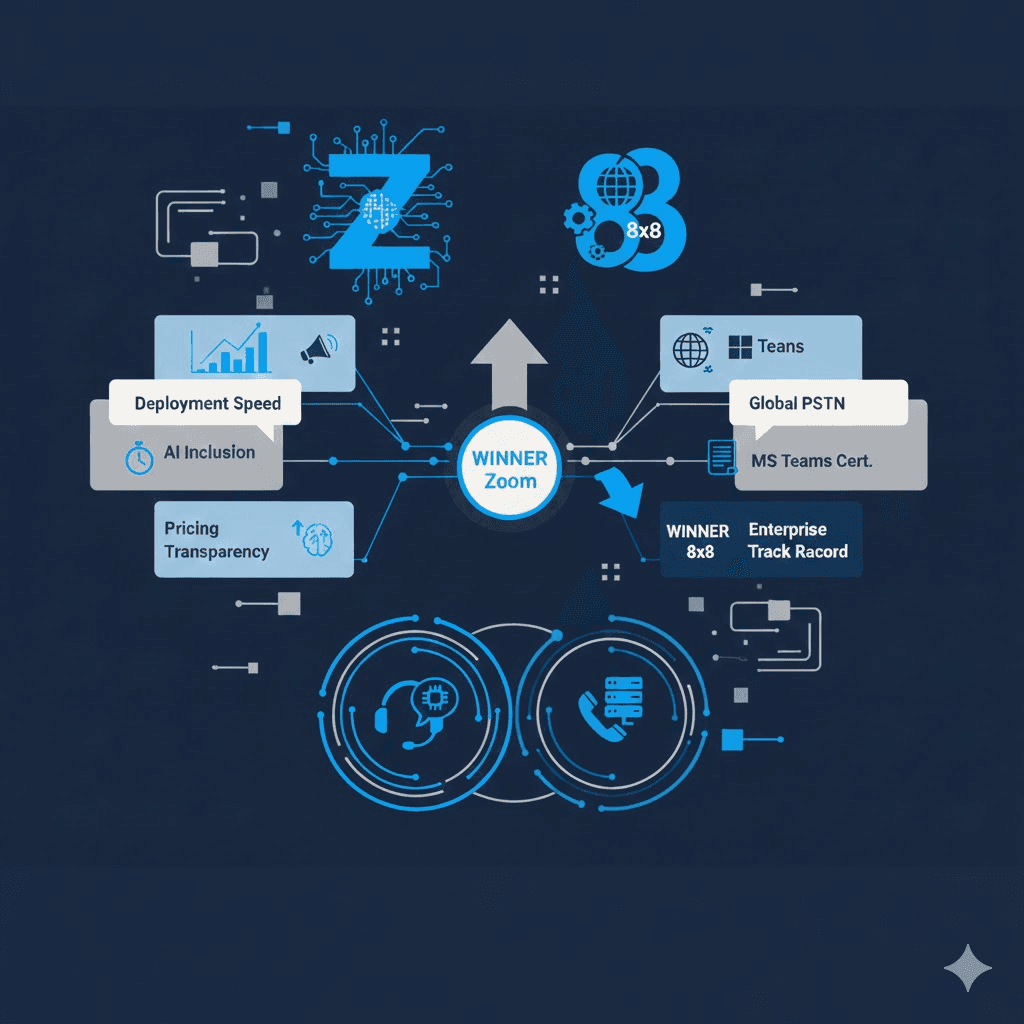
Zoom wins on deployment speed, AI inclusion, and pricing transparency. 8x8 wins on global PSTN coverage and Microsoft Teams certification. Neither wins on pricing honesty.
InflectionCX has guided dozens of migrations between these platforms. The patterns hold: Zoom deploys faster but carries a shorter enterprise track record. 8x8 offers deeper telephony but saddles organizations with split applications and opaque pricing.
Both vendors promise UC+CC integration on a single platform. They deliver it differently. This comparison breaks down where those differences cost you money and where they don't matter.
Who Should Pick Which (and Why)
Before the evidence sections below, here is the decision framework. Every detail that follows supports these recommendations.
Choose Zoom Contact Center if:
You already run Zoom Meetings, Phone, or Team Chat. Agents work in a familiar interface. Administrators manage fewer platforms. Training costs drop. Acceleraate's review notes that Zoom's single interface "hugely speeds up the onboarding process for new joiners."
AI-powered quality management and agent assistance are operational priorities. Zoom bundles AI Companion across all eligible Contact Center packages at no additional cost. At 150+ seats, the savings over 8x8's add-on model are substantial.
You need the platform running in weeks. Zoom implementations routinely finish in 2-6 weeks for standard deployments.
Your finance team wants published pricing they can model without waiting on a sales quote.
Your contact center operations are concentrated in North America or within Zoom's 47-country PSTN footprint.
Choose 8x8 if:
You need native PSTN in more than 47 countries. 8x8 covers 55+ countries natively.
Microsoft Teams is your primary collaboration platform and you need certified voice and contact center integration. 8x8 holds Microsoft certification that Zoom cannot match today.
You already run 8x8 Work and the switching cost outweighs the split-application friction.
You need a financially-backed 99.999% SLA across both UC and contact center. 8x8's combined SLA covers both; Zoom's applies specifically to the contact center.
You run complex outbound campaigns requiring predictive, progressive, and preview dialer modes with AMD and DNC filtering.
The rest of this piece is the evidence behind those recommendations.
At a Glance
Factor | Zoom Contact Center | 8x8 Contact Center | Edge |
|---|---|---|---|
Deployment Speed | Weeks (2-4 week implementations reported) | Months (3+ months for CRM integrations common) | Zoom |
Pricing Transparency | Published tiers starting at $69/month | Quote-only, no public pricing | Zoom |
AI Inclusion | AI Companion included at no additional cost | AI features require add-ons or top-tier plans | Zoom |
Ease of Use | Single interface for UC+CC | Requires separate 8x8 Work and Contact Center apps | Zoom |
Global PSTN Coverage | 47 countries | 55+ countries native | 8x8 |
Microsoft Teams Integration | Basic integration | Certified for both voice and contact center | 8x8 |
Enterprise Track Record | Newer to CCaaS (launched 2022) | 15+ years in contact center | 8x8 |
99.999% SLA | Contact center only | UC and contact center combined | 8x8 |
Sources: Zoom Contact Center Pricing, 8x8 vs Zoom Comparison, G2 Comparison
Analyst Recognition
Context matters before diving into features.
8x8 has appeared in Gartner's Magic Quadrant for UCaaS for fourteen consecutive years as of September 2025. The 2025 report named 8x8 a Visionary, highlighting UC+CC integration and midsize enterprise fit.
The CCaaS picture is different. NoJitter's analysis found that 8x8 was excluded from the 2025 Gartner CCaaS Magic Quadrant because it didn't meet the new inclusion threshold of averaging more than 100 seats per deployment. That reflects Gartner's shift toward mega-enterprise contact centers, not a capability judgment.
Forrester's Q2 2025 Wave positioned 8x8 as a Strong Performer, citing global telephony strength and high customer satisfaction.
Zoom Contact Center is newer to analyst coverage. It entered the market in 2022 and continues building its enterprise record. Gartner Peer Insights shows strong user ratings, with reviewers praising deployment speed and integration with the broader Zoom ecosystem.
The takeaway: 8x8 has deeper analyst validation for UCaaS. Zoom has momentum and velocity. Neither dominates CCaaS analyst rankings.
8x8's Split Application Problem
This is the single biggest operational issue in 8x8 deployments, and it comes up in nearly every client conversation we have about the platform.
8x8's UC and contact center products require separate applications. Agents run 8x8 Work for unified communications and 8x8 Contact Center for customer interactions. The two applications do not automatically synchronize presence.
The consequences are specific and measurable.
TrustRadius reviewers describe the problem directly: agents handling a contact center queue call can simultaneously receive a direct dial call on 8x8 Work. The system does not set the agent to unavailable across both applications. One reviewer noted it's "frustrating that you have to use 8x8 Work and 8x8 Contact Centre" and wished "both of the apps are integrated with each other."
The admin side compounds it. Gartner Peer Insights reviewers describe settings for "reporting, billing, contact center, and general UCaaS" as "separated into different platforms that are tied together, not one platform." Another reviewer summarized it as: "Admin panel is not intuitive and requires extensive training."
CRM integration adds another layer. 8x8's own documentation includes extensive troubleshooting guides for screen pop failures, SSO token termination, and permission conflicts between the Work and Contact Center applications.
Zoom Contact Center takes a different approach. Contact center functionality lives inside Zoom Workplace. Agents see queue status, direct calls, meetings, and chat in a single view. When an agent takes a contact center call, Zoom Workplace presence updates automatically. There is no second application to manage, train on, or troubleshoot.
G2's head-to-head comparison reflects the difference. Reviewers "found Zoom Contact Center easier to use, set up, and administer." For ongoing support, "reviewers felt that Zoom Contact Center is the preferred option."
This architectural gap matters most for operations with high agent turnover or seasonal staffing. Every additional application adds training time. Every disconnected system creates error surface. A retail contact center scaling from 50 to 200 agents for the holidays feels the training burden as direct operational cost.
AI Capabilities: Bundled vs. Add-On
AI features now drive CCaaS platform decisions. Both Zoom and 8x8 offer them. The delivery model creates a significant cost divergence.
Zoom's approach: AI Companion is included across all eligible Contact Center packages at no additional cost. Zoom's documentation confirms AI Companion provides call summaries, sentiment analysis, and real-time agent assistance across the board. One organization cited in Zoom's materials reduced "aftercall time from 4 and a half minutes to under 30 seconds" and "decreased call handle time by 3 minutes."
In December 2025, Zoom launched AI Companion 3.0 with agentic capabilities including personal workflows, retrieval across Zoom and third-party apps, and daily reflection reports. Zoom CEO Eric Yuan described the company's direction as building "an AI-first work platform."
8x8's approach: Advanced AI capabilities require separate purchases. 8x8's Engage FAQ states: "Conversation IQ (CIQ) is required for transcription of agent calls in UC... CIQ is available on a per-user basis and includes both Quality Management and Speech Analytics." Speech Analytics is separately required for contact center call transcription. Quality Management requires its own licensing for quality assessment.
The cost at scale is real. CloudTalk's 8x8 pricing analysis notes that "full-featured omnichannel access can cost up to $140/user/month (before add-ons). Many essential call center features like quality management, advanced analytics, or CRM integrations are only included in top-tier plans or behind custom quotes."
For a 150-seat operation requiring AI-powered quality management, the difference between bundled and add-on pricing compounds into six figures over a three-year contract.
Pricing Transparency
Zoom publishes three Contact Center tiers on its website:
Essentials: $69/month per user (voice, chat, SMS, video, AI Companion)
Premium: $99/month per user (adds email, social channels, outbound dialer)
Elite: $149/month per user (adds AI Expert Assist, Quality Management, Workforce Management)
8x8 publishes nothing.
As of Q1 2026, 8x8 requires a sales conversation for any pricing information. Nextiva's analysis confirms: "8x8 doesn't publish their prices directly on their website, so you need to contact them for a quote." Their last published plans ranged from $24-185 per user per month before they pulled the pricing page.
This opacity creates procurement problems. RFP timelines slip while waiting for 8x8 quotes. Budget planning requires assumptions instead of published figures. Competitive leverage disappears when you cannot verify what the other side charges.
CloudTalk's analysis identifies additional hidden costs: call center plan surcharges for features like outbound dialers and quality tools, and early termination fees that "could owe for the remainder of the contract, often $60-$200."
8x8 defenders point out that custom pricing allows negotiation flexibility. Fair enough. But custom pricing also enables price discrimination. Two similar organizations may pay vastly different rates for identical configurations, and neither would know.
Capterra reviews include complaints about pricing surprises and claims that "they quietly hiked up prices over time."
For operations leaders managing procurement, Zoom's published pricing provides planning certainty. You see the list price. You know your negotiated discount. You can model three-year TCO before signing anything.
Three-Year Total Cost of Ownership
Platform licensing is only part of total cost. Implementation, training, ongoing administration, and add-on licensing compound over time. The model below uses a 200-seat deployment at comparable feature tiers.
Zoom Contact Center (Elite tier, 200 seats)
Cost Category | Year 1 | Year 2 | Year 3 | Total |
|---|---|---|---|---|
Licensing ($149/seat/month) | $357,600 | $357,600 | $357,600 | $1,072,800 |
Implementation | $60,000 | $0 | $0 | $60,000 |
Training | $15,000 | $5,000 | $5,000 | $25,000 |
Admin overhead (FTE allocation) | $25,000 | $25,000 | $25,000 | $75,000 |
Total | $457,600 | $387,600 | $387,600 | $1,232,800 |
8x8 Contact Center (comparable tier + AI add-ons, 200 seats)
Because 8x8 does not publish pricing, we model three scenarios based on industry estimates and client experience:
Cost Category | Low ($150/seat) | Mid ($175/seat) | High ($200/seat) |
|---|---|---|---|
3-Year Licensing | $1,080,000 | $1,260,000 | $1,440,000 |
Implementation | $85,000 | $85,000 | $85,000 |
Training (dual application) | $45,000 | $45,000 | $45,000 |
Admin overhead (FTE allocation) | $120,000 | $120,000 | $120,000 |
3-Year Total | $1,330,000 | $1,510,000 | $1,690,000 |
Three-year difference vs. Zoom: $97,200 to $457,200 depending on 8x8's quoted rate.
Even at the low end of 8x8's pricing range, Zoom's bundled AI model and lower training and admin overhead create a cost advantage. At the mid and high end, the gap widens into territory that pays for an additional headcount or a meaningful technology investment elsewhere.
The key variables driving the difference:
AI licensing. Zoom bundles AI Companion. 8x8 charges separately for Conversation IQ and Quality Management.
Training. 8x8's dual-application model requires more training hours and ongoing reinforcement.
Admin overhead. 8x8's separate admin consoles require more FTE time for configuration and maintenance.
Plug your actual 8x8 quote into the model. If you don't have one yet, that's part of the problem.
Implementation: Weeks vs. Months
Zoom Contact Center implementations take 2-6 weeks for standard deployments and 8-12 weeks for complex integrations. Gartner Peer Insights reviewers confirm this: "The system was designed in a few weeks and was ready to go." Another reviewer detailed how "Zoom Professional Services provided more than adequate training opportunities" and that "planning and requirements gathering enabled design and setup to be well thought out."
The deployment speed comes from a few structural advantages. Organizations already using Zoom have administrators who understand the configuration model. The flow builder is visual and low-code. IVR trees and routing logic don't require deep technical resources. Most organizations maintain their own configurations post-implementation.
Zoom's technical library provides documentation with visual guides for flow configuration and routing setup that administrators can reference without calling support.
8x8 Contact Center implementations consistently take longer. SoftwareAdvice reviews document the pattern. One user reported: "It took 3 months to get it to successfully work with our CRM, which was the whole reason we went with 8x8." Another: "Implementation took an extremely long time, but we were compensated with free months of service." Others cite "complexity of setup of IVR" and "quite complicated way to set up scripts and hard to copy and paste in the structure, so a lot of manual work to program them."
Where 8x8 implementation excels: organizations with complex global telephony requirements find that 55+ country native coverage simplifies international deployments. Microsoft Teams shops benefit from the certified integration.
Where 8x8 implementation struggles: admin console complexity requiring extensive training, dual-application training tracks, and support responsiveness during the build. Gartner Peer Insights reviewers note: "Bad support with slow responses and not good advice. Frequent outages. Cost can balloon quickly."
Professional services cost ranges based on publicly available reports:
50-seat basic deployment: Zoom $15,000-25,000 / 8x8 $20,000-35,000
200-seat mid-market deployment: Zoom $40,000-75,000 / 8x8 $60,000-100,000
500+ seat enterprise: Both require custom scoping
Support Quality
Support separates vendors when things break. Both platforms carry mixed reviews with one notable difference.
Zoom reviews trend positive. Gartner Peer Insights reviewers describe working with Zoom as "a positive and professional experience." Zoom hosts monthly ZCC webinars where they answer questions live and demonstrate functionality. The G2 comparison notes: "When comparing quality of ongoing product support, reviewers felt that Zoom Contact Center is the preferred option."
8x8 reviews are more polarized. Positive: "Excellent customer support: the teams are responsive, available, and proactive." Negative: "Bad support with slow responses and not good advice." Trustpilot reviews surface cancellation difficulties: customers describe automated support loops that make it "nearly impossible to reach a real person." SoftwareAdvice reviewers describe "terrible support team" and "releases seem to break things" with deprecated functionality going unacknowledged for months.
Support quality at 8x8 appears to track with account size. Enterprise accounts with dedicated contacts report better experiences than mid-market accounts on standard support channels.
Enterprise Readiness: Reframing the Question
Enterprise buyers ask whether Zoom Contact Center is enterprise-ready in every evaluation. The concern is fair. Zoom entered CCaaS in February 2022. 8x8 has been at it for over 15 years.
The experience gap surfaces in specific places. 8x8 offers native PSTN in 55+ countries vs. Zoom's 47. 8x8 holds Microsoft Teams certification for both voice and contact center. Zoom's Teams integration remains more limited.
But enterprise readiness is more than a feature checklist. Operational complexity counts.
8x8 requires agents to run two separate applications. The presence sync gap creates confusion. The admin experience spans multiple consoles. Gartner Peer Insights reviewers describe Zoom as "easy to deploy" and "well integrated."
For a 200-seat contact center, the operational difference is substantial. Training time drops. Agent errors drop. IT support tickets drop.
The better question is: which enterprise problems are you solving? If you need native PSTN in 55+ countries, 8x8 is more ready. If you need agents to stop toggling between applications and you want AI capabilities included from day one, Zoom is more ready.
Beyond Platform Selection
Both Zoom and 8x8 sell platform consolidation. Neither fully delivers unified CX operations on its own.
Zoom consolidates the agent interface. UC and contact center live in one application. But Zoom's ecosystem remains separate from your CRM, your quality management workflows, and your AI governance. It handles customer interactions well. It does not handle the operational integration that ties those interactions to business outcomes.
8x8 consolidates telephony. UC and contact center share the same underlying phone system. But agents toggle between applications. Administrators manage separate consoles. The platform handles the pipes well. It does not solve the governance layer.
The gap between platform capability and operational reality is where most CX investments underperform.
When Zoom's AI Companion generates a call summary, who reviews it for accuracy before it enters your CRM? When 8x8's speech analytics flags a compliance risk, which system triggers the remediation workflow? When your AI agents handle 30% of interactions, who ensures they meet the same quality standards as your human agents?
Platform vendors solve platform problems. They provide infrastructure. They do not build the governance, quality standards, and analytics integration that turns platform capability into operational outcomes.
Metrigy's CX Optimization 2024-25 research found that more than half of companies with an integrated UC+CC platform reported higher revenues, improved employee productivity, improved CSAT, and reduced costs. Integration matters. But platform integration is only the foundation.
InflectionCX builds the layer above the platform. We implement Zoom Contact Center and 8x8 with unified governance: the same quality standards applied across AI-generated and human-generated interactions, single dashboards showing AI and human performance together, and frameworks that address who reviews AI outputs before they reach customers. The platform choice matters. What you build on top of it determines whether it pays off.
FAQ
Is Zoom Contact Center cheaper than 8x8?
For organizations requiring AI-powered quality management, yes. Zoom's published Elite tier at $149/month per user includes AI Expert Assist, Quality Management, and Workforce Management. 8x8 does not publish pricing, but industry estimates place comparable tiers at $95-140+/month before AI add-ons like Conversation IQ and Quality Management. The bundled vs. add-on difference compounds to 15-25% lower TCO for Zoom over three years at mid-market scale. Organizations running basic inbound voice without AI requirements may see less cost difference.
Can I migrate from 8x8 to Zoom without downtime?
With proper planning, yes. Most migrations run both platforms in parallel during a transition window, porting numbers in batches. Gartner Peer Insights reviewers report 4-8 weeks for mid-sized migrations. Start CRM integration testing before cutover. Route traffic gradually and validate the Zoom configuration before completing the switch.
Does Zoom Contact Center work with Microsoft Teams?
Zoom integrates with Teams for presence and basic collaboration. 8x8 offers deeper integration with Microsoft certification for both voice and contact center. 8x8's materials emphasize: "Only 8x8 delivers certified Teams solutions for both voice and contact center." If Teams is your primary UC platform, 8x8's certified integration is stronger. If you run Zoom Workplace as your primary UC, the Teams question is irrelevant.
Which platform has better AI?
Feature parity is close. Both offer call summaries, sentiment analysis, and agent assistance. The difference is the delivery model. Zoom includes AI Companion at no additional cost. AI Companion 3.0 added agentic workflows and cross-platform context. 8x8 structures comparable features as add-ons per their documentation. Organizations planning heavy AI use save money with Zoom's bundled approach.
How long does implementation take?
Zoom: 2-6 weeks standard, 8-12 weeks complex. 8x8: plan for 3+ months if CRM integration is involved. The gap comes from admin complexity and the dual-application training requirement on 8x8's side.
Next Steps
Choosing between these platforms requires mapping capabilities to your specific operational requirements. The real evaluation questions are specific: How many countries need PSTN coverage? What is your Microsoft Teams commitment? How fast must you deploy? What does your AI governance model look like? How will you measure quality across AI and human interactions?
If you want help modeling the comparison against your actual requirements, InflectionCX runs platform evaluations grounded in operational reality. We will tell you which platform fits and, more importantly, what to build on top of it.
More in Analysis


Ready for Better CX?

Whether you're selecting your CX technology stack or evaluating outsourcing options, InflectionCX is your go-to-partner. Contact us today.
AI Readiness Assessment
We map where AI fits in your operation. What's working, what's hype, what's actually worth doing.

Unified CX Outsourcing
InflectionCX runs contact centers where humans and AI operate as one system.