
Sarah Mitchell
CX Industry Analyst
The short version:
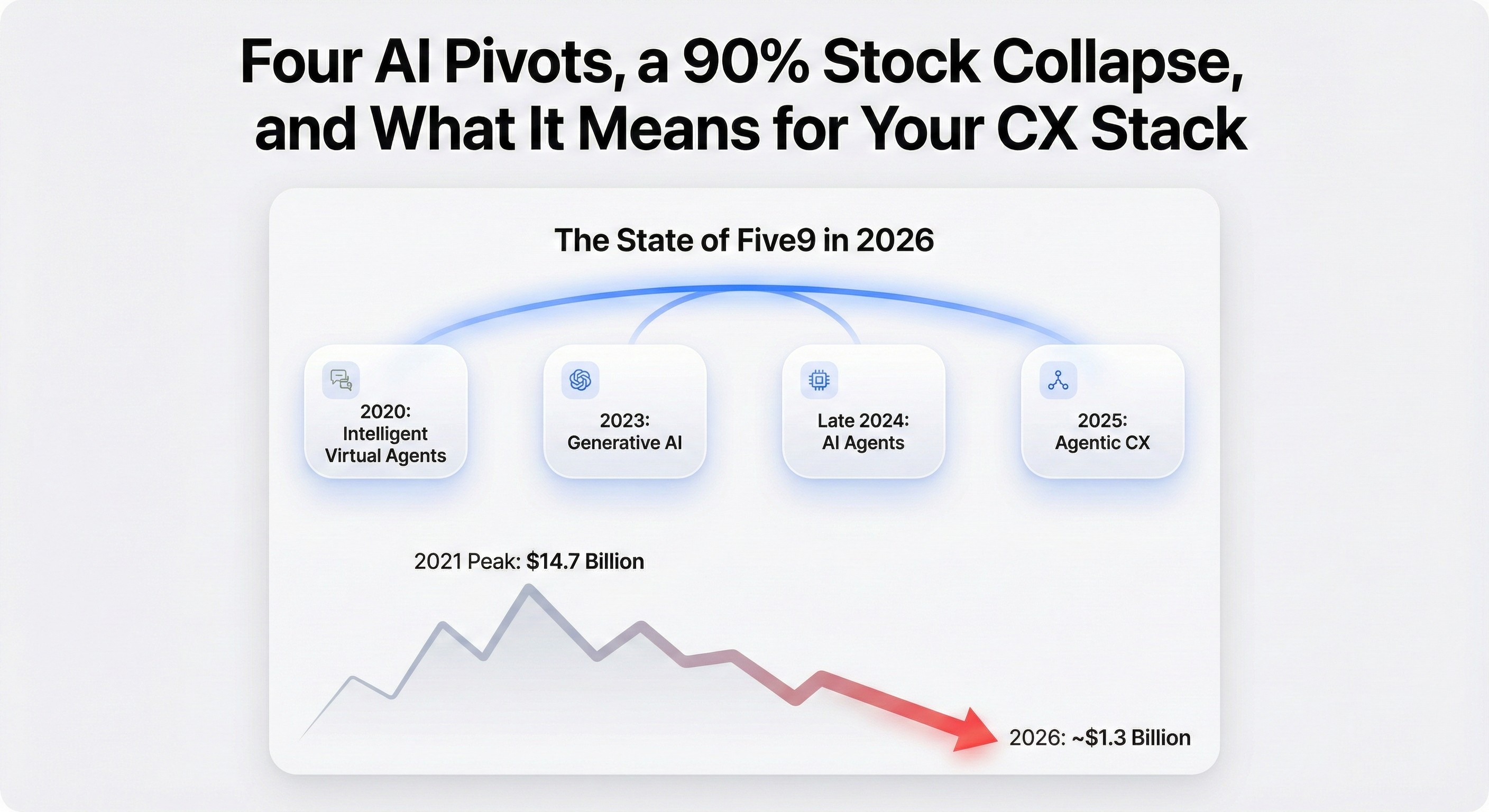
Five9 has cycled through four distinct AI branding strategies in three years — from Intelligent Virtual Agents to Generative AI to AI Agents to Agentic CX — while its stock price dropped roughly 90% from its 2021 peak, its CEO retired mid-crisis, three senior executives were ousted simultaneously, activist investors pushed for a sale, and a securities class action was filed alleging the company misled investors about business momentum. Customers across every major review platform report persistent reliability issues, opaque pricing with $5,950/month minimums, and AI features that underdeliver on marketing promises. If you're evaluating or currently running Five9, this is the context your rep isn't sharing.
The $14.7 Billion Question
In the summer of 2021, Five9 was worth $14.7 billion. Zoom Video Communications wanted to buy the company at that price — an all-stock acquisition that would have married Zoom's massive UCaaS distribution with Five9's deep contact center functionality. Five9's shareholders said no. The premium wasn't rich enough: only 13%, compared to the 23% Microsoft paid for Nuance around the same time. Zoom's own stock was declining, reducing the effective deal value. And the Department of Justice had opened a national security review of the transaction.
Those were defensible reasons in September 2021.
By early 2026, Five9's market capitalization sits around $1.3 billion. The stock, which peaked above $209 per share during those acquisition talks, recently hit a 52-week low of $16.18. A company that rejected a $14.7 billion exit has watched roughly 90% of that value evaporate in four years.
That single data point should shape every conversation about Five9's current positioning, its AI strategy, and whether the platform represents a safe long-term bet for your contact center operations. Not because stock price directly affects call quality — but because a company under this level of financial stress, leadership turnover, and activist investor pressure is not operating from a position of strategic clarity. It's operating from survival mode.
And that changes everything about how you should evaluate what Five9 is telling you.
Meanwhile, Zoom built its own contact center from scratch after the deal collapsed. CEO Eric Yuan was characteristically direct about it: the Five9 acquisition, he said, "was in no way foundational to the success of our platform nor was it the only way for us to offer our customers a compelling contact center solution." Three years later, Zoom Contact Center has over 1,100 customers, earned first-time inclusion in the 2025 Gartner Magic Quadrant for CCaaS, and is winning competitive displacements against established incumbents — including deals with a Fortune 100 company running 15,000 agents and Spain's national revenue service at 20,000 agents.
The irony is structural: Five9 rejected integration with the UCaaS platform that would have provided the unified communications backbone its customers now need, and in doing so, created the competitive threat that's now eroding its market position.
We'll do a full head-to-head comparison of Five9 and Zoom Contact Center in a separate analysis. This piece is about Five9 alone — the full picture of what's happening inside the company, what customers are experiencing, and what it means for anyone building their CX operations on this platform.
Four AI Pivots in Three Years: A Timeline of Trend-Chasing
Every CCaaS vendor talks about AI now. That's table stakes. The question that separates genuine innovation from marketing theater is consistency: Has the vendor been building toward a coherent AI vision, or have they been renaming the same capabilities every time a new buzzword trends on LinkedIn?
With Five9, the timeline tells a clear story.
Phase 1: Intelligent Virtual Agents (2020–2022)
In November 2020, Five9 acquired Inference Solutions, a conversational AI company, and began heavily promoting Intelligent Virtual Agents as the future of customer self-service. By early 2022, Five9 was trumpeting 180% year-over-year growth in IVA usage across its platform. The term "Intelligent Virtual Agent" saturated Five9's marketing, press releases, analyst briefings, and product positioning throughout this period.
This was a legitimate capability. IVAs had been evolving across the industry for years, and Five9's investment through the Inference acquisition was real. The messaging was aggressive but defensible.
Then ChatGPT launched in November 2022, and everything changed — not about the technology, but about the marketing.
Phase 2: Generative AI (2023–2024)
Within four months of ChatGPT's public release, Five9 shipped "Agent Assist 2.0 with AI Summary," explicitly marketed as using "the same generative AI technology behind ChatGPT." The IVA messaging didn't disappear, but it was rapidly eclipsed by a new narrative: Five9 was now a Generative AI company.
By March 2024, Five9 launched GenAI Studio, calling it "the First Enterprise-Ready Solution Offering Click-and-Customize Generative AI for the Contact Center." Chief Technology Officer Jonathan Rosenberg declared that generative AI represented a revolutionary step forward. The conference stage backdrops changed. The website copy changed. The analyst pitch decks changed.
The underlying product? It evolved incrementally. A summarization feature here, a knowledge base enhancement there. Solid improvements, but nothing that justified the revolutionary framing. The revolution was in the branding, not the capability.
Phase 3: AI Agents (Late 2024)
In November 2024, Five9 unveiled "AI Agents" — which the company's own press release described as "the next-generation of Five9 Intelligent Virtual Agents (IVA) which incorporates Generative AI."
Read that description carefully. This wasn't a new product. It was the Phase 1 technology (IVAs) combined with the Phase 2 technology (Generative AI), repackaged under a Phase 3 label that happened to align with the industry's latest obsession: autonomous AI agents.
The tell is in Five9's own language. When your "next-generation" product is explicitly described as a combination of your two previous generations, you're not innovating. You're relabeling.
Phase 4: Agentic CX (2025–Present)
By late 2025, Five9 launched "Genius AI innovations to Accelerate Agentic CX" at its CX Summit, introduced a new brand identity to "better reflect its advanced AI capabilities," and positioned Chief Product Officer Ajay Awatramani to explain that "our Agentic CX vision is about creating systems that don't just respond but also help teams better understand and anticipate customer needs."
The vocabulary had shifted again. Not IVA, not Generative AI, not AI Agents — now it was Agentic CX. A term that conveniently encompassed everything Five9 had been selling for the past three years while sounding like the thing every analyst was predicting would matter next.
What the Pattern Reveals
Each rebrand followed the same cadence: a new AI term gains mainstream traction, and within three to six months, Five9's messaging pivots to adopt it. The underlying technology evolves incrementally and legitimately — Five9 does employ talented engineers building real features. But the marketing velocity outpaces the engineering velocity by an order of magnitude, and that gap creates a problem that shows up in customer reviews, analyst reports, and deployment realities.
The Cavell Group attended Five9's October 2025 Analyst Summit and offered a measured but revealing assessment. On the AI vision: "This vision is increasingly shared across the industry, but no vendor has yet achieved it at scale, which leaves execution, rather than aspiration, as the real battleground." On AI revenue contribution: approximately 10% of subscription revenue — roughly $100 million — "putting Five9 broadly in line with peers." Not ahead of peers. In line. On agentic AI specifically: "Conceptually powerful, but still immature across the market. No vendor has proven scale here."
Most telling was the customer feedback Cavell reported from the summit itself: initial vendor marketing had created "unrealistic expectations of rapid containment and instant ROI," and in practice, deployments required lengthy tuning cycles with low early containment rates.
When a vendor's own summit attendees are describing an expectations gap between marketing and delivery, that's not a competitive analysis talking point. That's a deployment risk factor.
The Numbers Behind the Narrative
The stock price decline anchors the story, but the financial details underneath it explain why this isn't a temporary market correction. This is a structural shift in how the market values Five9's business.
Revenue Growth Is Decelerating. Fast
Five9 crossed $1 billion in annual revenue for the first time in 2024: $1.042 billion, representing 14% year-over-year growth. That sounds respectable until you trace the trendline.
2021: 40% growth. 2023: 17% growth. 2024: 14% growth. Q3 2025: approximately 8% growth.
For a company whose entire stock premium was built on the assumption of sustained high growth, sub-10% growth isn't a soft landing. It's a thesis change. The dollar-based net retention rate — a key SaaS metric measuring whether existing customers are spending more or less over time — peaked at 123% in Q3 2021 and declined to 107% by Q1 2025. That's still above 100%, meaning Five9's customer base is expanding on average, but the velocity is slowing and the risk of contraction is growing.
AI revenue is growing at 41–46% year-over-year and contributes approximately 10% of subscription revenue — around $100 million. That sounds promising in isolation. But as the Cavell Group noted, this puts Five9 "broadly in line with peers," not ahead of them. And here's the structural problem Piper Sandler identified in their January 2026 downgrade: AI concerns "continue to impact primarily seat-based models like Five9's."
This is an existential observation about Five9's business model, not just its stock price. If AI automation reduces the number of human agents a contact center needs — which is the explicit promise every CCaaS vendor, including Five9, is making — then per-seat pricing models face structural headwinds. Five9's entire revenue base is built on per-seat pricing. The company is simultaneously promising AI will reduce agent headcount while depending on agent headcount for revenue. That tension doesn't resolve itself with a rebrand.
Wall Street Has Lost Patience
Piper Sandler's downgrade to Neutral came with a target of $21 (from $26) and a blunt assessment: Five9 "is not gaining share within the CCaaS segment" and faces "positioning challenges in the upmarket segment." Their suggestion — "the best medium-term path for the company might be to go private" — is not standard analyst language. It's a signal that the public-market story may be over.
They weren't alone. Wells Fargo cut their target to $22. Baird cut to $24. DA Davidson cut to $24. Weiss Ratings issued an outright Sell recommendation with a D+ grade.
Morningstar assigned Five9 a no-moat rating, concluding that Five9 "will need to continue to invest heavily in go-to-market efforts and product innovation to attract and retain new clients, weighing on profitability upside." Translation: Five9 doesn't have a defensible competitive advantage that protects its market position, and maintaining relevance will be expensive.
The Securities Class Action
On December 4, 2024, a securities class action was filed against Five9 covering the period from June 4 through August 8, 2024. The lawsuit alleges Five9 made materially misleading statements about business momentum, telling investors that net new business was "strong irrespective of the macro" while the company was actually experiencing what it would later describe as "a challenging bookings quarter."
On August 8, 2024 — the day Five9 disclosed the actual state of its business and cut annual revenue guidance — the stock dropped 26.5% in a single trading session.
The class action is still in its early stages and no outcome has been determined. But for current and prospective Five9 customers, the allegation itself is relevant context: a company facing claims that it misrepresented its own business trajectory to Wall Street while simultaneously marketing AI capabilities that customers say underdeliver creates a credibility question that extends beyond the courtroom.
Leadership Turmoil: Three Waves of Instability
A contact center platform is a mission-critical system. When you evaluate vendor stability, leadership continuity matters because it signals whether the company can execute a coherent multi-year strategy or whether it's in perpetual reaction mode. Five9's leadership timeline over the past eighteen months reads like a crisis management case study.
The CEO Transition
Mike Burkland, who had led Five9 through its growth phase, stepped down as CEO in late 2022 due to health issues. He returned in a different capacity but announced his permanent retirement in July 2025, citing ongoing cancer treatment, with a transition to Executive Chairman. CFO Barry Zwarenstein also departed.
A new CEO, Amit Mathradas, was named in December 2025 and took the role effective February 2, 2026. Mathradas comes from Nintex, which he described as an "AI-centric, agentic business orchestration platform," and previously served as COO at Avalara. He's a credible executive with relevant experience. But he's inheriting a company in mid-crisis — declining growth, activist pressure, a securities lawsuit, demoralized employees, and an AI strategy that has prioritized branding over delivery.
New CEOs typically get a 90-day honeymoon. What Mathradas does with that window will tell you more about Five9's future direction than any marketing announcement.
The July 2025 Purge
In the same month that Burkland announced his retirement, three senior executives were removed simultaneously: CMO Niki Hall, EVP of Corporate Strategy Jim Doran, and Head of Human Resources Tricia Yankovich. Lead Independent Director David Welsh retired from the board after 14+ years in September 2025.
When a company removes its CMO, its head of strategy, and its head of HR at the same time, that's not normal organizational evolution. That's a board-level intervention. It suggests the people responsible for Five9's market positioning, strategic direction, and internal culture were deemed misaligned with whatever comes next — whether that's a turnaround, a sale, or something else entirely.
Three Rounds of Layoffs in Twelve Months
Five9 had never conducted layoffs in its 20+ year history. Then it conducted three rounds in twelve months.
August 2024: approximately 180 employees, roughly 7% of the workforce. April 2025: approximately 120 employees, about 4%. July–August 2025: a third wave, coinciding with the executive departures.
For buyers, the people implications are direct: your implementation team, your support contacts, your account managers — these roles have been hit by three rounds of reductions. Institutional knowledge walks out the door with every layoff, and the remaining team is operating under the stress of wondering whether another round is coming.
Employee reviews on Glassdoor paint a grim internal picture. One review from November 2025 described a company with "no vision or solution for declining stock price" where the CEO "blames everyone else, including investors for not understanding Five9's AI play, or lack of one." The review characterized the work environment as "the most negative, toxic environment I've ever worked in." Glassdoor employee satisfaction declined 7% over twelve months, with only 52% of employees expressing a positive business outlook.
Employee posts on TheLayoff.com describe low morale, fears of additional cuts, speculation about restructuring consultants from AlixPartners being engaged, and concerns about a possible sale. Whether or not these specific claims are accurate, the volume and consistency of internal discontent is itself a signal.
Activist Pressure and Sale Speculation
Anson Funds, an activist hedge fund, amassed a position in Five9 beginning in mid-2024 and publicly pushed the company to explore a sale. Additional activist firms, including Legion Partners and Scalar Gauge, also engaged. By December 2024, Five9 settled with Anson, granting portfolio manager Sagar Gupta a board seat.
CNBC reported a detail that's easy to miss but significant for long-term platform planning: Five9 renewed its change-of-control severance agreement for only one year in 2024. Previous renewals in 2014 and 2019 were for five years. A shorter renewal horizon suggests the board may be positioning for a transaction — a sale, a merger, a take-private — that would trigger those change-of-control provisions.
Speculated acquirers have included ServiceNow, Salesforce, Zoom (returning to the table after being rejected twice), Oracle, Genesys, and various private equity firms. Any of these scenarios would mean a potential change in product roadmap, support structure, pricing model, and strategic direction for existing Five9 customers.
If you're signing a 36-month Five9 contract today, you should be thinking about who might own your platform by the time that contract expires.
What Customers Are Actually Saying
Analyst reports and financial data tell the strategic story. Customer reviews tell the operational one. What follows is aggregated not for sensationalism but for pattern recognition — these are the themes that appear consistently across G2, Gartner Peer Insights, Capterra, TrustRadius, GetVoIP, and Trustpilot.
Pricing: The Pain Point That Unites Everyone
Five9 requires a 50-seat minimum across all plans, a 36-month contract commitment, and uses quote-based pricing on three of its five tiers. The entry point — 50 seats at $149 per user per month on the Core plan — creates a minimum commitment of approximately $5,950 per month, or roughly $214,000 over the life of the contract.
For context, here's how that stacks up:
Five9 | Zoom Contact Center | |
|---|---|---|
Entry-level price | $149/user/month | ~$69/user/month |
Mid-tier price | $179/user/month | ~$99/user/month |
Enterprise price | $229/user/month | ~$149/user/month |
AI capabilities | Add-on cost | Included at all tiers |
Minimum seats | 50 | None published |
Standard contract | 36 months | Flexible |
Minimum monthly spend | ~$5,950 | ~$69 |
Advanced capabilities — AI features, workforce management, quality management, analytics — are gated behind higher tiers or sold as add-ons with opaque pricing. The Salesforce connector alone reportedly costs around $13,000. The Master Services Agreement includes provisions that catch customers off guard: PSTN connections billed as outbound calls for the entire connection duration, a 5% annual price increase baked into renewals, and auto-renewal clauses requiring 30 days' written notice to cancel.
Customer language on pricing is consistent and blunt. A fifteen-year Five9 customer on Capterra wrote in 2025 that the platform "has declined terribly with a much much higher cost." A TrustRadius reviewer noted that Five9 was "overpriced" and that the "bang for the buck just was not where it needed to be." A GetVoIP reviewer stated simply: "They charge for every little thing they can get away with."
When your longest-tenured customers are your most vocal critics on pricing, the problem isn't perception. It's value delivery.
Reliability: 444+ Tracked Outages Since 2021
Call quality, dropped calls, and system crashes represent the most frequently cited complaint category across every review platform. Five9 has logged over 444 tracked outages since December 2021, according to CallTower's monitoring data.
A September 2025 Capterra reviewer described the situation: "Call stability is terrible, their servers are down all the time for extended periods of time — half the day, 10 hours+. You lose a lot of business and end up paying employees to wait for them to fix it." A G2 enterprise user reported that "Five9 often doesn't log calls correctly. Calls are dropped often. Calls transferred from our customer care team often do not come through the line." Another Capterra reviewer noted that "the software crashes a lot — as a user I have had the software crash multiple times while I was in a chat, on a phone call with a customer, or in the middle of writing an email."
G2's sentiment analysis across Five9 reviews identifies 40 mentions of call issues, 31 mentions of technical issues, and 30 mentions of missing features in negative feedback. These aren't edge cases. They're structural themes.
For regulated industries — healthcare payers operating under CMS oversight, financial services firms under SOX compliance, anyone handling PHI or PCI data — reliability isn't a feature preference. It's a regulatory requirement. Dropped calls during member interactions create compliance exposure, not just inconvenience. When your IVR crashes mid-call with a Medicare beneficiary during Annual Enrollment Period, that's not a technical issue. That's a CMS audit finding waiting to happen.
The Admin Console: Architecture From Another Era
Five9's Java-based administration console is a persistent sore point that speaks to architectural age. A G2 reviewer described it as looking "like it hasn't been updated since 2004 — the back-end is extremely outdated and unnecessarily difficult for the price."
Integration challenges compound the issue, particularly with Salesforce — arguably the most common CRM pairing in enterprise contact centers. One G2 verified user reported that associates "regularly encounter issues when attempting to launch the Five9 integrated softphone app within Salesforce," including "persistent acknowledgement notices that fail to close" and "error messages indicating that required components are missing, even when they are already installed."
For operations teams running multi-system environments — CRM, WFM, QA, telephony, reporting — a dated admin interface isn't a cosmetic issue. It translates directly into longer configuration times, higher error rates, and greater dependency on Five9 professional services, which cost extra. Every hour your workforce management team spends fighting the admin console instead of optimizing schedules is an hour of operational drag that compounds across your entire operation.
AI Promise vs. AI Reality
This is where the four-phase rebrand strategy meets the ground truth of deployment. And the gap is wide enough that it shows up not just in third-party reviews but in feedback collected at Five9's own events.
Gartner Peer Insights includes reviews specifically addressing Five9's IVA capabilities. One reviewer wrote: "Our experience with the IVA has had a lot of challenges. From reporting issues to lower than expected containment rates, we continue to work through several outstanding IVA issues."
The Cavell Group's customer research at Five9's October 2025 Analyst Summit reinforced this pattern: deployments required "lengthy tuning cycles" with "low early containment rates," and vendor marketing had created "unrealistic expectations of rapid containment and instant ROI."
A Trustpilot reviewer captured the broader sentiment: "In the realm of business technology, it is crucial to exercise caution when evaluating companies that make exaggerated claims. After a year of using Five9, we came to the regrettable realization that it was a poor decision."
A Capterra reviewer was more direct about the sales-to-delivery gap: "Five9 was hands-on during the setup. Their promises stated that Five9 had everything that we needed. What we received is not what we were promised." A GetVoIP reviewer echoed: "Their sales staff made promises that the application could not keep."
When the gap between marketing claims and deployment reality is wide enough that it shows up in verified customer reviews, independent analyst research, and feedback at the vendor's own customer summit, that's not a perception problem. That's a product-market alignment problem that four AI rebrands haven't fixed.
Support: Good Until You Need It Most
Five9 limits direct support access to only three designated employees per organization, creating a structural bottleneck for teams that need help. The general pattern in reviews is that support quality is adequate during normal operations but deteriorates sharply during critical incidents — exactly when you need it most.
A GetApp reviewer summarized the dynamic: "We normally have an amazing time with Five9 but when their systems go down they are really bad at communication and support during that time." A 2025 Capterra reviewer added: "They outsourced their support which isn't helpful."
G2 identified "Poor Customer Support" across 29 mentions in negative reviews. Given that Five9 has conducted three rounds of layoffs in twelve months, the question of whether support staffing is adequate to maintain service quality during peak stress periods is not theoretical. It's a question you should be asking your Five9 account team directly — and documenting their answer.
The Ratings Snapshot
Across major review platforms, Five9's ratings tell a split story:
Platform | Rating | Review Count | Notes |
|---|---|---|---|
Gartner Peer Insights | 4.5/5 | 709 | Gartner methodology tends to skew higher |
Capterra | 4.2/5 | 481+ | |
G2 | ~4.0/5 | 584+ | |
TrustRadius | 4.0/5 | N/A | |
Trustpilot | 3.4/5 | 731 | Unprompted reviews; Five9 flagged for non-response |
Glassdoor (Employee) | 3.7/5 | 737 | Declined 7% in 12 months; 52% positive outlook |
These aren't catastrophic ratings. Five9 is a functional platform that works well for many organizations, particularly those with straightforward inbound/outbound needs and the budget to absorb the pricing structure. But the pattern in the qualitative feedback — pricing opacity, reliability concerns, AI underdelivery, aging architecture, support limitations during crises — describes a platform that is adequate but deteriorating, not one that's earning its premium pricing.
The Trustpilot rating is the most telling data point. Unlike G2 and Gartner Peer Insights, where vendors can influence which customers leave reviews, Trustpilot captures unprompted feedback. At 3.4 out of 5 — rated "Average" by Trustpilot's own scale — and with Five9 flagged for not responding to negative reviews, the unfiltered customer voice tells a different story than the curated review platforms.
The CCaaS Market Is Moving — With or Without Five9
Five9's challenges don't exist in isolation. The entire CCaaS landscape is undergoing a structural transformation that makes vendor stability and strategic clarity more important than they've been in a decade.
The Consolidation Wave
The era of assembling a contact center from seven different point solutions is ending. NICE, positioned number one in the 2025 Gartner Magic Quadrant for CCaaS, put it bluntly: "Enterprises are done stitching together point solutions that overpromise and underdeliver. Those Frankenstacks can't keep pace." CX Today reports that "tool fatigue" has become a recurring pain point driving purchasing decisions.
M&A activity confirms the trend: SharpenCX merged with Ytel in December 2025, Five9 itself acquired Acqueon Technologies for $170 million, Verint completed four AI acquisitions in 2024, NEC is acquiring CSG Systems for $2.9 billion. The market is consolidating around platforms that can deliver unified operations, not collections of features.
UCaaS and CCaaS Are Converging
The line between unified communications and contact center technology is disappearing. RingCentral launched its "Customer Engagement Bundle" merging UCaaS and CCaaS in November 2025. Microsoft confirmed Teams Phone extensibility for Dynamics 365 Contact Center. Gartner projects that by 2028, 90% of organizations will rely on cloud office platforms for telephony — up from 30% in 2025.
The business case for convergence is substantial. Metrigy research found that companies with integrated UC and CC platforms reported improved CX ratings by 56.6%, boosted agent efficiency by 37.4%, and revenue increases of 99.6%. A Forrester study with RingCentral found that UCaaS-CCaaS alignment reduced call handling times by 45%.
This trend is particularly unfavorable for Five9, which operates as a standalone CCaaS platform without its own unified communications layer. The Zoom acquisition that Five9 rejected would have solved this problem. Now Five9 must partner with UCaaS providers or watch customers migrate to platforms that offer both natively.
Agentic AI: Real but Overhyped
Every vendor, including Five9, is promising that agentic AI will transform customer service. The projections are dramatic: Gartner predicts agentic AI will autonomously resolve 80% of common issues by 2029. Cisco research suggests 68% of CX interactions will be handled by AI within three years. BCG reports early implementers achieving 50% reduction in time to resolution.
But the reality check matters. Only 25% of contact centers have successfully integrated AI automation, according to Zendesk. Gartner estimates that by 2026, only 1 in 10 agent interactions will actually be automated. And 39% of AI customer service bots were pulled back or reworked due to errors in 2024.
Here's the number that should reframe the entire AI conversation: despite all the automation promises, Gartner projects the global contact center workforce will grow from 15.3 million in 2025 to 16.8 million by 2029. Agents become more important, not less. The question isn't whether AI replaces humans. It's how AI and humans work together — and that's an operations question, not a technology purchasing question.
The Advisory Gap Nobody's Filling
BCG found that 9 in 10 customer service leaders report difficulties navigating vendors and system integrators. The CX Network's Global State of CX 2025 identified the top challenges as demonstrating ROI (40%), finding budget (35%), and integration with existing tools (31%).
The market has no shortage of platforms. What it lacks is operators who can tell you which platform actually fits your operation, deploy it properly, staff it with trained agents, build the AI workflows that work in practice rather than in demos, and measure outcomes that matter to your business.
That's the gap between technology purchasing and operations strategy. And it's the gap that platform-versus-platform comparison articles — including the dozens of "Five9 vs. [Competitor]" posts currently ranking on Google — consistently fail to address.
What This Means If You're on Five9 Today
This analysis isn't an argument that Five9 is a bad product. It's an argument that Five9 is a product under significant organizational stress, and that stress has implications for platform stability, innovation velocity, and long-term strategic direction that buyers need to weigh against the company's marketing claims.
If Your Renewal Is Approaching
You have leverage, and more of it than usual. Five9's growth has decelerated to sub-10%, which means retention is now existential for the company. Use that leverage — on pricing, on contract length, on SLA commitments, on support guarantees. The 36-month standard term with 5% annual escalators is negotiable, especially now. Push for annual terms. Push for concrete SLA penalties tied to uptime, not just credits that never materialize. Push for named support contacts rather than the three-person bottleneck.
If Five9 won't negotiate meaningfully on contract terms, that tells you something about how they view the relationship.
If You're Paying for AI Capabilities
Measure what you're actually using versus what was promised during the sales cycle. The pattern in customer reviews and analyst research suggests a meaningful gap between marketed AI capabilities and deployed AI reality. If your containment rates are low, your tuning cycles are long, and your ROI timeline keeps extending, that's not a you problem. It's a platform problem.
Ask Five9 for deployment benchmarks — not marketing case studies, but actual performance data from customers in your industry with similar use cases. If they can't or won't provide that, you have your answer about how mature the AI capabilities actually are.
If You're Evaluating Long-Term Platform Risk
The activist investor pressure, the one-year change-of-control renewal, the sale speculation, the new CEO transition — these aren't rumors. They're documented, public-record events that create legitimate uncertainty about what Five9 looks like in 18–36 months.
If Five9 is acquired by a strategic buyer like ServiceNow or Salesforce, your platform experience could change significantly: different roadmap priorities, potential sunset of features that overlap with the acquirer's existing products, different support models. If Five9 goes private through PE, expect cost optimization that could affect support staffing and R&D investment.
Having a documented migration plan isn't pessimism. It's operational prudence. You don't need to execute it. But you need to have it.
If You're Watching the Leadership Transition
Amit Mathradas officially assumed the CEO role on February 2, 2026. The first 90 days of a new CEO's tenure typically produce the clearest signals about strategic direction. Pay attention to whether the messaging shifts toward operational fundamentals — retention, reliability, support quality, deployment success rates — or whether it introduces yet another AI rebranding cycle.
The former suggests a leader focused on fixing real problems. The latter suggests more of the same.
The Bigger Question
The CCaaS market is projected to grow from roughly $7 billion in 2025 to $29–39 billion by 2033–2035. That growth will reward platforms and operators that deliver measurable outcomes, not the ones with the most aggressive marketing cycles.
In that environment, the question isn't really "Should I stay on Five9 or switch to a competitor?" Every CCaaS platform has strengths and limitations. The question is: "Am I approaching my CX infrastructure as a technology purchasing decision or as an operations strategy?"
Because the companies getting the best outcomes aren't the ones that picked the "best" platform. They're the ones that built unified operations — the right combination of technology, AI systems, human expertise, and operational processes — designed around their specific customer interactions, compliance requirements, and performance targets.
A platform is a component. Operations is the system. And no amount of AI rebranding changes that fundamental distinction.
Next in this series: Five9 vs. Zoom Contact Center — the 2026 comparison that goes beyond features.
InflectionCX operates unified customer experience operations for healthcare and financial services organizations, combining AI systems with human expertise across multi-state contact center operations. We run the technology. We deploy the agents. We measure the outcomes. If you're evaluating your CX stack and want a conversation grounded in operational reality rather than vendor marketing, we're easy to find.
More in Analysis


Ready for Better CX?

Whether you're selecting your CX technology stack or evaluating outsourcing options, InflectionCX is your go-to-partner. Contact us today.
AI Readiness Assessment
We map where AI fits in your operation. What's working, what's hype, what's actually worth doing.

Unified CX Outsourcing
InflectionCX runs contact centers where humans and AI operate as one system.