
Sarah Mitchell
CX Industry Analyst
Most CX platforms force a choice between operational continuity and modernization. Verint's Open Platform bets you shouldn't have to make it — decoupling the intelligence and automation layer from the underlying telephony so you can upgrade what matters without ripping out what works. That's the architectural thesis. Whether it holds up depends on your environment, your integration requirements, and how much you're willing to invest in a platform that gates its best capabilities behind partnership tiers.
We evaluated the Verint Open Platform across five operational dimensions — architecture, AI maturity, workforce management depth, integration flexibility, and total cost of ownership — drawing on production CX operations experience, technical documentation review, and peer analysis from Gartner, G2, and TrustRadius. This is what we found.
How We Evaluated This Platform
Every vendor assessment on the internet is either written by the vendor or by a review aggregator that's never operated a contact center. We think that's a problem.
This assessment applies InflectionCX's platform evaluation framework, developed through years of building and operating unified CX environments across healthcare and financial services. We score platforms across five weighted dimensions:
Dimension | Weight | What We're Measuring |
|---|---|---|
Operational Fit | 25% | Does the platform solve real production constraints, or just demo well? |
Integration Flexibility | 25% | Can it connect to what you already have without a forklift migration? |
AI Capability Maturity | 20% | Are the AI features production-ready or still in "innovation lab" territory? |
Compliance & Governance | 15% | Does it meet HIPAA, PCI-DSS, SOC 2, and state-level requirements out of the box? |
Total Cost of Ownership | 15% | What does it actually cost over 36 months, including integration labor? |
We reviewed Verint's public documentation, API specifications, partner-level technical guides, and 248 verified peer reviews on TrustRadius. We cross-referenced G2 scores (where Verint WFM holds a 9.2 in Skills Management) and Gartner Peer Insights ratings (4.1 out of 5 across 300+ reviews). Where we had direct operational exposure, we say so. Where we're working from documentation and peer data, we say that too.
One disclosure: InflectionCX operates its own intelligence layer — Prism, Atlas, and Encore — which performs some functions that overlap with Verint's bot architecture. We evaluate Verint both as a potential underlying platform component and as an alternative approach to the same operational problems we solve differently.
What Is the Verint Open Platform and Who Should Care?
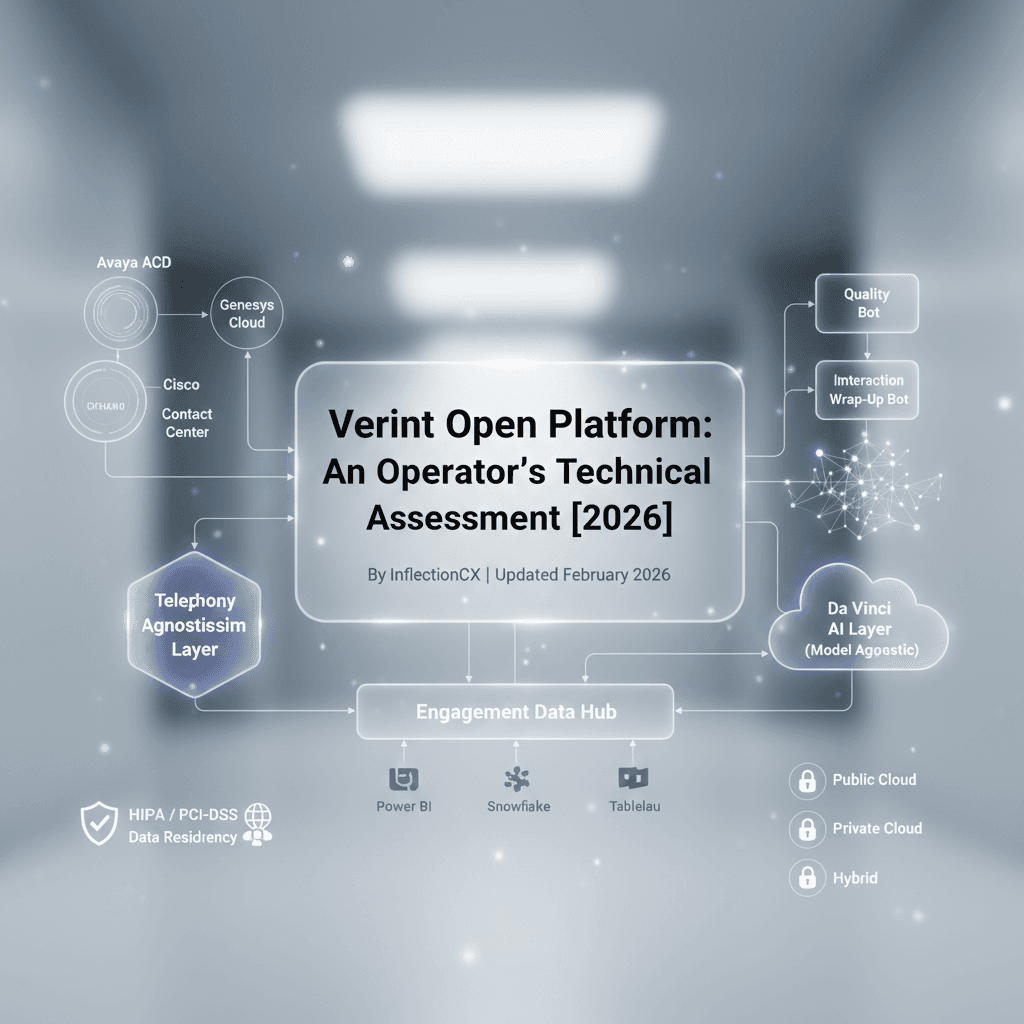
Verint's Open Platform is a composable CX automation suite built on a specific architectural bet: that telephony is becoming a commodity, and the value in contact center operations has shifted to the intelligence layer — quality management, workforce optimization, interaction analytics, and AI-driven automation — that sits on top of it.
This matters if you're running a hybrid telephony environment (which, according to Gartner, still describes roughly 60% of enterprise contact centers). It matters less if you've already standardized on a single CCaaS provider like Genesys Cloud or NICE CXone, where native WFM and analytics may be simpler to deploy even if they're less capable.
Verint sits in an unusual competitive position. It is not included in the Gartner CCaaS Magic Quadrant — it's evaluated separately in the Workforce Engagement Management category, where it has held a leadership position for over a decade. Following the Thoma Bravo acquisition in 2025 and the subsequent Calabrio merger, Verint is consolidating its position as a best-of-breed WEM layer rather than a full CCaaS replacement.
For operations leaders, the practical question is: do you need the best workforce engagement and quality management platform available, or do you need an all-in-one CCaaS that's good enough at everything? Verint bets on the former. That bet pays off in specific scenarios and falls flat in others.
How Does Verint's Architecture Actually Work?
The platform rests on three architectural decisions that have real operational implications.
Telephony agnosticism. Verint connects to any ACD — on-premises Avaya, cloud-native Genesys, Cisco, legacy systems from that acquisition three years ago — and applies unified WFM, QA, and automation across all of them. In our experience running multi-site operations across multiple states, this is genuinely rare. Most platforms that claim telephony neutrality mean they support two or three specific integrations. Verint's support extends to legacy systems that other vendors won't touch.
Composable deployment via specialized bots. Rather than requiring a monolithic platform deployment, individual capabilities deploy independently through what Verint calls "specialized bots." You can add automated quality scoring without touching scheduling. You can deploy real-time coaching without migrating recording infrastructure. Each module operates through standardized data contracts. In practice, this means you can start with one capability and expand — but it also means each bot has its own licensing, which complicates procurement.
Model-agnostic AI (Da Vinci). The Da Vinci AI layer supports multiple LLM backends — Verint's proprietary models, Azure OpenAI, Google Gemini, and open-source alternatives. When a better foundation model ships, Verint can swap the backend without breaking customer integrations. This matters more than most buyers realize: organizations locked into single-model architectures in 2023 are already hitting capability ceilings.
The Engagement Data Hub: Verint's Strongest Architectural Asset
Most CX platforms fragment data by function. Recordings in one system. Survey responses in another. Agent performance in a third. Building cross-functional analysis requires custom ETL pipelines that break every time a vendor updates their schema.
Verint's Engagement Data Hub (EDH) normalizes interaction data across all channels — voice, chat, email, social — into a consistent schema. When you add speech analytics, that data automatically populates alongside WFM data. You can correlate schedule adherence with sentiment scores without building a data pipeline. The hub exposes OData services for export to Power BI, Tableau, Snowflake, or Databricks using standard JSON formats.
This is genuinely differentiated. In our work integrating intelligence systems across contact center operations, the data normalization problem is consistently the most expensive and time-consuming challenge. Organizations evaluating platforms should weight the data layer at least as heavily as any individual feature.
Deployment Flexibility
Environment | Infrastructure | SLA | Best For |
|---|---|---|---|
Public Cloud | AWS-hosted | 99.99% | Standard deployments, fastest feature access |
Private Cloud | Customer's Azure/AWS | Negotiated | Data sovereignty, regulated industries |
Hybrid | Site-to-cloud VPN | 99.95% | Sensitive data on-prem, metadata in cloud |
Hybrid deployments use TLS 1.2+ for transit and AES-256 encryption for storage. Real-time VM replication via Zerto handles failover. For healthcare and financial services operations that must maintain data residency requirements, the hybrid option is production-ready — not a roadmap item.
What Can Verint Da Vinci AI Actually Do in Production?
Verint's AI approach differs from competitors in modularity rather than raw capability. Instead of a monolithic virtual assistant, the platform deploys task-specific bots that integrate into existing workflows. Six bots currently have documented production outcomes:
Bot | Function | Documented Outcome |
|---|---|---|
Quality Bot | 100% automated interaction scoring | $4M savings via increased supervisor capacity (telecom case study) |
TimeFlex Bot | Agent self-service scheduling with gamification | 30% reduction in attrition |
Interaction Wrap-Up Bot | Generative call summarization | Reduced after-call work and handle time |
Knowledge Automation Bot | Unified agent knowledge base | 20-second reduction in average call duration |
Interviewing Bot | Audio-based candidate screening | Assessment analysis in minutes vs. hours |
Data Insights Bot | Natural language data querying | Real-time trend and anomaly detection |
The Quality Bot is the headline capability. Moving from 2% manual QA review to 100% automated evaluation fundamentally changes how quality management works — and the $4M savings figure comes from a documented telecom deployment, not a projection. However, calibrating automated scoring to match your organization's quality standards requires significant upfront investment in model tuning. Out-of-the-box accuracy varies.
The Da Vinci transcription engine provides real-time and batch transcription with speaker diarization, utterance-level sentiment scoring, topic detection using both pre-trained and custom models, and acoustic analysis for silence, overtalk, and emotional cues. Domain-specific models exist for financial services, healthcare, and retail. Custom vocabulary training requires a separate configuration workflow.
Limitations Worth Acknowledging
Custom entity training requires significant labeled data — plan for a 60-90 day ramp before custom models reach production accuracy. Some advanced analytics features are restricted to higher licensing tiers, which Verint's sales process doesn't always make transparent upfront. Batch processing is substantially more cost-effective than real-time for high-volume operations; organizations processing more than 100,000 monthly interactions should model both pricing scenarios.
The bot architecture also creates a multiplication problem in procurement: each specialized bot carries its own license, and the total cost of deploying three or four bots across a large operation can exceed what competitors charge for bundled suites. More on this in the pricing section.
How Does Verint WFM Compare to Anything Else on the Market?
This is where Verint's decades of enterprise deployment experience show most clearly. The workforce management capabilities are deep, mature, and — based on G2's peer review data — measurably ahead of competitors. Verint scored 9.2 in Skills Management versus Genesys at 7.8, and users consistently praise the forecasting accuracy and scheduling flexibility.
The WFM system ingests workload data from contact center queues, back-office ticketing systems, and branch traffic to generate unified forecasts across what Verint calls "One Workforce." Forecasting APIs support both point-in-time and time-series queries. Schedule data follows ISO 8601 with proper timezone handling. Webhook notifications fire on scheduled publish events.
The API maturity here is high — full CRUD operations for workload forecasting, agent preferences, and skills management. Intraday management has real-time read with more limited write capabilities. If your organization's primary need is best-in-class workforce optimization, Verint WFM is the benchmark that others are measured against.
Where WFM Users Report Friction
Peer reviews on TrustRadius and G2 consistently identify three pain points: the initial learning curve is steep (particularly for WFM administrators), the user interface feels dated compared to cloud-native competitors, and the technical implementation requires dedicated resources. These aren't fatal problems, but they're real operational costs that should factor into your timeline and resource planning.
What Does the Verint Open Platform Actually Cost?
Verint does not publish transparent pricing, which is itself a data point about their sales process. Based on procurement data from Vendr and verified peer reports, expect approximately $200,000 for a 36-month enterprise contract, with an average annual cost around $34,500 per year for mid-market deployments. Negotiated discounts of roughly 26% are achievable.
But the sticker price understates the real cost. Factor in:
Integration labor. Deep integrations require partner-level API access (see below). Budget 50-100% of an integration architect and at least one full-time backend developer for a 12-16 week implementation.
Per-bot licensing. Each specialized bot — Quality Bot, TimeFlex Bot, Knowledge Automation Bot — licenses separately. An organization deploying three bots across 500 agents will pay substantially more than the base platform cost suggests.
Training and change management. The platform's depth creates a long ramp-up period. Organizations consistently report 3-6 months before administrators are fully proficient.
API access tiers. Comprehensive documentation requires partner-level credentials. Technology Partner, ISV Partner, and System Integrator Partner tiers each unlock different API capabilities and support levels. If your evaluation requires deep integration testing, factor in the partnership investment timeline.
For organizations spending time modeling the full cost picture across multiple platforms, this is exactly the kind of analysis where working with an operator who's done the math before — rather than a vendor's ROI calculator — makes the difference between a sound investment and an expensive lesson.
Verint vs. NICE CXone vs. Genesys Cloud: An Honest Comparison
No assessment is complete without positioning against the alternatives buyers are actually considering. Here's how Verint compares on the dimensions that matter operationally:
Capability | Verint Open Platform | Genesys Cloud CX | NICE CXone |
|---|---|---|---|
Telephony Agnosticism | Best in class — true bring-your-own-ACD | Prefers Genesys telephony | Prefers NICE telephony |
WFM Depth | Best in class — 9.2 G2 score | Good (7.8 G2 score), "clunky" per reviewers | Strong |
API Documentation | Good, but gated behind partner access | Excellent — 3,000+ public endpoints, free sandbox | Very good — DEVone program offers no-cost access |
AI Maturity | Strong, model-agnostic | Strong, native | Very strong, most extensive AI portfolio |
Data Unification | Best in class — Engagement Data Hub | Separate stores per product | Good |
Developer Experience | Restricted — requires partnership for deep access | Best in class — Python, JS, .NET, Java, Go SDKs | Good — immediate no-cost developer access |
Support Quality | 8.5 G2 rating | 8.1 G2 rating | Good |
Implementation Complexity | High — steep learning curve, dedicated resources | Moderate — cloud-native, faster time to value | Moderate |
When Verint Wins
You're running multiple ACD systems and need a unified intelligence layer across all of them. Your WFM requirements are complex and demand best-in-class forecasting and scheduling. You need a data architecture that normalizes interaction data across channels without custom ETL. You're in a regulated industry that requires hybrid or private cloud deployment with granular data residency controls.
When Competitors Win
Genesys Cloud wins when you want the fastest developer experience: a free sandbox, 3,000+ public API endpoints, and extensive SDKs across five languages. If your team prefers self-service exploration before talking to sales, Genesys removes that friction entirely.
NICE CXone wins on AI breadth and immediate developer access through the DEVone program. If AI-driven automation is your primary investment thesis rather than WFM optimization, NICE's portfolio is currently the most extensive.
Both win on time to value for organizations that are already standardized on their telephony and want the simplest path to adding WFM and analytics. If you're not running a hybrid environment, the telephony agnosticism that defines Verint's value proposition may not apply to you.
What Are the Real Implementation Challenges?
A realistic implementation timeline for the Verint Open Platform runs 13-16 weeks for core deployment, with ongoing optimization extending beyond that:
Phase | Timeline | Focus |
|---|---|---|
Foundation | Weeks 1-4 | API access, authentication, monitoring infrastructure, environments |
Core Integration | Weeks 5-12 | Primary data flows, error handling, data transformation, health dashboards |
Optimization | Weeks 13-16 | Performance tuning, caching, advanced error handling, documentation |
Enhancement | Ongoing | Additional bots, AI integration, custom applications |
Resource requirements: Integration architect (50-100%), backend developer (100% per developer), DevOps engineer (25-50%), QA engineer (50%), and project manager (25-50%).
Three integration anti-patterns consistently cause problems: polling-heavy integrations that strain rate limits (use webhooks instead), monolithic data extracts that overload batch processing (implement incremental sync), and direct database access that breaks on upgrades (always use official API endpoints).
For organizations that have been through this process before, these are familiar patterns. For those undertaking a platform integration for the first time, the learning curve is real — and it's one of the primary areas where experienced operational guidance pays for itself many times over.
Compliance and Security: What's Production-Ready
For healthcare and financial services operations, compliance isn't a feature — it's a prerequisite. Verint's security posture covers the essentials:
Certifications: SOC 2 Type II, PCI-DSS, HIPAA-eligible configurations, ISO 27001.
Data protection: TLS 1.2+ for all API communications, AES-256 field-level encryption, data residency options for GDPR and CCPA, audit logging for all API operations, role-based data masking, and automated DSAR workflows.
Recording compliance: The Capture Control API enables PCI-DSS payment handling — pausing recording during card entry and resuming after. Legal hold preserves interactions indefinitely for litigation. Automated redaction strips credit card numbers from audio and transcripts.
This is table stakes for regulated industries, and Verint delivers it cleanly. The hybrid deployment option with on-premises data retention and cloud-based analytics is particularly well-suited to healthcare organizations navigating state-level data residency requirements — a constraint we encounter regularly in multi-state CX operations.
The Thoma Bravo Factor: What the Acquisition Means for Buyers
Thoma Bravo's acquisition of Verint in 2025, and the subsequent integration of Calabrio, creates both opportunity and uncertainty. On the positive side, the combined entity strengthens Verint's WEM capabilities and adds Calabrio's customer base. On the cautionary side, PE-backed consolidations historically prioritize margin expansion — which can mean reduced R&D investment, support restructuring, and pricing increases over the medium term.
Buyers should negotiate contract protections now: lock in pricing for the full term, establish SLAs for feature parity and support response times, and include termination provisions triggered by material service degradation. This isn't speculation — it's standard practice for any platform evaluation where ownership has recently changed hands.
Frequently Asked Questions
Is the Verint Open Platform a CCaaS replacement? No. Verint is a workforce engagement and CX automation layer that sits on top of your existing telephony. It does not provide its own ACD, IVR, or call routing. It integrates with CCaaS platforms from Genesys, NICE, Five9, Cisco, Avaya, and others, adding WFM, quality management, analytics, and AI automation to whatever telephony you already run.
Can Verint work with multiple phone systems simultaneously? Yes — this is its primary architectural differentiator. Verint connects to multiple ACDs concurrently and applies unified workforce management, quality scoring, and analytics across all of them. For organizations running hybrid environments from mergers or phased migrations, this is uniquely valuable.
How long does a typical Verint implementation take? Core deployment runs 13-16 weeks with dedicated resources. Full optimization including advanced bot deployment and custom integrations typically extends to 6-9 months. Organizations should budget for a 3-6 month WFM administrator proficiency ramp.
What happened with the Thoma Bravo acquisition? Thoma Bravo completed its acquisition of Verint in 2025 and is integrating Calabrio into the platform. The long-term implications for pricing, support, and R&D investment are still unfolding. Buyers should negotiate accordingly.
Does Verint publish pricing? No. Based on market data, expect approximately $200,000 for a 36-month enterprise contract, with per-bot licensing adding significant incremental cost. Negotiate early and model the full TCO including integration labor.
Verdict: Verint Open Platform Scores
Dimension | Score (1-10) | Assessment |
|---|---|---|
Operational Fit | 8 | Excellent for hybrid environments; less compelling for single-CCaaS shops |
Integration Flexibility | 7 | Architecturally strong, but gated documentation and partnership requirements create friction |
AI Capability Maturity | 7 | Model-agnostic approach is forward-thinking; individual bot capabilities are strong but licensing adds up |
Compliance & Governance | 9 | Production-ready for healthcare and financial services with hybrid deployment options |
Total Cost of Ownership | 6 | Platform cost is competitive; per-bot licensing and integration labor push real TCO higher than initial quotes suggest |
Overall: 7.4 / 10
Verint Open Platform is the right choice for organizations running multi-ACD environments that need best-in-class workforce management and a unified data layer across disparate telephony systems. It's the wrong choice for organizations that want a turnkey, all-in-one CCaaS with minimal integration overhead.
The platform's architectural bets — telephony agnosticism, composable AI, unified data — are sound. The execution is mature in WFM, strong in quality management, and promising in AI automation. The barriers are real: steep learning curves, gated developer access, opaque pricing, and per-bot licensing that complicates budget modeling.
For operations leaders navigating a platform decision, the most expensive mistake isn't choosing the wrong vendor — it's evaluating platforms on vendor demos rather than operational requirements. Start with your constraints. Map your telephony landscape. Model the full TCO including integration labor and training. Then determine whether Verint's architectural bet aligns with the problem you're actually solving.
InflectionCX operates unified CX environments that combine AI agents with human agents across healthcare and financial services. Our Advisory & Platform Selection practice helps operations leaders evaluate, select, and implement CX platforms based on production requirements — not vendor demos. Talk to our team →
Sources: Gartner Peer Insights (2025), G2 Grid Reports (2025-2026), TrustRadius Verified Reviews (248 WFM reviews), Vendr Procurement Data, Verint Technical Documentation, PeerSpot Comparisons, CX Today Editorial Analysis, Princeton/Georgia Tech GEO Research Study.
More in Analysis


Ready for Better CX?

Whether you're selecting your CX technology stack or evaluating outsourcing options, InflectionCX is your go-to-partner. Contact us today.
AI Readiness Assessment
We map where AI fits in your operation. What's working, what's hype, what's actually worth doing.

Unified CX Outsourcing
InflectionCX runs contact centers where humans and AI operate as one system.