
Gannon Costello
CX Technology Analyst
Zoom Contact Center is the better CCaaS choice for mid-market and growing enterprise buyers in 2026. Talkdesk offers deeper feature sets and vertical specialization, but its three-year contract requirements, AI features gated behind add-on pricing, documented implementation delays, and a customer satisfaction score that collapsed 27 points in a single year should give every buyer pause. InflectionCX operates as a Unified CX company across both platforms — integrating AI agents and human operations under single governance, quality standards, and analytics — and this comparison reflects what we see in real deployments, not what either vendor shows in demos.
The Talkdesk Satisfaction Collapse No One Is Talking About
Before comparing features or pricing, mid-market buyers need to understand what happened to Talkdesk's customer base between 2023 and 2025.
In 2023, Talkdesk earned Gartner "Customers' Choice" status with 87% of customers willing to recommend the platform. One year later, that number plummeted to 60% — dead last among all evaluated CCaaS vendors. Talkdesk lost its Customers' Choice status and ranked joint last for deployment experience, tied with Ericsson and CloudTalk.
The score recovered to 81% in the 2025 report. That recovery is real and worth acknowledging. But 81% still trails Zoom Contact Center at 91%. It still trails Content Guru at 100% and Dialpad at 95%. And the 27-point single-year collapse represents something no partial recovery erases: a period where the majority of Talkdesk's own customers would not recommend the platform.
A vendor's satisfaction score can dip. A 27-point collapse to last place signals structural problems.
Zoom Contact Center, by contrast, entered the same Gartner evaluation with 91% willingness to recommend and the highest product capabilities rating among newer entrants — and this in only its third year on the market.
The Gartner Leader badge tells you what analysts think. The satisfaction data tells you what customers experience. For mid-market buyers signing multi-year contracts, the customer data matters more.
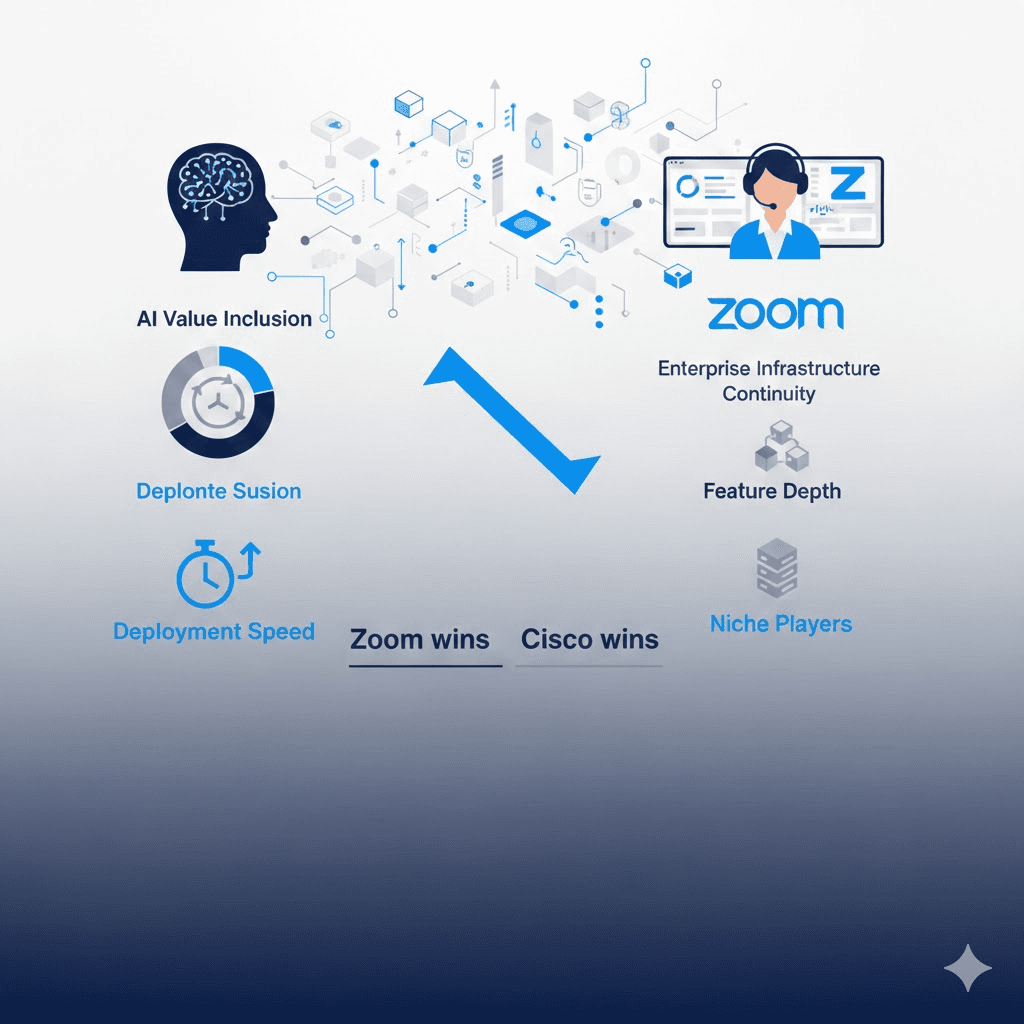
At a Glance: The Competitive Scorecard
Category | Zoom Contact Center | Talkdesk | Verdict |
|---|---|---|---|
AI Pricing Model | Included at no extra cost | Paid add-ons (Copilot, Autopilot) | Zoom |
Contract Flexibility | Annual/monthly available | 3-year minimum, auto-renewal | Zoom |
Deployment Speed | 4–6 weeks typical | 8–12 weeks; documented 12+ month delays | Zoom |
Pricing Transparency | Three published tiers | Complex SKU + add-ons + telecom fees | Zoom |
Customer Satisfaction | 91% recommend (Gartner 2025) | 81% recommend (recovered from 60%) | Zoom |
UCaaS + CCaaS Integration | Single platform, single admin | Requires separate UC vendor | Zoom |
Video Support | Native, one-click escalation | Available but not core | Zoom |
Ease of Use | Familiar Zoom interface | Capable but steeper learning curve | Zoom |
Omnichannel Depth | Voice, video, chat, SMS (growing) | Voice, chat, email, SMS, social (mature) | Talkdesk |
Workforce Management | Basic native, improving | Comprehensive native WFM | Talkdesk |
Vertical Solutions | Horizontal focus | Healthcare, financial services, retail | Talkdesk |
Feature Breadth | 600+ features since 2022, growing | Mature, comprehensive | Talkdesk |
Gartner CCaaS MQ 2025 | Niche Player (first year) | Leader (5th year, after dropping to Visionary) | Talkdesk |
AI-Human Governance | Neither solves this | Neither solves this |
Talkdesk wins on feature depth and vertical specialization. Zoom wins on everything that determines whether your contact center deployment actually succeeds: cost predictability, deployment speed, AI accessibility, customer satisfaction, and platform simplicity.
Neither platform provides unified governance across AI and human interactions. That is the Unified CX problem, and it is why InflectionCX exists.
The Three-Year Trap: Talkdesk's Contract Practices
This is the comparison that should change how you evaluate Talkdesk. It is not about features. It is about what happens after you sign.
What the Contract Actually Says
Talkdesk's Master Subscription Agreement — the contract every customer signs — contains Section 13.2, which states that each order "shall automatically renew for successive Renewal Terms of three years in length" unless written notice is given at least 30 days before the current term expires.
Read that again. Three-year auto-renewal. Not one year. Three years. Miss the 30-day window, and you are locked in for another 36 months.
What Happens When Customers Try to Leave
The contract language is one thing. How Talkdesk enforces it is another.
A Trustpilot reviewer documented an attempt to cancel that Talkdesk's legal department rejected because the customer's email "does not contain the word 'renew', 'not renew', 'turn off' or 'turn off autorenewal' anywhere in that email." The customer had communicated their intent to cancel. Talkdesk's legal team ruled the communication insufficient because it didn't use specific contractual terminology — and auto-renewed the contract.
Another reviewer reported that their business "tried for about a year (literally) to get assistance" with billing issues. When they stopped paying to force resolution, Talkdesk sent them to a collection agency and simultaneously renewed the contract they were disputing.
A third reviewer described being "forced to pay for 24 lines instead of 14 for 3 more years" after an auto-renewal they tried to prevent.
These are not isolated incidents. They represent a pattern documented across dozens of reviews on Trustpilot, where Talkdesk holds a poor overall rating driven substantially by contract and billing complaints.
The pattern is serious enough to have generated litigation. A Delaware Superior Court case (Talkdesk, Inc. v. DM Trans LLC) involves contract disputes over auto-renewal, service quality failures, and unconscionability claims, with the defendant citing "constant service connection issues, audio failures, stuck call statuses, inaccurate usage recording."
What Zoom's Contract Looks Like
Zoom Contact Center offers annual and monthly billing. Published pricing. No documented pattern of auto-renewal disputes. No litigation over contract enforcement practices that we can identify.
For mid-market organizations — where a three-year contract represents a significant financial commitment and where operational needs change rapidly — the contract structure alone should be a decisive evaluation factor.
AI Pricing: Included vs. Gated
Talkdesk charges separately for AI. Zoom includes it. The financial and operational consequences are substantial.
Talkdesk's Add-On Model
Talkdesk Copilot — real-time agent guidance, conversation summaries, suggested responses — is a paid add-on. So is Talkdesk Autopilot, the conversational AI self-service engine. These are not included even on the most expensive CX Cloud Elite plan at $165/user/month.
Nextiva's independent pricing analysis confirms the problem: "Many of Talkdesk's signature features are paid add-ons, even on the most expensive Elite plan. This includes critical AI tools like Talkdesk Autopilot (virtual agent) and Talkdesk Copilot (agent assist)." The analysis describes Talkdesk's model as "a high base price, plus a long contract, plus metered usage, plus paid add-ons" — a structure that makes total cost prediction difficult.
Industry analysts estimate comparable AI features cost $20–30 per seat per month as add-ons. For a 100-agent deployment, that is $24,000–$36,000 per year in AI costs alone — on top of the base licensing.
Zoom's Included Model
Zoom AI Companion is included at no additional cost across all eligible Zoom Contact Center plans. Real-time agent guidance, conversation summaries, sentiment analysis, and AI-generated follow-up tasks are standard features. AI Expert Assist — real-time knowledge retrieval and next-best-action recommendations — is included in the Elite tier or available as an add-on.
No separate procurement cycle. No per-feature billing. No budget negotiation for AI capabilities that should be table stakes.
Why This Matters Beyond Cost
The pricing model determines adoption. When AI features require separate purchase and approval, organizations deploy them selectively — giving AI tools to some agents but not others, enabling some capabilities but not the full suite. When AI is included, organizations deploy it universally.
Zoom reports that AI Companion is enabled across 1.2 million accounts. That adoption density means continuous improvement through usage data. Talkdesk's add-on model inherently limits the feedback loop.
But here is what neither pricing model addresses: who governs the AI once it is deployed? When Zoom's AI Companion generates an inaccurate summary or when Talkdesk's Copilot suggests a non-compliant response, whose quality standards apply? How do AI-handled interactions get scored alongside human-handled interactions? This governance gap exists regardless of whether you pay for AI separately or get it included. It is the Unified CX layer that neither platform provides.
What Talkdesk Genuinely Does Well
Balanced analysis requires acknowledging Talkdesk's real strengths. For specific buyer profiles, they are meaningful.
Vertical solutions are genuinely differentiated. Talkdesk Industry Experience Clouds provide pre-built healthcare compliance workflows with Epic EHR integration, financial services regulatory templates with PCI compliance tools, and retail e-commerce integrations with seasonal scaling. These are not marketing overlays — they are functional configurations that reduce implementation effort for regulated industries. The 2024 IDC MarketScape recognized Talkdesk as a Leader, citing these vertical capabilities.
Feature depth exceeds Zoom's current offering. Talkdesk's native workforce management, quality management, interaction analytics, and AI agent capabilities are more mature than Zoom's. The AI portfolio — Copilot, Autopilot, AI Trainer, Agentic AI — offers deeper customization options for organizations willing to pay for and configure them. The 2025 Gartner Magic Quadrant positioned Talkdesk as a Leader for the fifth year, recognizing industry-specific solutions and the Talkdesk Embedded product.
Omnichannel implementation is more mature. Voice, chat, email, SMS, and social media channels all operate from a unified routing engine. Zoom's voice and video channels are excellent; its email and social channels are less mature. Organizations requiring sophisticated email management or social media engagement today will find Talkdesk's channels more production-ready.
G2 validates feature satisfaction. Talkdesk is a G2 Leader with 1,700+ five-star ratings and #1 positioning in 23 G2 reports. For organizations prioritizing feature comprehensiveness as measured by user reviews, this is meaningful.
These strengths are real. The question is whether they justify the contract terms, pricing complexity, and operational risks that come with them.
What Talkdesk Gets Wrong — According to Its Own Customers and Employees
Implementation Delays While Paying Full Fees
The Gartner Peer Insights 2024 report ranked Talkdesk joint last for deployment experience among all evaluated CCaaS vendors. Customer reviews document specific failures.
One Trustpilot reviewer reported waiting over a year for implementation while paying full contract fees: their implementation team had been "working on setting up their solution for over a year" while the organization was "still not live" and charged annual contract fees throughout. Another described implementation as "the slowest, most frustrating experience ever" with support that was "outsourced, not knowledgeable, not supportive, and delayed."
Consider the combined impact: a three-year contract starts billing from signature, not from go-live. If implementation takes 12 months, you have paid for a year of service you could not use — and still owe two more years.
Support Quality Disparity
Support quality appears to correlate with contract size. Enterprise customers with large deployments report responsive, knowledgeable teams. Mid-market customers — exactly the segment this article addresses — report different experiences.
Trustpilot reviews describe support issues taking months to resolve, with multiple reviewers reporting that live support is effectively unavailable. One reviewer noted that local problems or new VOIP trunk setups "can take 2–6 months" to resolve. Another described "outages between the actual voice service and components of the reporting suites, resulting in client penalties totaling tens of thousands of euros."
Capterra's review analysis identifies two recurring negative themes among verified reviewers: "frequent connectivity disruptions" and "unreliable call stability." For a contact center platform, call stability is not a nice-to-have.
Pricing Complexity
The $85–$165/agent/month range is the base price. It is not the total cost.
Workforce management, quality management, advanced analytics, and AI features all require add-ons or tier upgrades. Telecom usage — actual phone calls — is billed separately on top of per-user licensing. Industry Experience Clouds for healthcare and financial services run $225/user/month before add-ons.
GetApp's review analysis finds that reviewers' opinions on pricing are mixed, with some reporting that "the pricing can be inflexible and high, especially for small businesses" and that the "billing system" is "confusing and not transparent, with occasional overcharges." The combination of high base prices, required add-ons, separate telecom fees, and three-year commitments creates a total cost that mid-market buyers consistently report exceeding initial expectations.
Organizational Stability Concerns
This is not about feature evaluation. It is about whether the vendor you are signing a three-year contract with will maintain stable operations throughout that commitment.
TechCrunch reported that Talkdesk conducted three rounds of layoffs in less than 14 months between 2022 and 2023, with at least 140 employees affected in the September 2023 round alone. The layoffs were attributed to "lower revenue projections."
RepVue data shows only 30% of Talkdesk sales representatives currently hitting quota, with a 2.6 out of 5 culture and leadership rating — ranked #4,384 out of 6,097 companies evaluated. A RepVue reviewer from April 2025 described a "constant revolving door of leadership," called the product "poor," stated that "most current customers are escalated for product not working or failing to meet expectations," and called the AI "very clunky."
Glassdoor reviews reference "cutting for IPO readiness" — but no IPO has materialized in over four years since Talkdesk's last funding round ($230M Series D at $10B valuation in August 2021). The company has not raised new capital since.
None of this means Talkdesk will fail. But it means mid-market buyers should ask hard questions during evaluation about support staffing levels, implementation team stability, and the company's financial trajectory before committing to a three-year contract.
Zoom Contact Center: The Case for Simplicity
Zoom's contact center trajectory is not hypothetical. It is measurable, accelerating, and documented.
Deployment Speed That Changes the Math
Vensure Employer Solutions migrated 3,000 users in a single day without service interruptions, achieving 90% positive survey responses and a 2-minute average call resolution time. AVI-SPL deployed 200 agents across seven countries, describing the experience as "stress-free" and reporting $70,000+ in annual savings with a 5% NPS increase.
Typical Zoom Contact Center migration for mid-market organizations: 4–6 weeks from contract to go-live. The 2025 Gartner Magic Quadrant specifically cited "simplified setup and administration" as a Zoom strength. G2 comparison data confirms reviewers find Zoom Contact Center easier to set up than Talkdesk.
For organizations where every month of delayed deployment represents wasted licensing fees and lost operational efficiency, deployment speed is not a secondary consideration. It is a financial calculation.
The Unified Platform Advantage
Zoom delivers Meetings, Phone, Team Chat, and Contact Center within a single application. One admin portal. One identity system. One interface that agents, supervisors, and back-office employees already know. Zoom Phone has surpassed 10 million paid seats, creating a massive installed base where Contact Center adoption is a configuration change, not a migration project.
Talkdesk requires a separate UCaaS vendor — and ironically, Talkdesk itself publishes a blog about integrating with Zoom for unified communications. Talkdesk customers may already be paying for Zoom's UC platform while using a separate, more expensive contact center from a different vendor.
Metrigy research quantifies the unified platform value: companies using UC and CC from a single vendor experience a 26.5% improvement in customer ratings, an 18% reduction in operational costs, a 22.6% increase in revenue, and a 23.1% boost in employee efficiency. The same research shows 64% of CCaaS buyers prefer purchasing from their UCaaS provider.
Zoom is one of only two vendors recognized in both the Gartner UCaaS Magic Quadrant (Leader for six consecutive years) and the CCaaS Magic Quadrant. Talkdesk does not offer UCaaS.
AI That Gets Deployed, Not Just Licensed
Zoom AI Companion is enabled across 1.2 million accounts. Monthly active users are growing 4x year-over-year. Customer outcomes are documented: testimonials report cutting after-call work from 4.5 minutes to under 30 seconds and decreasing call handle time by 3 minutes.
When AI is included at no cost, organizations deploy it across every agent from day one. When AI is a paid add-on, organizations ration it. The deployment model determines whether AI delivers enterprise-wide transformation or selective, partial improvement.
Product Velocity and Trajectory
Zoom has added 600+ features since the February 2022 launch. Zoomtopia 2025 announcements included AI Companion 3.0 with agentic capabilities, deep Salesforce and ServiceNow integrations, Virtual Agent for Healthcare with EHR integrations, and EU data center availability.
Eric Yuan stated on Zoom's Q2 FY2026 earnings call that of Zoom's top 10 contact center wins, all represented displacements of major CCaaS vendors, and 40% were migrations off first-generation cloud solutions. High-value customers ($100K+ ARR) in the CX segment grew 94% year-over-year.
Industry analyst Sheila McGee-Smith wrote in No Jitter that Zoom Contact Center "is not only competing with CCaaS market leaders; it is sometimes replacing them." Zeus Kerravala of ZK Research argued that Zoom "should shift right" in future Gartner evaluations, citing "tremendous growth up and down market."
The Honest Limitations
Zoom's workforce management capabilities are less mature than Talkdesk's. Quality management is simpler. Vertical-specific compliance packages do not exist natively — organizations in healthcare or financial services will need to build configurations or work with implementation partners. The 2025 Gartner Magic Quadrant flags "breadth of features" and "limited third-party integrations" as cautions.
For organizations with genuinely complex WFM requirements or deep vertical compliance needs, these gaps matter. For the majority of mid-market contact centers running voice and digital channels with standard quality programs, they do not.
Total Cost of Ownership: The Real Numbers
100-Agent Mid-Market Deployment
Component | Zoom Elite | Talkdesk Elite + Add-Ons |
|---|---|---|
Base licensing | $149/agent/month | $165/agent/month |
AI agent assist | Included | ~$25/agent add-on |
Quality management | Included in Elite | ~$25/agent add-on |
WFM | Included in Elite | Included in Elite |
Advanced analytics | Included | ~$20/agent add-on |
Telecom/usage fees | Standard telephony | Separate billing |
Estimated monthly total | $14,900 | $23,500+ |
Estimated annual total | $178,800 | $282,000+ |
Contract commitment | Annual available | 3-year minimum |
Estimated annual difference: $103,000+ — and that is before accounting for the separate UCaaS licensing that Talkdesk deployments typically require, or the financial risk of a three-year contract with a vendor whose customers reported a 60% satisfaction rate 18 months ago.
For organizations in healthcare or financial services requiring Talkdesk's Industry Experience Cloud ($225/user/month before add-ons), the gap widens further — directly relevant to InflectionCX's client base in these verticals.
What Neither Platform Gives You
Both Zoom and Talkdesk leave the same operational problem unsolved.
When Zoom's AI Companion generates a conversation summary, who verifies its accuracy before it enters the customer record? When Talkdesk's Copilot suggests a response that creates compliance exposure, who owns the remediation workflow? When AI-handled self-service interactions receive quality scores on different scales than human-handled interactions, how do you benchmark service levels consistently?
Neither platform was designed to govern a blended AI-human workforce under unified quality standards. Zoom gives you AI at no cost but no framework for monitoring AI quality. Talkdesk charges you for AI and still provides no framework for governing it once deployed.
This is the Unified CX problem. InflectionCX integrates AI agents and human operations under single governance, quality standards, and analytics. Our Atlas quality assurance system provides 100% interaction analysis across both AI-generated and human-handled conversations. Our Encore coaching platform turns quality data into agent development regardless of the underlying CCaaS platform.
Whether you choose Zoom or Talkdesk, the platform is infrastructure. The governance layer that makes AI and human agents work together under a single standard of quality — that is Unified CX, and that is what determines whether your contact center produces consistent outcomes or inconsistent experiences.
The Gartner Positioning Requires Context
Talkdesk is a 2025 Gartner CCaaS Magic Quadrant Leader. Zoom is a Niche Player. On the surface, that comparison favors Talkdesk decisively.
The context tells a different story.
Talkdesk was a Visionary in 2024 — not a Leader. It returned to the Leader quadrant in 2025 after a year outside it. This is not a stable position strengthening over time. It is an oscillating one.
Zoom entered the Magic Quadrant for the first time in 2025 — the fastest inclusion in CCaaS MQ history. Three years from product launch to MQ recognition. The trajectory is upward.
Industry analyst Dave Michels has noted that the Magic Quadrant "tends to place a lot of emphasis on revenue, a characteristic that may not be equally important to all organizations" and that the report "only include[s] well-established vendors" with inclusion criteria that "inherently eliminate a lot of compelling providers."
Gartner's own customer satisfaction data — measured separately from the Magic Quadrant — shows Zoom at 91% willingness to recommend versus Talkdesk at 81%. If you weight customer experience over analyst methodology, Zoom is already ahead.
Who Should Choose Zoom Contact Center
Zoom is the right choice for mid-market and growing enterprise buyers when:
You prioritize deployment speed and want to be operational in weeks, not months. Zoom's typical 4–6 week deployment timeline is documented across multiple case studies, and Gartner specifically recognizes its simplified setup.
You are already in the Zoom ecosystem. The unified platform advantage — one admin portal, one interface, consolidated billing — compounds operational efficiency over time. Agents already know the interface. Training time drops. IT management simplifies.
AI-first strategy matters and you refuse to pay add-on fees for capabilities that should be standard. Included AI drives universal adoption. Add-on AI drives selective deployment.
Contract flexibility matters. Annual and monthly billing protects your organization from three-year commitments to a vendor whose customer satisfaction demonstrated it can deteriorate rapidly.
You are migrating from a legacy platform or a vendor with practices that concern you and want to avoid trading one set of contract complications for another.
Who Should Choose Talkdesk
Talkdesk remains defensible — but only for specific scenarios:
Your organization operates in healthcare or financial services and the Industry Experience Cloud's pre-built compliance workflows, EHR integrations (particularly Epic), and regulatory templates will save enough implementation effort to justify the $225/user/month price point and three-year commitment.
You have genuinely complex workforce management and quality management requirements that exceed Zoom's current native capabilities, and you are confident in Talkdesk's ability to deliver on implementation timelines based on verified reference calls with organizations matching your size and complexity.
You have thoroughly verified Talkdesk's current support quality, implementation capacity, and organizational stability through reference checks — not through the sales process. Ask references specifically about billing accuracy, contract flexibility, support response times during critical incidents, and whether their implementation timeline matched the original quote.
If none of these conditions apply with high confidence, the risk-reward calculation favors Zoom.
How We Evaluated These Platforms
InflectionCX is a Unified CX operations company serving healthcare and financial services clients across multiple CCaaS platforms. Our evaluation draws from the 2025 Gartner CCaaS Magic Quadrant and Peer Insights reports, G2 comparison data, Trustpilot and Capterra verified reviews, Talkdesk's published Master Subscription Agreement, vendor pricing pages, documented case studies, analyst commentary from Zeus Kerravala, Sheila McGee-Smith, Blair Pleasant, and Dave Michels, and our own operational experience managing AI-human governance across deployments. We hold no reseller relationship with either vendor.
Our Verdict
Talkdesk built legitimate capabilities over 14 years. Its vertical solutions, feature depth, and Gartner Leader status reflect real investment. We do not dispute those credentials.
But credentials do not tell the full story. The contract practices are aggressive. The AI features are gated behind add-on pricing. The customer satisfaction collapsed to 60% and has only partially recovered. The implementation timeline regularly exceeds expectations while billing continues. The company has conducted multiple layoff rounds and has not raised capital in over four years. The employees themselves describe leadership instability and product challenges.
Zoom Contact Center is the clearly stronger choice for the majority of mid-market buyers in 2026.
The AI pricing advantage alone — an estimated $103,000+ annual difference for a 100-agent deployment — justifies serious evaluation. The deployment speed advantage compresses time to value from months to weeks. The unified UCaaS+CCaaS architecture eliminates an entire vendor relationship. The contract flexibility protects your organization from three-year commitments. And the customer satisfaction data — 91% versus 81%, and that 81% arrived after a historic collapse — suggests that the organizations actually using these platforms prefer Zoom.
The trajectory matters as much as the current position. Zoom achieved Gartner MQ recognition in three years, is growing customers at 100%+ annually, and is displacing major CCaaS vendors in competitive deals. Talkdesk oscillated between Visionary and Leader while its customers reported the worst satisfaction in the industry.
And regardless of which platform you choose, plan for the governance layer. Enabling AI is the beginning, not the end. The operational framework that ensures AI and human agents produce consistent, governed, compliant customer experiences — that is Unified CX, and it is what InflectionCX provides. Because the real question was never just Zoom versus Talkdesk. It was whether your contact center investment produces reliable outcomes or unpredictable risks. The platform choice matters. The governance architecture matters more.
Frequently Asked Questions
Does Talkdesk require a three-year contract?
Yes. Talkdesk's published Master Subscription Agreement states that contracts auto-renew for "successive Renewal Terms of three years in length" unless written notice is provided at least 30 days before the current term expires. Three-year commitments are required for published list pricing. Zoom Contact Center offers annual and monthly billing options without multi-year commitments.
Is Zoom Contact Center better than Talkdesk for mid-market?
For the majority of mid-market buyers, yes. Zoom offers lower total cost of ownership (AI included vs. paid add-ons), faster deployment (weeks vs. months), higher customer satisfaction (91% vs. 81% Gartner willingness to recommend), unified UCaaS+CCaaS on one platform, and flexible contract terms. Talkdesk is defensible for organizations with specific vertical compliance requirements in healthcare or financial services that its Industry Experience Clouds address.
Why did Talkdesk's Gartner satisfaction score drop to 60%?
The specific causes were not publicly disclosed by Gartner. However, the 2024 Peer Insights report also ranked Talkdesk joint last for deployment experience, and customer reviews consistently cite implementation delays, billing disputes, contract enforcement practices, and support quality concerns. The score recovered to 81% in the 2025 report, which Talkdesk attributes to improved account management under a CTO who joined in April 2024.
Does Talkdesk charge extra for AI features?
Yes. Talkdesk Copilot (real-time agent assist) and Talkdesk Autopilot (virtual agent/self-service) are paid add-ons even on the most expensive CX Cloud Elite plan ($165/user/month). Independent pricing analyses estimate AI add-on costs of $20–30 per seat per month. Zoom AI Companion is included at no additional cost with all eligible Zoom Contact Center plans.
How long does Talkdesk implementation actually take?
Standard deployments are quoted at 8–12 weeks. However, the 2024 Gartner Peer Insights report ranked Talkdesk joint last for deployment experience. Customer reviews document implementations exceeding 12 months while full contract fees continued to accrue. Zoom Contact Center typically deploys in 4–6 weeks for mid-market organizations, with documented cases of same-day migrations for larger deployments.
Can I cancel my Talkdesk contract early?
Talkdesk's MSA permits termination only under specific breach conditions with notice and cure periods. Early termination for convenience is not standard. Customer reviews document difficulty canceling even at term expiration due to auto-renewal enforcement. One reviewer reported their cancellation communication was rejected because it did not contain the specific words "renew" or "not renew." Review the complete MSA and negotiate termination provisions before signing.
How does Zoom's AI Companion compare to Talkdesk Copilot?
Both provide real-time agent guidance including conversation summaries, suggested responses, and knowledge retrieval. Talkdesk offers deeper AI customization through AI Trainer and Agentic AI capabilities. The critical difference is access: Zoom AI Companion is included at no cost and enabled across 1.2 million accounts. Talkdesk Copilot requires separate procurement and budget approval, which inherently limits deployment breadth.
What is the total cost difference between Zoom and Talkdesk?
For a 100-agent mid-market deployment requiring AI, quality management, and workforce management, estimated annual costs are approximately $178,800 for Zoom Contact Center Elite versus $282,000+ for Talkdesk Elite with necessary add-ons — a difference exceeding $103,000 per year. This estimate excludes separate UCaaS costs that Talkdesk deployments typically require and does not account for the financial risk of Talkdesk's mandatory three-year contract commitment.
InflectionCX is the Unified CX company — integrating AI agents and human operations under single governance, quality standards, and analytics. We operate across Zoom, Talkdesk, Genesys, NICE, and other CCaaS platforms.
More in Analysis


Ready for Better CX?

Whether you're selecting your CX technology stack or evaluating outsourcing options, InflectionCX is your go-to-partner. Contact us today.
AI Readiness Assessment
We map where AI fits in your operation. What's working, what's hype, what's actually worth doing.

Unified CX Outsourcing
InflectionCX runs contact centers where humans and AI operate as one system.