
What an AI Agent Is
The phrase "AI agent" currently covers a range of technology so wide that it has almost no practical meaning. A rule-based IVR that routes calls on keyword detection is marketed as an AI agent. So is a system that can authenticate a customer, retrieve account history, process a claim, send a confirmation, and update three downstream systems without a human involved. Contact center leaders evaluating AI are expected to treat these as comparable options. They are not.
A working definition: an AI agent is a software system that perceives inputs, applies reasoning, and executes actions with some degree of autonomy toward completing a task. In a contact center, that task is typically resolving a customer interaction or a component of one. The critical variable is how much of the interaction the system can handle, under what conditions, and with what failure behavior when those conditions aren't met.
The way to cut through vendor framing is to ask about scope and failure. What interaction types is this system designed to handle? What percentage of your actual interaction volume does that cover? What happens to everything outside that scope? What does a failed handling attempt look like for the customer? Those questions will tell you more about what you are being sold than any capability demonstration.
InflectionCX operates contact centers and builds AI systems. The systems we build are in production use in our own operations before they are offered to clients. That experience shapes how we write about this technology: we are not describing what AI agents are supposed to do. We are describing what they do.
The Capability Spectrum
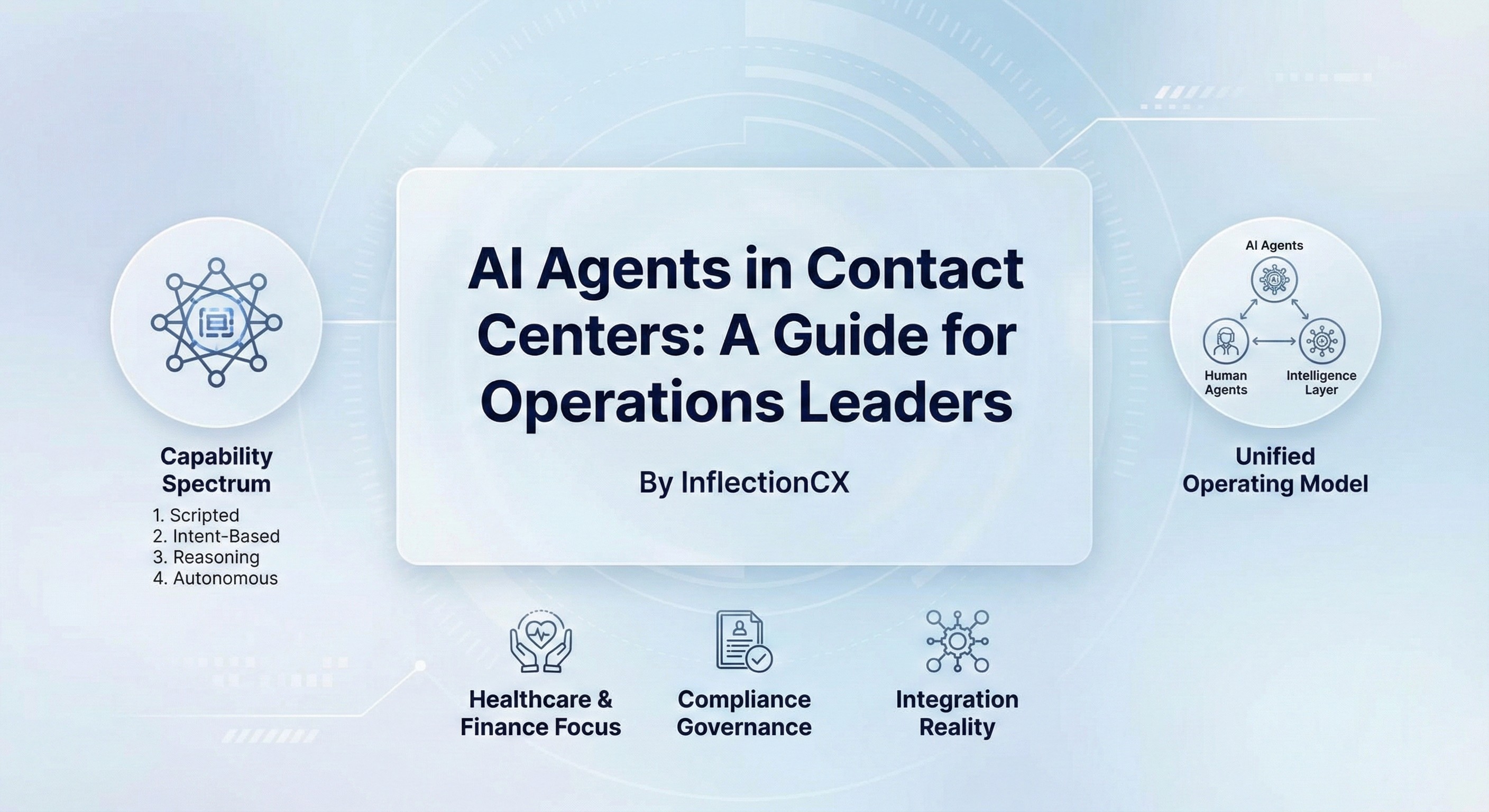
AI agents in contact center applications operate across four levels of capability. Vendors rarely volunteer which level they are selling. Understanding the spectrum protects you from buying Level 2 at a Level 4 price.
Level 1: Scripted Automation. The system follows pre-defined decision trees. It does not interpret language; it matches inputs to predetermined paths. This is the architecture underneath legacy IVR and rule-based chatbots. Deployment is straightforward and the behavior is predictable, but the system breaks when the customer's interaction doesn't follow the expected path, which happens at a rate that surprises organizations running this technology for the first time.
Level 2: Intent-Based Handling. The system interprets natural language well enough to identify what the customer is trying to accomplish and respond dynamically within a constrained scope. The constraint is critical: these systems perform well on interaction types they were trained on and degrade outside them. The majority of AI agents in production contact center deployments operate at this level, including many that are marketed as something more sophisticated.
Level 3: Reasoning and Action. The system can handle multi-step tasks, make decisions across integrated data sources, and adapt based on conversational context. It can be interrupted, redirected, and corrected mid-interaction without losing the thread. Genuine AI agents at this level exist and are in production deployments, but they require meaningful integration work, calibration time, and ongoing governance infrastructure to deliver reliable performance. A Level 3 agent in a well-defined domain with clean data integration performs substantially better than the same system deployed against fragmented infrastructure.
Level 4: Autonomous Orchestration. The system coordinates multiple agents or workflows to complete complex tasks end-to-end, with minimal human oversight. This represents the frontier of current development. Production deployments at this level in contact center environments are rare and require extensive guardrails. Organizations being told they can achieve this level of autonomy in a standard implementation timeline should examine that claim carefully.
The capability spectrum is not a ranking of better to worse. Level 1 systems are the right choice for specific, high-volume, low-variance tasks where predictability matters more than flexibility. The mistake is deploying a Level 2 system expecting Level 3 performance, or buying Level 3 capability for a use case that Level 2 would have handled at a fraction of the cost.
Where AI Agents Produce Operational Value
Contact center applications where AI agents reliably produce operational value share a consistent profile: the interaction type is high in volume, the required actions are well-defined, the data needed to complete those actions is accessible via integration, and the consequence of a handling error is recoverable. Where that profile holds, AI agents produce meaningful results. Where it doesn't, the economics and the performance deteriorate together.
High-volume transactional interactions. Appointment scheduling, balance inquiries, claim status requests, policy lookups, address updates, and similar interactions represent substantial portions of volume in healthcare and financial services contact centers. The task is clear, the data is retrievable, and the resolution criteria are objective. These are the interactions where AI agents are not compromising; they are the appropriate handler.
After-hours and overflow coverage. An AI agent does not have scheduling constraints. For organizations with significant after-hours inquiry volume or contact patterns that create peak periods exceeding staffing capacity, AI agents provide consistent coverage without the unit economics of human staffing. This is one of the cleaner deployment cases because the alternative is not a human agent; it is a voicemail, a callback, or a customer left waiting.
First-contact triage and routing. An AI agent that gathers context, verifies identity, and classifies intent before transferring to a human agent reduces the time human agents spend on intake and improves the accuracy of routing decisions. The value here is not containment; it is compression of the human agent's handle time on the interactions that require human handling.
Real-time agent assistance. AI systems that operate alongside human agents during live interactions, surfacing relevant account information, flagging compliance considerations, and suggesting next actions, produce measurable improvements in handle time, first-contact resolution, and quality scores without removing human judgment from the interaction. This application is underdeployed relative to its operational return, in part because it doesn't fit the "AI replacing humans" narrative that drives vendor marketing but doesn't reflect how the best-performing contact centers are using the technology.
Post-interaction processing. Summarization, disposition coding, follow-up task creation, and CRM updates consume significant agent time after every interaction and introduce variability in data quality when done manually at scale. AI agents can automate this work reliably on interaction types with well-defined outputs, freeing human agents for higher-value activity and producing cleaner operational data downstream.
Quality assurance at scale. Human QA programs evaluate a sample of interactions because full coverage is not feasible with human evaluators. AI-powered QA evaluates the full interaction population against consistent criteria, identifies compliance gaps, surfaces coaching opportunities, and generates performance pattern data that sample-based programs cannot produce. The operational intelligence that comes from 100% interaction evaluation changes how you understand your own contact center. It is an application we have built into our own operations and consider foundational, not supplemental.
Where AI Agents Break Down
The same operational experience that validates AI agent performance in certain applications reveals where the technology fails. These failure modes are not on the product roadmaps vendors share in sales processes, which is a reason to document them here.
Emotionally complex interactions. A customer calling about a denied claim involving a seriously ill family member, a financial services client in distress about an account freeze, a healthcare member navigating a billing dispute during an already difficult medical situation: these interactions require a human response. The best AI systems can detect elevated emotional states and route to human agents, but they cannot replace the human capacity to acknowledge distress, adapt tone in real time, and manage the relational dimension of a difficult conversation. Organizations that route these interactions to AI agents on the basis of cost do so at the expense of outcomes they will not be able to measure until they show up in churn and satisfaction data.
Regulatory gray areas. AI agents can be trained on regulatory requirements and configured to flag likely compliance exposures. They should not be the final judgment in interactions where the compliance question requires contextual interpretation. In HIPAA-governed healthcare interactions, FDCPA-governed collections, and state-specific financial services contexts, the ambiguities that create regulatory risk are precisely the ambiguities that current AI systems handle least reliably. Governance infrastructure matters here: an AI agent that was compliant at deployment may not remain compliant as regulations, policies, and conversational patterns evolve.
Novel scenarios. AI agents perform on patterns they have been trained on. When an interaction falls outside those patterns, because of a product change, a policy update, a crisis event, or simply a situation that wasn't represented in training data, performance degrades in ways that are difficult to predict in advance. The volume of genuine edge cases in production is reliably higher than pre-deployment modeling accounts for. This is not a reason to avoid deployment; it is a reason to build detection and escalation infrastructure before you need it.
Establishing trust in new customer relationships. In healthcare and financial services, customers in early-stage relationships carry elevated uncertainty about whether the organization will handle their data, their claims, and their money well. AI-first engagement during this period of relationship formation has produced measurable increases in early churn in deployments across both verticals. Trust is built in human interactions and then maintained through AI efficiency. Inverting that sequence has predictable consequences.
The Integration Problem
AI agents are bounded by the data and systems they can access. An AI agent that cannot retrieve a customer's account status, verify their identity against an authoritative source, or update a record in the CRM after completing an interaction is not an AI agent; it is an expensive IVR. The integration infrastructure that makes AI agents operationally useful is consistently underestimated in pre-deployment planning and consistently the source of the first delays in implementation.
Contact centers are built on layered infrastructure that accumulated over years rather than designed for coherence. CCaaS platforms, CRMs, EMRs or core banking systems, workforce management tools, and QA platforms were selected at different points in time to solve different problems. APIs exist where they were built for other integration purposes. Data models differ across systems. Authentication requirements add complexity at every integration point. An AI agent that works cleanly in a vendor's demonstration environment, connected to systems designed for that demonstration, will encounter a different reality when connected to a production contact center's actual infrastructure.
The questions to ask before any deployment commitment: Which systems does this AI agent need to read from and write to in order to complete the interactions you are targeting? What APIs are available for each of those integrations? What is the state of data quality in each of those systems? What authentication and security requirements apply? What happens to the interaction if a downstream system is unavailable during handling?
Get technical answers to those questions from your own IT and operations teams, not from the vendor. The delta between what integration requires and what the vendor's sales process represents it as requiring is one of the most reliable predictors of implementation timeline and cost overruns.
Compliance and Governance
In healthcare and financial services, compliance is not a deployment consideration; it is an operating condition. AI agents interacting with patients and members under HIPAA, or with consumers under FDCPA, TCPA, or state-specific financial regulations, are subject to the same requirements as human agents, with the additional complexity that AI behavior is harder to audit after the fact and harder to correct in real time.
The compliance infrastructure that AI agent deployments require includes: configuration that incorporates regulatory requirements into handling logic; monitoring that evaluates a sufficient sample of AI-handled interactions for compliance adherence; escalation protocols that route interactions exceeding the AI's compliance confidence to human agents; and a governance cadence that updates AI configuration when regulations, policies, or conversational patterns change.
That governance cadence is where most deployments are weakest. AI agents are treated as technology deployments with a go-live date and a maintenance mode. They are not. They are operational systems that require continuous monitoring for performance drift, and compliance drift is a specific form of performance drift that carries regulatory consequences rather than just operational ones.
Evaluating 100% of interactions, including AI-handled ones, against consistent compliance criteria produces the audit trail and the early warning system that regulated industry deployments require. We built this capability into our own operations before we considered it a client offering. The organizations that run AI agents without this infrastructure are accumulating regulatory exposure that will surface on the timeline of their next examination, not the timeline of their AI deployment.
The Unified Operating Model
AI agents are not a contact center strategy. They are infrastructure within a contact center strategy. The organizations that have generated durable operational improvement from AI agent deployment share a structural characteristic: they did not deploy AI agents into an existing operating model and wait for results. They redesigned the operating model around the division of labor between AI agents, human agents, and the intelligence systems that connect them.
InflectionCX calls this Unified CX Operations. The principle is that AI agents, human agents, and intelligence infrastructure operate on shared data, shared workflows, and shared performance visibility rather than as separate systems with separate vendor relationships, separate reporting, and separate governance.
In practice, this means several things. Interaction routing is determined by what produces the best outcome for each interaction type, not by what the AI agent can handle or what costs less per contact. The routing logic is explicit, maintained, and updated based on performance data. Human agents handling interactions that AI cannot take have real-time AI assistance available to them: relevant context surfaced, compliance considerations flagged, suggested actions available. The intelligence layer, quality assurance and coaching infrastructure, evaluates performance across AI-handled and human-handled interactions on the same criteria and closes the loop to both.
The economics of this model are different from the economics of AI deployment as cost reduction. The unit cost math on replacing human agents with AI agents is compelling in vendor presentations and frequently disappointing in production because it doesn't account for the interactions outside AI handling scope, the quality degradation that requires human recovery, or the workforce complexity created when the displaced volume is the easy volume and the hard volume remains. The unified model produces different math: AI handling the volume it handles well, human agents handling the volume that requires human capability, and an intelligence layer that makes both perform better over time.
Evaluating Vendors
The contact center AI vendor market is large, moving rapidly, and characterized by significant variance between what companies claim in sales processes and what they deliver in production deployments. A structured evaluation framework is not optional for organizations in regulated industries where a failed deployment carries compliance, workforce, and customer relationship consequences.
The evaluation questions that matter, and why they matter:
What interaction types is this system designed to handle, and what percentage of our actual volume do those represent? Every AI agent has a designed scope. Get it in writing before the contract, not after deployment. The interactions outside that scope are handled by something else; know what.
What does the system do when an interaction falls outside its scope? The answer reveals the quality of the escalation design. "Routes to a human agent" is a beginning, not an answer. What does the customer experience during that escalation? How much of the interaction context transfers? How does the human agent receive it?
What does a production deployment in our vertical look like, and can we speak with those clients? Reference checks in the same vertical and at comparable scale matter more than generic case studies. AI that performs well in retail does not necessarily perform well under HIPAA or FDCPA. Call the references.
What does integration with our specific systems require? Ask for a technical assessment against your actual infrastructure, not a general integration overview. The answer to this question is the foundation of your implementation timeline and your true cost of ownership.
How is compliance handled, and what happens when the AI gets it wrong? Get specific answers about liability, monitoring, and remediation. If the vendor cannot provide specific answers, the compliance governance model is not built.
What are the performance metrics, how are they defined, and how are they measured? Containment rate, deflection rate, CSAT, and handle time can all be defined in ways that flatter a system's apparent performance. Understand the measurement methodology before you use the numbers to build a business case.
What is the governance model for keeping the system calibrated over time? The AI you deploy today will need to be updated as your products, policies, regulations, and customer patterns change. Who does that work, on what cadence, triggered by what signals?
What Implementation Looks Like
AI agent implementations in contact centers follow a consistent pattern that differs from the timeline and resource requirements projected in vendor sales cycles. Understanding that pattern before committing resources protects both the business case and the relationship with leadership that funds it.
The first phase, integration and configuration, takes longer than planned in nearly every production deployment. System integrations surface data quality issues that weren't visible until connection was attempted. Edge cases in your interaction population that weren't represented in training data require remediation. Security and authentication requirements add steps. Budget additional time and technical resource for this phase. It is not an indication that the technology is wrong; it is the nature of deploying AI into real operational infrastructure rather than demonstration environments.
The second phase, calibration against live traffic, produces performance below projected levels in the early period. Containment rates in this phase will not match the numbers from UAT or the projections from the business case. This is expected behavior. The system is performing against your actual interaction population for the first time, and adjustment is required. The organizations that force higher containment in this phase before the system is calibrated for it do so at the expense of customer experience and generate data quality problems that take longer to resolve than the containment pressure saved.
The third phase, optimization and scope expansion, is where the operational return that justified the investment begins to materialize. If the initial deployment scope is performing well against calibrated metrics, this is when adjacent interaction types are brought into AI handling and when the data generated by the first phase becomes actionable for performance improvement.
Ongoing operation is a governance function, not a maintenance mode. AI agent performance drifts as the operational environment changes. Regulatory updates, product changes, policy revisions, and shifts in customer behavior all affect how a trained model performs against current interactions. The organizations that treat AI agent governance as an ongoing operational responsibility rather than a post-deployment cleanup function sustain their performance over time. The organizations that don't will face a re-calibration project at the worst possible moment.
How to Know If You're Ready
The question contact center leaders should answer before initiating an AI agent evaluation is not whether AI agents are ready for contact centers. For specific applications, with appropriate infrastructure and governance, they are. The question is whether your contact center is ready for AI agents.
The readiness factors that determine deployment outcomes:
Operational baseline clarity. Do you have accurate, current data on your interaction volume by type, your containment and resolution rates by channel, your handle time by interaction segment, and your cost per interaction by category? AI agent business cases built on estimated or outdated operational data produce projections that don't survive contact with production results. The baseline exists to set honest expectations and to measure against.
Interaction taxonomy. Have you mapped your interaction types and identified which ones are high-volume, low-variance, and supported by accessible data? This is the foundation of deployment scoping. Without it, you are deploying against assumptions rather than against a defined operational target.
Infrastructure readiness. What is the state of your integration environment? Are the APIs available that AI agent operation will require? What is the quality of the data in the systems the AI agent will need to access? These questions have answers, and the answers determine your actual implementation timeline and cost.
Workforce impact clarity. AI agent deployment changes what human agents do. The volume they previously handled shifts; the complexity profile of what remains changes; the skills required to handle it may need development. Organizations that plan for this transition before deployment maintain workforce stability and performance continuity through it. Organizations that address it after the fact manage the consequences of not having planned.
Governance infrastructure. Who owns ongoing AI agent performance monitoring after deployment? What metrics trigger a review? What is the process for updating the system when regulations, products, or policies change? These are operational questions with operational answers. If the answers don't exist before deployment, the governance function defaults to whoever is closest to the problem when it surfaces, which is a reliable path to inconsistent outcomes.
Honest success criteria. Define what success looks like at 90 days, six months, and twelve months before you begin. Define it against metrics that reflect actual operational value: resolution rate, customer experience scores, compliance adherence, cost per resolved interaction. Not containment rate in isolation, which measures how many interactions the AI handled without measuring whether it handled them well.
The readiness assessment is not a reason to delay indefinitely. It is a tool for deploying deliberately. Contact center leaders who have been burned by technology investments that underdelivered understand the difference between buying something and implementing something. AI agents are no different in that respect. The proof of value is in the production results, and the production results are a function of what you put in place before the technology goes live.
About InflectionCX
InflectionCX provides unified contact center operations for healthcare and financial services organizations, combining AI agents, human agents, and proprietary intelligence systems under a single operational architecture. Our AI systems were built to solve our own operational problems before they were offered to clients. That experience is the basis for what we have written here.
If you are evaluating AI agents for your contact center, we will tell you what we have seen work, what we have seen fail, and what we think your operation is ready to deploy. We do not run demonstrations before we understand your operational baseline.
More in Guides

Ready for Better CX?

Whether you're selecting your CX technology stack or evaluating outsourcing options, InflectionCX is your go-to-partner. Contact us today.