
Sarah Mitchell
CX Industry Analyst
The trade press covered the Verint brand unification in February as a corporate housekeeping story. Verint absorbs Calabrio. Calabrio's product name continues. Dave Rhodes, formerly Calabrio's CEO, takes over the combined company. The messaging emphasizes an "AI-powered CX automation platform" and the industry's "broadest" portfolio.
That framing misses what is actually happening.
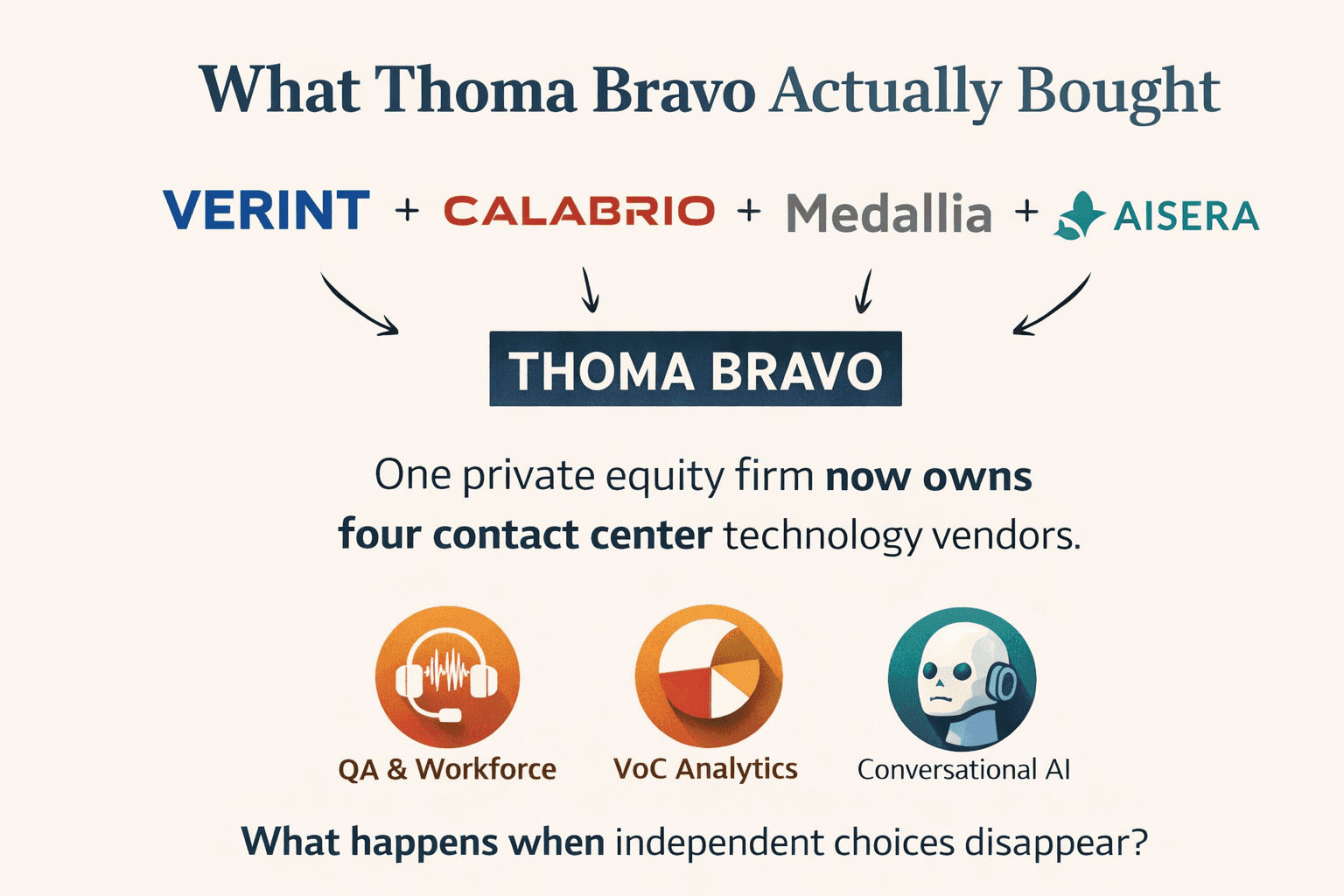
Thoma Bravo, a private equity firm with $184 billion in assets under management, has assembled the most concentrated portfolio of contact center quality and workforce technology in the market. The firm now controls Verint, Calabrio, Medallia, and Aisera. That covers quality assurance and quality management, workforce engagement management, voice of the customer analytics, and conversational AI. For the thousands of contact center operations that depend on some combination of these tools to evaluate, schedule, and improve their workforce, the question is no longer which vendor to choose. It is what happens when a single PE firm owns most of the choices.
What Thoma Bravo Actually Bought
The Verint acquisition closed on November 26, 2025, at $2 billion in enterprise value. Within weeks, Thoma Bravo combined Verint with Calabrio and installed an operating partner as interim chairman. Dan Bodner, who had led Verint since its origins as a Comverse division in the 1990s, transitioned to an advisory role. Dave Rhodes took over as CEO in February 2026. Hundreds of employees were laid off shortly after, consistent with the PE integration playbook that DMG Consulting had predicted months earlier: cost-cutting, duplication elimination, and tightened R&D budgets.
The product overlap between Verint and Calabrio is extensive. Both offer quality assurance, automated quality management, recording, analytics, workforce management, and surveying. These are not complementary businesses being combined for breadth. They are direct competitors being merged for margin. The strategic logic is consolidation, not innovation.
Layered on top of that are Medallia, which Thoma Bravo took private for $6.4 billion in 2021, and Aisera, a conversational AI platform in which Thoma Bravo led a $90 million Series D. Medallia competes with Verint in voice of the customer analytics. Aisera competes with Verint's bot and automation capabilities. Whether these assets eventually fold into the combined platform or remain separate portfolio companies, the competitive dynamics shift either way. Thoma Bravo controls both the products and the alternatives.
The Roadmap Risk Nobody Is Writing About
When a publicly traded company like Verint reports earnings, it publishes product roadmaps, defends R&D investment to analysts, and faces competitive pressure to ship features. When that same company goes private under PE ownership, the incentives change. The pressure shifts from product innovation to margin expansion. R&D budgets tighten. Roadmap timelines extend. The features that get prioritized are the ones that drive renewals and upsells, not necessarily the ones that solve the hardest operational problems.
For contact center operations teams that built their quality programs around Verint's evaluation frameworks, or their scheduling workflows around Calabrio's WFM, the practical question is straightforward: will the tools you depend on continue to improve at the pace your operation requires?
DMG Consulting framed this directly in their assessment of the deal. Thoma Bravo's early moves would center on eliminating duplication and consolidating overhead while tightening R&D and go-to-market budgets. That is not speculation. It is the playbook. Thoma Bravo laid off between 40% and 50% of staff at the Boeing Digital Aviation Solutions companies it acquired in 2025, within months of closing those deals. The Verint layoffs, reported at hundreds of positions across multiple regions, follow the same pattern.
None of this means the product stops working tomorrow. It means the product evolves more slowly, support responsiveness may change, and the competitive pressure that previously pushed Verint and Calabrio to improve against each other no longer exists. The two sharpest competitors in the WEM and QA space are now the same company, owned by a firm whose stated strategy is to build a profitable platform through scale efficiencies.
What This Means for QA and WFM Buyers
Contact center quality assurance has historically been one of the most vendor-dependent functions in operations. QA scorecards are built inside the platform. Evaluation workflows are configured around platform-specific features. Calibration processes assume platform-level consistency. Switching QA tools is not like switching a CRM integration. It touches how supervisors evaluate agents, how coaching programs are structured, and how compliance documentation is maintained.
That dependency gives the merged Verint-Calabrio entity significant pricing power. Buyers who have built multi-year QA programs inside these platforms face meaningful switching costs. When the combined company begins optimizing for margin, as private equity acquisitions invariably do, those switching costs become leverage.
The same dynamic applies to workforce management. WFM configurations, forecasting models, scheduling rules, and adherence reporting are deeply embedded in operational workflows. Migrating WFM platforms is a multi-month project that affects every frontline supervisor and every scheduling decision during the transition.
For operations leaders running these tools today, the immediate action is not to panic-migrate. It is to assess concentration risk. How many critical operational functions depend on platforms now controlled by a single PE firm? Is your QA evaluation framework portable, or is it locked inside a vendor-specific configuration that would take months to rebuild? If Verint raises prices 15% at renewal, which it now has market positioning to do, what is your alternative?
The Structural Opportunity for Independent QA
Consolidation at the vendor level creates structural opportunity for operational approaches that do not depend on any single platform's evaluation framework.
Quality assurance that is built as a portable, structured data layer rather than a vendor-locked configuration can survive platform transitions, PE-driven pricing changes, and roadmap slowdowns without operational disruption. When evaluation logic lives in a system designed around the client's quality framework rather than the vendor's product architecture, the switching cost drops dramatically. The QA program travels with the operation, not with the tool.
That is the direction the market needs to move regardless of what happens with Verint. The contact center industry has treated QA as a feature inside the WFM or CCaaS platform for too long. The result is that most operations cannot change their evaluation approach without changing their technology, and cannot change their technology without disrupting their evaluation approach. It is a dependency loop that PE consolidation is about to make more expensive.
Operations that decouple quality evaluation from platform dependency are positioned to negotiate from strength rather than captivity. They can adopt new CCaaS or WFM platforms based on operational fit without rebuilding their entire quality program. They can run evaluation frameworks that work consistently across multiple platforms, sites, and delivery models. And they can make QA decisions based on what produces the best outcomes for their clients and members, rather than what the vendor's product supports.
What to Watch
Three dynamics will play out over the next 12 to 18 months.
First, pricing. Verint and Calabrio's combined customer base gives the unified entity leverage that neither had alone. Watch for renewal pricing changes, particularly for mid-market customers who lack the negotiating power of Fortune 100 accounts.
Second, product rationalization. Thoma Bravo has said the Calabrio product name will continue. Whether that means genuine parallel development or a gradual sunset of one platform in favor of the other will become clear as engineering resources are allocated post-integration. The first indicator will be feature parity. When one platform stops receiving capabilities that the other gets, the rationalization has begun.
Third, talent. Hundreds of employees have already been laid off. The people who built the evaluation frameworks, the WFM algorithms, and the AI capabilities that made these products valuable are dispersing into the market. Some will land at competitors. Some will start companies. The institutional knowledge that made Verint and Calabrio category leaders is not preserved by the brand unification. It walks out with the people.
For contact center operations leaders, the Verint-Calabrio merger is not a product announcement. It is a structural change to the vendor landscape that affects how you evaluate, schedule, and improve your workforce. The organizations that recognize this early and begin reducing their platform dependency will be better positioned than those who wait for the renewal notice.
InflectionCX is a unified CX operations company combining AI agents, human agents, and intelligence systems. Our quality assurance framework, Atlas, is designed as a portable evaluation layer that operates independently of any single CCaaS or WFM platform.
More in Analysis


About InflectionCX

Strategy, technology, and operations from a single partner.
InflectionCX runs contact centers with human agents and AI agents inside one operating system. We handle the technology, the people, and the operations. You get lower costs, tighter compliance, and better outcomes.