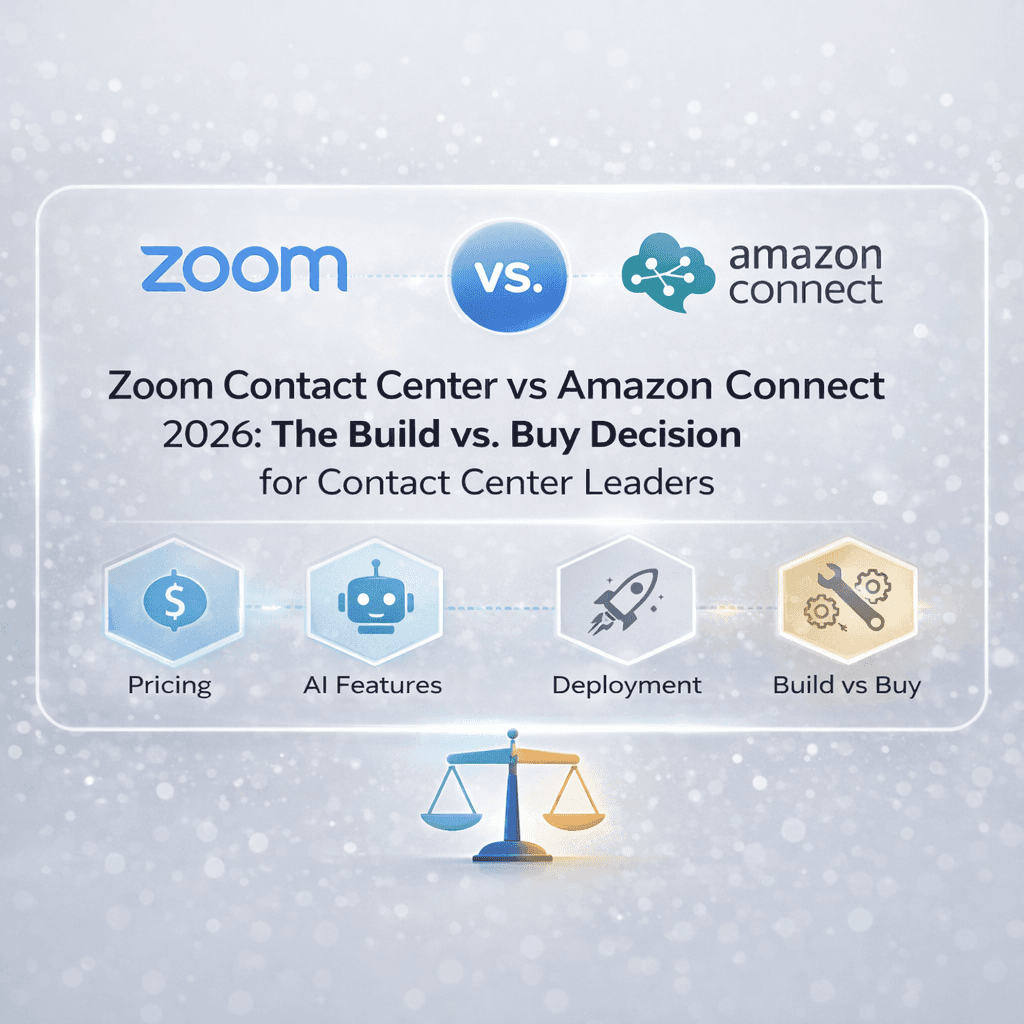

Gannon Costello
CX Technology Analyst
InflectionCX runs multi-state contact center operations on Zoom CX for healthcare and financial services clients. This comparison reflects what we know from deploying and operating the platform daily, combined with documented analyst research, user reviews, and vendor data from 2024 through early 2026.
Amazon Connect gives you extraordinary customization if you have AWS developers on staff. Zoom Contact Center gives you a working contact center in weeks with AI features included at no extra cost. Connect costs less per minute but hides real expense in Lambda functions, storage, support contracts, and the technical headcount needed to build and maintain the platform. Zoom costs more per seat but delivers predictable billing and faster time to value. If your organization has deep AWS expertise and wants unlimited architectural flexibility, Connect is worth evaluating. If you need to be operational quickly and want your CX team focused on customers instead of infrastructure, Zoom is the stronger choice.
This is the build vs. buy question applied to contact center infrastructure, and the answer depends on your operational constraints more than any feature checklist. InflectionCX advises enterprise CX teams on this decision regularly because the wrong choice creates years of compounding cost, whether that cost shows up in AWS invoices or in delayed time to value.
This analysis draws on Gartner Peer Insights reviews, G2 user feedback, Forrester research, vendor documentation, and analyst commentary from 2024 through early 2026.
How Do Zoom Contact Center and Amazon Connect Compare Overall?
Capability | Amazon Connect | Zoom Contact Center | Edge |
|---|---|---|---|
Deployment Speed | Days to months depending on complexity | 2 to 8 weeks typical | Zoom |
Pricing Transparency | Per-minute plus multiple variable components | Per-seat tiers with defined feature sets | Zoom |
AI Capabilities | Embedded via Q, Lex, Contact Lens (simplified pricing since March 2025) | AI Companion included at no extra cost | Zoom |
Ease of Use | Requires AWS expertise and developer resources | Familiar Zoom interface, low-code flow builder | Zoom |
Customization Depth | Unlimited via AWS services integration | Constrained to platform capabilities | Connect |
Enterprise Maturity | Gartner Leader, third consecutive year | Gartner Magic Quadrant inclusion, first year (2025) | Connect |
Video Integration | Requires third-party tools | Native video escalation from any channel | Zoom |
Workforce Management | Available via optimization features | Elite tier ($149/month) | Connect |
Unified Communications | Separate from UCaaS | Same platform as Zoom Phone, Meetings, Team Chat | Zoom |
Does Amazon Connect Require Developers to Set Up and Run?
This is the question that should come before any pricing comparison or feature checklist. Amazon Connect's value depends on your organization having dedicated technical resources with AWS expertise. The platform delivers real flexibility. It also requires real capability to make that flexibility work.
User reviews across G2 and Gartner Peer Insights document this consistently. One reviewer warned that the platform is "not for beginners, thinking it's just to install, set up, and be ready to go." Another described the learning curve as "steep" even for technically capable teams. A third noted that implementation "requires more than just a flow at first, internal network configuration, integrations into current systems."
Job postings tell the same story. Amazon Connect specialist roles routinely require 3 to 5 years of experience, proficiency in Python or Node.js, and deep knowledge of Lambda, DynamoDB, S3, CloudWatch, and API Gateway. AWS itself recommends establishing a "Center of Excellence" staffed with contact center domain experts, technical specialists, change management leads, and analytics professionals. That is ongoing headcount, not a one-time implementation cost.
Analyst Rebecca Wetteman, CEO of Valoir, put it directly in CX Today's coverage of the March 2025 Next Generation Connect release: "When we start talking about CX and AI in the contact center, it cannot be a 'here you go, developers, build a house out of an acorn and a hunk of steel.' It has to be more turnkey integrated for the business user."
No Jitter's competitive analysis was equally direct: "Businesses can't really do anything with Connect until they go through the seven-step AWS sign-up process... many organizations simply don't have the skills to set up a call center from basic building blocks."
AWS addressed these concerns with the March 2025 "Next Generation" release, which embedded first-party AI across all channels with single-click enablement and introduced simplified pricing. Analyst Liz Miller of Constellation Research described this as AWS "taking responsibility and providing users with the necessary out-of-the-box features." That was a meaningful step forward. The fundamental dynamic has not changed: Connect rewards engineering investment and punishes organizations that underestimate the technical commitment.
The honest question for your team is whether you want to build a contact center or operate one. Organizations with strong engineering cultures and existing AWS infrastructure get real value from Connect's platform approach. Organizations that need their CX leadership focused on customer outcomes rather than infrastructure management will get to value faster on Zoom.
Is Zoom Contact Center Enterprise-Ready?
Zoom earned first-time inclusion in the 2025 Gartner Magic Quadrant for CCaaS just three years after launch. Amazon Connect has been a Gartner Leader for three consecutive years. That gap in analyst positioning is real and worth acknowledging.
It is also worth putting in context. Zoom is a six-time Leader in the Gartner Magic Quadrant for UCaaS. It is one of only two companies with placements in both the UCaaS and CCaaS Magic Quadrants. In the 2025 Gartner Peer Insights Voice of the Customer report, 91% of Zoom Contact Center customers indicated willingness to recommend the platform, a figure higher than many of the established CCaaS providers in the analysis.
Zeus Kerravala, a widely cited industry analyst, noted that Zoom "can go toe-to-toe with anyone" based on its innovation velocity. Sheila McGee-Smith of McGee-Smith Analytics observed that "Zoom may be the new kid on the block, but they are getting noticed." CX Today's Magic Quadrant analysis noted that Zoom's trajectory suggests it will rise in coming years as it addresses breadth of features and third-party integration gaps that Gartner identified.
Where the platform is still maturing:
Workforce management capabilities require the Elite tier at $149 per user per month. Competitors include forecasting and scheduling at lower price points. Organizations with complex multi-skill scheduling across hundreds of agents should evaluate whether Zoom's WFM meets their specific requirements or whether a dedicated WFM tool integrated via API is the better path.
Outbound calling capabilities are functional but newer than what you would find on Five9 or NICE. Organizations running significant outbound programs with predictive dialing, campaign management, and compliance controls should evaluate carefully.
The email channel works but is not yet at parity with voice and chat in terms of depth. Organizations with high email volume and complex email routing should test before committing.
One Gartner Peer Insights reviewer noted that "if something is part of the contact center, it isn't part of the regular phone system; they are managed separately." This administrative separation adds overhead for teams expecting fully unified management.
We run our healthcare and financial services operations on Zoom CX. The platform handles the compliance, routing, analytics, and AI requirements we need in regulated industries. The gaps listed above are real, and we work around some of them. The pace at which Zoom closes these gaps is also real, and it is faster than any other CCaaS provider we track. That trajectory matters when you are making a three-year platform commitment.
How Much Does Amazon Connect Actually Cost?
Amazon Connect's per-minute pricing looks attractive on paper. The total cost picture is more complicated, and the complexity itself becomes a cost.
According to Amazon Connect's official pricing page, the March 2025 "Unlimited AI" pricing offers $0.038 per minute for voice, including AI features, plus telephony charges. A la carte pricing starts at $0.018 per minute for basic voice. These are the starting point, not the total.
Here is what adds up beyond the base rate:
Telephony: $0.0022 per minute for US DID inbound calls, plus $0.03 per day for number rental. Outbound calling adds per-minute charges that vary by destination. International rates compound quickly for global operations.
Analytics: Contact Lens costs $0.015 per minute for the first 5 million minutes. Organizations wanting conversational analytics, sentiment detection, and automated quality management pay this on top of base voice charges.
Conversational AI: Amazon Lex voice requests cost $0.004 per request. Complex IVR flows with multiple Lex invocations multiply this cost per interaction.
Storage: S3 call recording storage costs approximately $0.023 per GB per month. High-volume contact centers accumulate significant storage costs, especially in regulated industries where retention requirements extend to 7 or 10 years.
Compute: Lambda function costs include $0.20 per million requests plus compute charges based on memory and execution duration. One user reported a Lambda function for sentiment analysis costing $86 per day before optimization. After a 97.7% reduction, it still cost $730 per year. That is one function.
Workforce tools: Forecasting and scheduling cost $27 per agent per month. Amazon Q in Connect costs $40 per agent per month as a standalone feature.
AWS Support: Not included in platform pricing. Business Support costs 10% of monthly AWS spend with a $100 minimum. Enterprise Support for mission-critical operations costs more.
Data egress: $0.09 per GB for data transferred out of AWS. Analytics exports, CRM integrations, and backup processes all trigger egress fees.
Nextiva's analysis summarized the core budgeting challenge: "Your final bill combines many line items, usage, number rentals, call connection fees, features, and is complex to review." CloudTalk's pricing breakdown confirmed that pricing "can be unpredictable and hard to estimate." AWS re:Post discussions confirm that "AWS bill shock is so common that several consulting agencies specialize in decoding AWS bills."
A 75-agent contact center handling 100,000 voice minutes and 50,000 chat messages would pay approximately $4,780 per month in base charges alone. That figure excludes advanced features, support contracts, custom development labor, and the ongoing technical headcount needed to maintain the platform.
How Much Does Zoom Contact Center Cost?
Zoom Contact Center publishes three pricing tiers with defined feature sets. You know what you are paying before you sign.
According to Zoom's pricing page:
Tier | Monthly Cost | What You Get |
|---|---|---|
Essentials | $69 per user | Voice, Chat, SMS, Video, AI Companion (transcription, summaries, sentiment) |
Premium | $99 per user | Everything in Essentials plus Email, Social Channels, Outbound Dialer |
Elite | $149 per user | Everything in Premium plus AI Expert Assist, Quality Management, WFM |
AI Companion ships at no additional cost on all tiers. That includes automatic conversation summaries, real-time sentiment analysis, keyword detection, and post-call task generation. Competitors typically charge $20 to $30 extra per agent per month for comparable AI features. At 75 agents, that is $1,500 to $2,250 per month you are not paying with Zoom.
Dependencies to account for: Zoom Contact Center requires a Zoom Workplace Business subscription at $199.90 per user per year. Organizations not already on Zoom should include this in total cost modeling. Telephony costs are separate through Zoom Phone or BYOC configurations.
A 75-agent center on the Premium tier pays approximately $7,425 per month for seat licenses. That is higher than Connect's base estimate but includes AI features that Connect charges separately for, eliminates usage variability risk, and does not require technical headcount to maintain the platform.
For organizations already using Zoom for meetings and phone, the incremental cost of adding Contact Center is lower and the integration value is higher. You are not adding a new vendor to your stack. You are extending the platform your agents already know.
How Do AI Features Compare Between Zoom and Amazon Connect?
Both platforms invested heavily in AI through 2024 and 2025. The approaches are different in ways that matter operationally.
AI Capability | Amazon Connect | Zoom Contact Center | Cost Included? |
|---|---|---|---|
Conversation Summaries | Yes, via Amazon Q | Yes, via AI Companion | Connect: included in Unlimited AI pricing. Zoom: included on all tiers |
Real-Time Transcription | Yes, via Contact Lens | Yes, via AI Companion | Connect: $0.015/min (a la carte). Zoom: included |
Sentiment Analysis | Yes, via Contact Lens | Yes, via AI Companion | Connect: $0.015/min (a la carte). Zoom: included |
Agent Assist / Suggested Responses | Yes, via Amazon Q | Yes, via AI Expert Assist | Connect: $40/agent/month (standalone). Zoom: included on Elite tier |
Virtual Agent / Chatbot | Yes, via Amazon Lex | Yes, via Zoom Virtual Agent | Connect: $0.004/request. Zoom: included |
Voice Self-Service AI | Yes, via Lex + Connect Voice ID | Yes, via AI Virtual Voice Agent (Oct 2025) | Connect: per-request. Zoom: included |
Custom AI Model Integration | Yes, via Amazon Bedrock | Limited to platform roadmap | Connect: additional cost. Zoom: not available |
Quality Management Scoring | Yes, via Contact Lens | Yes, via Zoom QM | Connect: included in Unlimited AI. Zoom: Elite tier |
Amazon Connect gives you more flexibility to customize AI models through Bedrock, train on proprietary data, and build specialized capabilities beyond what AWS provides natively. The March 2025 "Next Generation" release made activation simpler with single-click enablement and bundled AI pricing, which was a direct response to criticism that Connect's AI required too much assembly.
Zoom's approach is different. AI Companion is on by default, works out of the box, and costs nothing extra. For most contact center operations, the native AI capabilities cover what agents and supervisors need: transcription during calls, summaries after calls, sentiment tracking for supervisors, and knowledge base suggestions during interactions. The October 2025 AI Virtual Voice Agent release extended this to voice self-service, competing directly with Lex. At Zoomtopia 2025, Zoom announced that AI Expert Assist has gone agentic, meaning it can execute actions (process a refund, update an account, schedule a callback) with agent supervision rather than just suggesting them.
In our operations, AI-assisted summarization reduces after-call work from roughly 4.5 minutes to about 30 seconds per interaction. Across a 100-agent center handling 400 calls per day, that is over 2,600 hours of agent time recovered per month. That math works on either platform. The question is how fast you get there and what it costs to maintain.
For organizations that need to build custom AI workflows, integrate proprietary machine learning models, or push beyond what any commercial platform provides natively, Connect's architecture gives you more room. For organizations that want AI working across their contact center within days of deployment, Zoom delivers that without a development team.
How Long Does Each Platform Take to Deploy?
Amazon Connect deployments range from 2 days to many months depending on scope. AWS customer stories highlight rapid examples: Dow Jones deployed "in just three weeks instead of months" for basic service desk functionality. Hankook achieved a 2-day deployment for remote work enablement. These represent straightforward implementations without complex integrations.
Enterprise deployments with custom routing, CRM integrations, workforce management, and specialized reporting need longer timelines. AWS recommending a Center of Excellence is not marketing language. It signals that ongoing development investment is expected, not optional.
The AWS partner ecosystem helps bridge capability gaps. TTEC Digital has completed 500+ Connect deployments. Persistent Systems specializes in legacy modernization. VoiceFoundry focuses on mid-market implementations. These specialists know what they are doing, but they add consulting costs to the total investment.
Zoom Contact Center deployments cluster in the 2 to 8 week range for standard implementations. Platform familiarity is a genuine accelerator. If your agents already use Zoom for meetings, the contact center interface feels like the same application because it is the same application.
Deployment stories back this up. Vensure Employer Solutions "moved 3,000 people in a single day" without service interruptions. Topaz Services described onboarding as "swift and efficient." One Gartner Peer Insights reviewer noted: "During the RFP process, Zoom was the only vendor to conduct a reverse demo and truly understand our business workflows." Another reported "successfully converted multiple call centers receiving over 100,000 calls in six months."
Zoom recommends phased migrations, deploying one department and channel at a time. The Zoom Up Partner Program spans 8,000+ partners across 150+ countries with specific contact center sales and implementation competencies. InflectionCX is one of those partners, and we handle deployment alongside ongoing operations for clients who want both.
The deployment timeline difference reflects the core architectural difference between these platforms. Connect's flexibility requires corresponding implementation investment. Zoom's integrated approach gets you to production faster and keeps your CX team focused on operations rather than infrastructure.
What Happens When You Migrate From a Legacy Platform?
Migration is where plans meet reality. Both platforms support it, but the experience differs.
Amazon Connect migrations from legacy systems like Avaya show documented returns. Forrester Research found a 241% ROI with payback in under one year for Connect implementations. ANA X airline achieved 58% lower monthly running costs after migration. These results assume successful implementation and sustained operations.
Migration challenges concentrate around integration complexity. Legacy telephony, CRM connections, workforce management tools, and custom applications all need reconnection. Organizations with extensive technology ecosystems face longer timelines and higher risk. The AWS partner ecosystem provides migration expertise through validated Service Delivery Partners who specialize in specific source platforms like Avaya, Cisco, and Genesys.
Zoom migrations benefit from platform simplicity. The familiar interface reduces training requirements significantly. One agency "successfully converted multiple call centers receiving over 100,000 calls in six months" according to Gartner reviews. Zoom's technical library documents migration strategies including parallel operation, phased cutover, and direct replacement.
Both platforms support hybrid deployments during transition. You can route specific call types or departments to the new platform while keeping legacy systems running for complex scenarios. This reduces risk but extends timelines.
The migration pitfalls are the same regardless of destination: underestimating integration complexity, discovering undocumented dependencies, and underbudgeting for agent training. We have seen all of these across our deployments. The organizations that migrate successfully are the ones that treat it as an operational transformation, not a software installation.
Does Video in Customer Service Actually Matter?
Video gets mentioned in every Zoom Contact Center review as a differentiator. The honest answer is that it matters a lot for specific use cases and very little for others.
Zoom Contact Center allows escalation from voice or chat to video without leaving the interaction. Agents can share screens, see customer environments, and demonstrate solutions visually. This is native to the platform, not bolted on. Amazon Connect does not have native video capabilities. Organizations that need video must integrate third-party tools, which adds complexity and creates seams between the voice and video experience.
Metrigy research put numbers to this: companies using visual engagement achieved 22% higher revenue, 25% higher customer ratings, and 18% better agent efficiency compared to voice-only interactions. According to Frost and Sullivan, 50% of financial services firms already use video chat for customer interactions, with another 44% planning to adopt within the year.
Where video creates real value:
Healthcare: HIPAA-compliant video consultations without a separate telehealth platform. Patients connect with providers through the same contact center infrastructure that handles scheduling calls and billing questions. We use this in our healthcare operations.
Financial services: Advisors walk clients through portfolio reviews, loan applications, and account setup face to face. The trust dynamic is different on video than on a phone call, and for high-value interactions that difference translates to revenue.
Technical support: Seeing the actual problem beats interpreting a verbal description. Cricut's customer service team described video escalation as "a game-changer" for diagnosing product issues.
Field service: Remote diagnostics before dispatching a technician saves truck rolls. That is direct cost reduction.
Where video adds less value: high-volume transactional interactions, basic account inquiries, and use cases where speed matters more than depth. If your contact center handles mostly quick calls and chats, video is a nice capability to have available but will not change your operational metrics.
The strategic question is whether any of your interaction types would benefit from face-to-face engagement. If the answer is yes, Zoom is the only major CCaaS provider that delivers this natively. If the answer is no, it is still a good platform for other reasons, and the video capability costs you nothing extra to have available.
What Do Both Platforms Miss? The Unified CX Gap.
Neither platform delivers what InflectionCX calls Unified CX out of the box. Unified CX is the integration of AI agents and human agents under single governance, quality standards, and analytics. Both platforms require deliberate architectural decisions to get there.
Amazon Connect's modular architecture lets you construct Unified CX, but the design effort falls entirely on your team. You have to intentionally architect single governance across channels, consistent quality standards across AI and human interactions, and unified analytics that span automated and agent-assisted experiences. The building blocks are there. Assembly is your responsibility.
Zoom Contact Center's integrated architecture simplifies some of this and constrains other parts. Native AI reduces integration complexity. Platform boundaries limit governance options. Organizations standardized on Zoom achieve unified communications naturally. Organizations with mixed technology environments face integration work.
In practice, what we see across client engagements is that the platform choice influences but does not determine whether you achieve Unified CX. The organizations that get there are the ones that pair their platform with an operational layer that enforces consistent quality regardless of whether an AI or a human handled the interaction.
In our deployments, this means 100% interaction analysis across both AI and human conversations under a single quality framework. In healthcare and financial services, where compliance teams need to prove what happened on every interaction, the industry-standard practice of manually reviewing 3 to 5% of calls is not acceptable. It creates audit risk and misses the patterns that drive quality improvement. Our Atlas system extends Zoom's native Quality Management to cover every interaction. Our Encore system turns the patterns Atlas identifies into targeted coaching that actually changes agent behavior.
You can build comparable operational discipline on either platform. On Zoom, you get there faster because the native integration points are simpler and the AI features are already running. On Connect, you have more architectural flexibility but need more time and more technical resources to realize it.
Frequently Asked Questions
Which platform costs less for a 100-agent contact center?
Total cost depends on usage patterns, feature requirements, and whether you have AWS technical resources on staff. Amazon Connect's usage-based pricing is less expensive for low-volume or highly variable operations where in-house AWS expertise already exists. Zoom's per-seat pricing is less expensive for predictable volumes given the AI features included at no extra charge. A 100-agent center handling 150,000 monthly voice minutes would pay approximately $6,000 to $8,000 monthly under Connect's Unlimited AI pricing, compared to $9,900 to $14,900 monthly under Zoom depending on tier. The Connect estimate excludes implementation costs, ongoing development labor, and AWS support contracts that organizations without existing AWS expertise will need.
How long does implementation actually take?
Amazon Connect implementations range from days for basic deployments to 6 or more months for complex enterprise scenarios with custom integrations. Zoom implementations typically complete in 4 to 8 weeks for standard deployments. Organizations migrating from legacy platforms should add 2 to 4 months for parallel operation and cutover regardless of destination. Implementation timeline depends more on organizational readiness and integration complexity than on which platform you choose.
Can Zoom Contact Center handle enterprise scale?
Yes. Zoom Contact Center supports enterprise deployments with customers operating thousands of agents. Gartner's positioning reflects feature breadth relative to established competitors, not scale limitations. Enterprises with complex workforce management requirements, large outbound programs, or advanced analytics needs may find gaps relative to NICE or Genesys. Enterprises prioritizing unified communications, video integration, AI included at no extra cost, and fast deployment find Zoom capable at scale. We operate it daily in regulated industries.
Does Amazon Connect require developers?
Basic Amazon Connect deployments can launch without dedicated developers using the visual flow builder. Any meaningful customization, CRM integration, custom reporting, or AI configuration requires technical resources with AWS expertise. Organizations should plan for ongoing technical investment to extract full platform value. The March 2025 Next Generation release simplified some capabilities but did not eliminate the technical expertise requirement for complex scenarios.
Which platform has better AI capabilities?
Both platforms offer comparable core AI capabilities: conversation summarization, real-time assistance, sentiment analysis, and quality automation. Amazon Connect provides more customization through Amazon Bedrock integration and Lex configuration. Zoom provides simpler activation with AI Companion included at no additional cost on every license. Organizations that need to build custom AI workflows and train on proprietary data will find more room on Connect. Organizations that want AI working across their contact center on day one without a development team will get there faster on Zoom.
Is Amazon Connect pricing really unpredictable?
Multiple independent sources confirm this. Nextiva's analysis found pricing "complex to review" with many combined line items. CloudTalk described it as "unpredictable and hard to estimate." AWS community discussions confirm that bill shock is common enough that consulting agencies specialize in decoding AWS bills. The March 2025 Unlimited AI pricing simplified the AI component but did not eliminate the variable cost structure across telephony, storage, compute, support, and data egress.
Can Zoom Contact Center meet healthcare and financial services compliance requirements?
Yes. Zoom Contact Center supports HIPAA compliance through Business Associate Agreements, encrypted communications, and role-based access controls. For financial services, the platform provides call recording with configurable retention, PCI-compliant payment processing through PCI Pal integration, and comprehensive audit trails. InflectionCX runs regulated healthcare and financial services operations on Zoom CX with these compliance requirements fully addressed.
Should I choose Amazon Connect or Zoom Contact Center?
If you have AWS developers, existing AWS infrastructure, and want maximum architectural flexibility, Amazon Connect gives you a powerful foundation to build on. If you need a production contact center running in weeks, want AI included without per-feature charges, and value having your contact center on the same platform as your phone system and meetings, Zoom Contact Center is the stronger choice. Most organizations we work with choose Zoom because they want to focus their CX leadership on customer outcomes rather than infrastructure management. The ones who choose Connect tend to have dedicated engineering teams and see the contact center as a custom software project, which it effectively becomes.
InflectionCX operates unified customer experience operations for healthcare and financial services organizations, combining proprietary AI systems with human expertise on the Zoom CX platform. We deploy the technology, run the agents, and measure the outcomes. If you are evaluating Zoom Contact Center or Amazon Connect and want a conversation grounded in what actually happens after the contract is signed, [contact our team].
More in Analysis


Ready for Better CX?

Whether you're selecting your CX technology stack or evaluating outsourcing options, InflectionCX is your go-to-partner. Contact us today.
AI Readiness Assessment
We map where AI fits in your operation. What's working, what's hype, what's actually worth doing.

Unified CX Outsourcing
InflectionCX runs contact centers where humans and AI operate as one system.