
Sarah Mitchell
CX Industry Analyst
UJET is a cloud-native contact center platform built around a single architectural bet: the platform should never store customer data. Instead of maintaining its own databases of interaction records, call recordings, and chat transcripts, UJET processes communication data in transit and writes everything directly to your CRM. This "PII-less" architecture, combined with native mobile SDKs and a deep Google Cloud partnership, makes UJET a compelling option for healthcare and financial services organizations where compliance complexity drives real operational cost. But the platform carries meaningful trade-offs in reporting depth, workforce management, and ecosystem breadth that any serious evaluation needs to address.
We run contact center operations across healthcare and financial services at InflectionCX. We evaluate CCaaS platforms not as analysts scoring feature matrices, but as operators who live with the downstream consequences of architectural decisions. This guide reflects that perspective — what UJET's design choices mean for the people who actually have to build workflows, pass audits, and hit service levels every day.
In this guide:
What does the 15-minute metadata handoff look like in practice?
How does UJET handle HIPAA compliance for healthcare contact centers?
What do financial services teams need to know about UJET and regulatory compliance?
How does UJET compare to Five9, Genesys, Talkdesk, and NICE CXone?
What does the UJET–Google Cloud CCAI relationship mean for buyers?
How should you evaluate UJET's AI and automation capabilities?
How does UJET integrate with Salesforce, ServiceNow, and your existing stack?
How does UJET's CRM-first architecture eliminate PII risk?
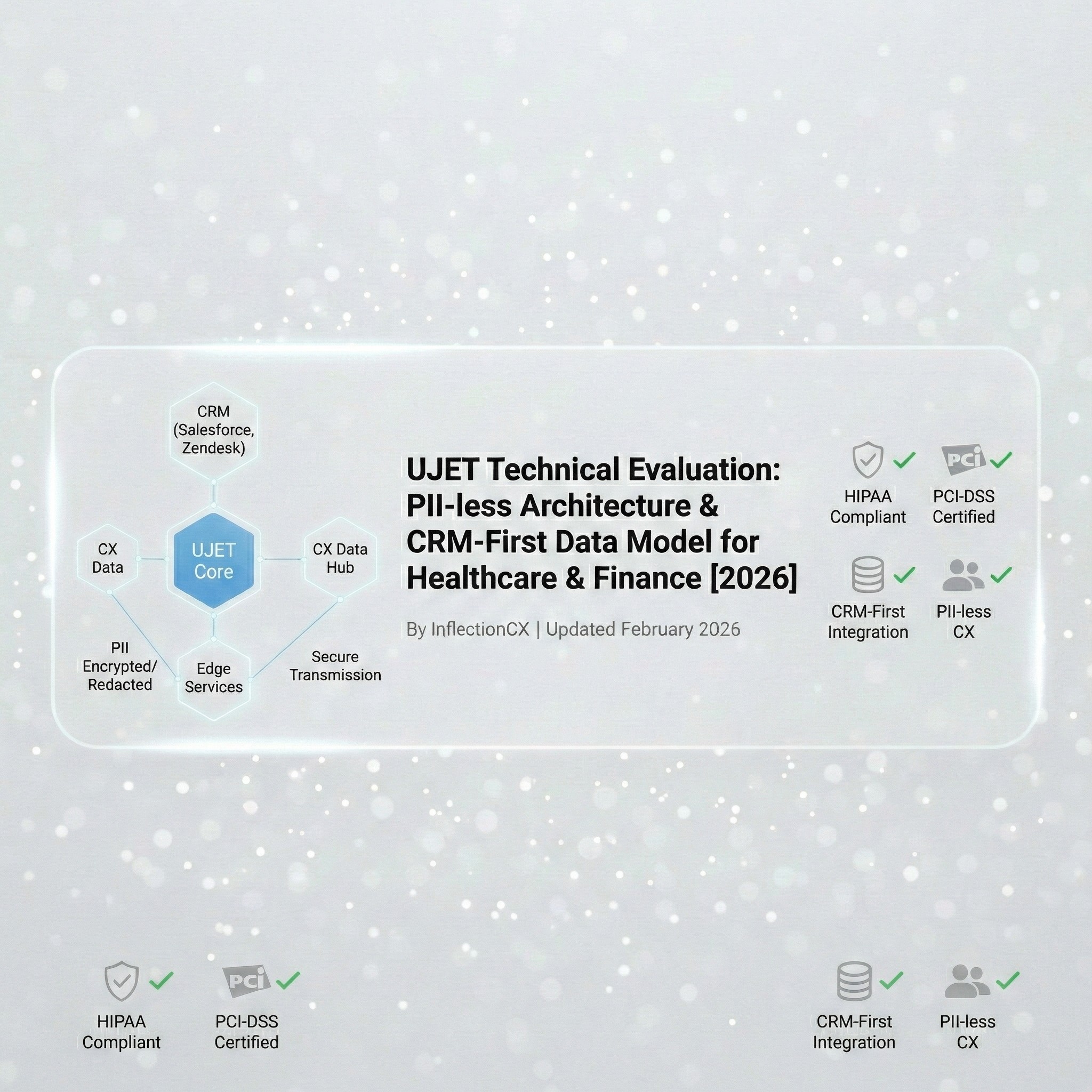
UJET's core architectural differentiator is its "PII-less" data model, which means the platform processes customer interaction data in transit but does not store it permanently. When a session ends, UJET packages the interaction record, transmits it to your CRM or designated storage, confirms delivery, and deletes the data from its environment. Your CRM becomes the single system of record for all customer interactions.
Most CCaaS platforms function as secondary systems of record. They maintain their own databases of customer interactions, call recordings, chat transcripts, and agent notes. This creates a cascading set of operational problems that compound over time. You're managing sensitive data across multiple systems. You're reconciling records between your CRM and your contact center platform. Every compliance audit requires pulling data from multiple sources. Every GDPR "Right to be Forgotten" request means tracking down and deleting customer data from multiple databases.
UJET inverts this model entirely. The platform handles the communication layer — routing calls, managing chat sessions, processing media — but treats itself as a transient conduit rather than a destination for data. The practical result is that your compliance surface area shrinks to a single system. Your agents see one source of truth. Your data governance team manages one set of retention policies instead of two.
For organizations in healthcare and financial services, where every additional system that touches protected data creates audit scope, this architectural choice has direct cost implications. A contact center platform that never stores PHI or PCI data is a contact center platform that doesn't need to be independently audited for PHI or PCI data storage.
The trade-off is dependency. Your CRM's availability, API rate limits, and storage capacity become critical infrastructure for your contact center operation. If Salesforce throttles your org during a volume spike, UJET's data delivery queues until capacity frees up. This isn't a theoretical concern — it's a capacity planning requirement that needs to be addressed during implementation.
What does the 15-minute metadata handoff look like in practice?
UJET transmits interaction data to your external storage or CRM within 15 minutes of session completion. During this window, UJET encrypts all communication data in transit, packages a JSON metadata file containing 20+ data points (participant details, transfer history, handle duration, diagnostic telemetry), delivers the file via native CRM connectors or to external storage (SFTP or Google Cloud Storage), confirms successful delivery, and then permanently deletes the data from its environment.
For organizations using native CRM connectors (Salesforce, Zendesk, ServiceNow, and others), this process is largely automatic. The interaction record appears in your CRM as a logged activity with associated recordings and transcripts.
For organizations running custom or proprietary CRMs, the handoff requires configuring external storage with a specific folder structure:
Folder | Contents |
|---|---|
| JSON logs of chat interactions |
| Images and videos from SmartActions |
| Master session JSON file |
| Audio files |
| Voicemail recordings |
The 15-minute window matters operationally in a few specific ways. First, real-time reporting during this window relies on UJET's own dashboards and API endpoints rather than your CRM's reporting tools. If your quality assurance process requires immediate post-call review, you'll work within UJET's interface for that first 15 minutes. Second, if your CRM experiences downtime during the handoff window, UJET queues the delivery and retries. You need to understand the retry behavior and failure notification mechanisms during implementation planning — ask specifically about dead letter handling and alerting for failed deliveries.
From an operator's perspective, the 15-minute window rarely creates friction for standard workflows. Where it matters is in escalation scenarios: if a supervisor needs to pull a recording for an active complaint that just ended, they need to know whether to look in UJET's interface or wait for CRM delivery. Training your team on this timing is a small but necessary part of rollout.
How does UJET handle HIPAA compliance for healthcare contact centers?
UJET maintains HIPAA compliance certification and will execute a Business Associate Agreement (BAA), which is the baseline requirement for any technology vendor handling Protected Health Information (PHI) in a healthcare contact center environment. The PII-less architecture provides an additional compliance advantage: because UJET doesn't persistently store PHI, the platform reduces the scope of your HIPAA risk assessment compared to platforms that maintain their own data stores.
Healthcare contact center compliance extends well beyond checking a HIPAA certification box. Here's what operators actually need to evaluate:
PHI in transit vs. PHI at rest. UJET encrypts data in transit using TLS 1.2+ and processes PHI during live interactions — agents see patient information on screen, recordings capture spoken PHI, and chat transcripts contain written PHI. The critical question is what happens during the 15-minute handoff window. During that period, PHI exists temporarily within UJET's encrypted environment before being transmitted to your CRM and deleted. Your BAA should explicitly address data handling during this transient window, including breach notification obligations if UJET's environment were compromised during the handoff period.
Call recording controls. Healthcare interactions frequently require the ability to pause and resume recording — for example, when a member provides a Social Security number or discusses sensitive mental health information. Verify that UJET's recording controls support agent-initiated pause/resume and that your QA workflows account for gaps in recordings.
EHR and health plan system integration. UJET's native CRM connectors cover Salesforce, ServiceNow, and other general-purpose platforms. If your healthcare operation runs on Epic, Cerner, or a proprietary health plan administration system, you'll be building custom integrations through UJET's Generic API. Assess the development effort required, particularly around screen pop functionality that pulls member eligibility and claims data into the agent workspace.
Audit trail requirements. HIPAA requires maintaining access logs showing who viewed PHI and when. Because UJET writes interaction data to your CRM, your audit trail lives in your CRM's access logging rather than in a secondary system. This is architecturally cleaner — but it means your CRM's audit logging must be properly configured before go-live, not after.
D-SNP and Medicare plan-specific requirements. If your operation handles Dual Special Needs Plans or Medicare Advantage programs, you're subject to CMS call recording and monitoring requirements beyond standard HIPAA. UJET's recording and quality monitoring capabilities should be evaluated against CMS audit protocols, not just general HIPAA requirements.
The bottom line for healthcare: UJET's architecture is genuinely advantageous for HIPAA compliance because it eliminates a secondary PHI data store. But "HIPAA compliant" is a starting point, not an endpoint. The operational compliance work — configuring recording controls, building EHR integrations, establishing audit trails, meeting plan-specific CMS requirements — still falls on your team.
What do financial services teams need to know about UJET and regulatory compliance?
Financial services contact centers face a more complex regulatory matrix than almost any other vertical. UJET's compliance certifications include PCI DSS (for payment card data), SOC 2 Type II (for security controls), and GDPR (for data residency). These address significant portions of the compliance landscape, but financial services operators need to evaluate beyond certifications.
PCI DSS and payment handling. UJET's approach to PCI compliance is architecturally sound. The SDK handles secure payment input through a PCI-compliant field where card data is invisible to agents — they see only a transaction confirmation. This eliminates the most common PCI failure point in contact centers: agents viewing, speaking, or writing down card numbers. For financial services teams processing payments over the phone, this is a meaningful operational improvement over platforms that rely on agent discipline and "pause recording" buttons for PCI compliance.
Dodd-Frank call recording requirements. The Dodd-Frank Act requires financial institutions to record all phone conversations related to securities and commodities transactions. This is a blanket recording requirement with no opt-out — every call must be captured, stored, and retrievable. UJET's recording capabilities support this, but the storage question is critical: because recordings are transmitted to your CRM or external storage after the 15-minute handoff, your storage system must meet Dodd-Frank retention requirements (typically 3-5 years depending on the specific regulation). Ensure your storage infrastructure can handle the volume and retention period.
Sarbanes-Oxley implications. SOX requires that recorded calls related to financial reporting cannot be altered or deleted during retention periods. Your CRM or storage system — not UJET — bears this responsibility, since UJET deletes recordings after handoff. Confirm that your storage solution supports immutable records or write-once-read-many (WORM) configurations.
TCPA and outbound compliance. If your financial services operation includes outbound calling (collections, account servicing, marketing), TCPA compliance requires consent management, time-of-day restrictions, and DNC list adherence. UJET's outbound capabilities include contact list management and DNC list support through the API, but outbound is not the platform's primary strength. Evaluate whether UJET's outbound tools meet your volume and compliance requirements, or whether you'll need a supplemental dialer.
Data residency and cross-border requirements. UJET offers configurable data residency at the tenant level (US, EU, and select Asia Pacific regions). For financial services organizations subject to data localization requirements — particularly those operating across multiple jurisdictions — this configurability matters. Verify that the specific data flows (voice, chat, metadata) all respect residency boundaries, not just the primary interaction record.
The emerging regulatory landscape. The Keep Call Centers in America Act of 2025 introduces new requirements for agent location disclosure. If your operation uses offshore or nearshore agents, UJET's agent management capabilities should support location-based disclosures in IVR flows or agent scripts. This is a newer requirement that many platforms haven't fully addressed.
How does UJET compare to Five9, Genesys, Talkdesk, and NICE CXone?
UJET competes in the CCaaS market against platforms with significantly larger market share and broader feature sets. The meaningful differences are architectural, not cosmetic — they determine which operational problems each platform solves well and which it doesn't.
UJET vs. Five9
Five9 is the strongest platform for outbound voice operations — predictive dialing, campaign management, blended inbound/outbound workflows. If your operation is outbound-heavy (collections, sales, appointment setting), Five9's capabilities are deeper than UJET's.
UJET's advantages over Five9 emerge in inbound digital and mobile experiences. The PII-less architecture provides compliance simplification that Five9's traditional data model doesn't match. UJET's mobile SDKs with SmartActions (biometric authentication, photo/video capture, in-app payments) are capabilities Five9 doesn't natively offer. Five9's architecture reflects its evolution from earlier platforms — functional but carrying technical debt that shows up in integration patterns and data flow complexity.
Dimension | UJET | Five9 |
|---|---|---|
Core strength | Inbound, mobile, digital CX | Outbound voice, blended operations |
Data architecture | PII-less, CRM as system of record | Platform stores interaction data |
Mobile SDK | Native with SmartActions | Web-view based |
AI foundation | Google Cloud CCAI | Proprietary + partnerships |
Outbound dialing | Basic capabilities | Industry-leading predictive dialer |
WFM | Limited native WFM | Built-in workforce management |
Analyst coverage | Gartner Cool Vendor (2019); not in MQ or Forrester Wave | Gartner MQ Leader; Forrester Wave Leader |
Best for | Mobile-first CX, compliance-sensitive verticals | High-volume outbound, blended operations |
UJET vs. Genesys Cloud
Genesys Cloud is the platform you choose when you need everything in one system — WFM, quality management, deep analytics, workforce engagement, outbound, and a massive app marketplace. It maintains its own comprehensive system of record with internal analytics that don't require external BI tools.
UJET offers the opposite architectural philosophy: push data to your CRM, keep the platform lightweight, integrate deeply with a smaller number of systems rather than broadly with hundreds. For organizations already invested in Salesforce or ServiceNow as their operational backbone, UJET's approach reduces complexity. For organizations that want their contact center platform to be the operational hub, Genesys is the stronger choice.
Dimension | UJET | Genesys Cloud |
|---|---|---|
Architectural philosophy | Lightweight conduit, CRM-centric | Comprehensive platform, self-contained |
Native WFM | Limited | Industry-leading |
App marketplace | Smaller ecosystem | 350+ pre-built integrations |
Analytics | Relies on CRM/external BI | Deep native analytics |
Mobile experience | Native SDK with SmartActions | Primarily web-view widgets |
Multi-cloud | Active-active across GCP, AWS, Azure | Primarily AWS |
Compliance approach | PII-less reduces audit scope | Comprehensive but adds audit surface |
Best for | CRM-centric operations, mobile-first | Full-suite contact center needs |
UJET vs. Talkdesk
Talkdesk is UJET's closest competitor in positioning: cloud-native, AI-focused, API-first, founded in the 2010s without legacy architecture. The differentiation between them is real but narrow.
Talkdesk has a larger integration ecosystem (70+ pre-built connectors vs. UJET's smaller set), a more mature app marketplace, and stronger native industry solutions for healthcare (Talkdesk Healthcare Experience Cloud) and financial services. UJET counters with deeper mobile-native capabilities, the PII-less architecture (which Talkdesk doesn't replicate), and the Google Cloud CCAI partnership that provides access to Google's AI infrastructure.
For healthcare and financial services specifically, Talkdesk's industry-specific solutions are more developed as pre-packaged offerings. UJET's advantage is architectural — the compliance simplification from PII-less data handling. The choice often comes down to whether you value pre-built industry workflows (Talkdesk) or architectural compliance advantages (UJET).
UJET vs. NICE CXone
NICE CXone is the enterprise incumbent — massive scale, comprehensive WFM (NICE is the market leader in workforce management), deep analytics, and the broadest feature set in the market. If you're running a 5,000+ seat operation with complex scheduling requirements, NICE CXone's WFM alone may justify the platform.
UJET cannot match NICE CXone's breadth. The comparison only makes sense when UJET's specific strengths — mobile-native capabilities, PII-less architecture, Google Cloud AI integration, multi-cloud resilience — align with specific operational requirements that NICE CXone addresses less elegantly. For mid-market organizations (100-1,000 seats) in regulated industries who value architectural simplicity over feature comprehensiveness, UJET warrants serious evaluation.
What does the UJET–Google Cloud CCAI relationship mean for buyers?
UJET serves as the omnichannel front-end for Google Cloud's Contact Center AI (CCAI) Platform. This is an OEM partnership, not a reseller arrangement — UJET's platform is architecturally integrated with Google Cloud's AI infrastructure, and Google sells the combined solution through its cloud marketplace.
For buyers, this relationship has several practical implications. UJET's virtual agent capabilities are built on Google's Dialogflow (both ES and CX), which means you get access to Google's natural language understanding models, training infrastructure, and ongoing AI research investment. The platform supports both Dialogflow ES (simpler, intent-based) and Dialogflow CX (complex, stateful conversation flows with visual builders), as well as custom bot integration for organizations using non-Google AI platforms.
The partnership also means UJET benefits from Google Cloud's infrastructure investments — security practices, global network, and operational standards. Google's decision to partner with UJET (rather than building their own contact center UI or partnering with a larger vendor) signals confidence in UJET's architecture, particularly the CRM-first approach that aligns with Google's broader data ecosystem philosophy.
The risk dimension is vendor dependency. If Google shifts its CCAI strategy — acquiring a different front-end, building native capabilities, or de-prioritizing the contact center space — UJET's AI roadmap is directly affected. The July 2025 development where Onix acquired UJET's professional services unit adds a layer of complexity: Onix, a Google Cloud Premier Partner, is now the primary implementation partner for UJET-on-Google-Cloud deployments. This doesn't change the product, but it does change who's responsible for getting you live.
For Google Cloud-centric organizations already running workloads on GCP, the UJET integration path is significantly smoother than bringing in a non-Google-aligned CCaaS platform. For multi-cloud or AWS-centric organizations, the Google dependency is worth factoring into your long-term architecture planning, though UJET's multi-cloud infrastructure (active workloads across GCP, AWS, and Azure) mitigates single-cloud risk at the platform level.
How should you evaluate UJET's AI and automation capabilities?
UJET's AI capabilities span four functional areas: virtual agents (customer-facing automation), agent assist (real-time support for live agents), automated post-interaction processing, and conversational analytics. The capabilities are real, but evaluating them requires separating infrastructure access from production performance.
Virtual agents. UJET supports Dialogflow ES and CX for building conversational AI flows, plus a custom bot integration API for organizations using other platforms. The platform handles intent-to-action mapping — routing decisions, data collection, escalation triggers — and preserves full conversation context during handoff from virtual agent to human agent. This context preservation is important: the human agent sees the entire bot conversation transcript and any data collected, rather than starting from scratch.
The quality of your virtual agent depends on your Dialogflow design, training data, and intent architecture — not on UJET. The platform provides the plumbing; you build the intelligence. If you don't have conversational AI expertise in-house, factor in the cost of a Dialogflow implementation partner.
Agent assist. During live interactions, UJET can surface real-time transcription, knowledge base article suggestions, sentiment detection alerts, compliance phrase detection, and suggested responses. These capabilities are powered by Google Cloud's AI infrastructure and delivered through the agent workspace.
The honest evaluation question is how well these features perform in your domain. Agent assist in a general customer service context is different from agent assist in a healthcare plan's member services call where clinical terminology, plan-specific benefits language, and regulatory disclosure requirements create a specialized vocabulary. Ask for a proof-of-concept that uses your actual interaction data — not generic demos.
Automated summaries. Post-call AI-generated summaries reduce after-call work by creating structured notes that inject directly into CRM case records. This is genuinely useful and increasingly table-stakes across CCaaS platforms. Evaluate summary quality against your specific documentation requirements. Healthcare operations, for example, need summaries that capture clinical information accurately — a summary that paraphrases a member's medication concern incorrectly creates downstream risk.
Spiral conversational analytics. This is UJET's most operationally interesting AI capability. Beyond keyword spotting, Spiral analyzes patterns across interaction transcripts to identify emerging issues — detecting, for example, that a specific app bug is driving contact volume even when customers describe the problem differently each time. For operations teams, this closes the gap between "calls increased 20%" and "calls increased because of a specific product issue we can fix." The value depends on transcript volume and the maturity of your existing voice-of-customer analytics program.
What are UJET's mobile SDK capabilities and SmartActions?
UJET's mobile SDK is arguably the platform's strongest technical differentiator. While most CCaaS platforms offer mobile support through web-view wrappers (essentially a mobile browser window pointing at a chat widget), UJET provides native iOS and Android SDKs that integrate directly with device capabilities.
The binary footprint adds approximately 8 MB to your app store download. Integration uses Swift Package Manager for iOS and Gradle for Android. Memory-leak testing confirms stability for background operations — the SDK won't trigger iOS background app termination.
SmartActions are the capability that makes the native SDK integration meaningful. These are agent-triggered or automated prompts during live sessions that leverage device hardware:
SmartAction | What it does | Why it matters |
|---|---|---|
Biometric authentication | Triggers Face ID or fingerprint on the customer's device | Eliminates knowledge-based verification ("mother's maiden name"), reducing average handle time by 30-45 seconds per interaction |
Photo/video request | Activates native camera, securely transmits media to CRM | Customer shows the problem instead of describing it — transformative for insurance claims, product damage, technical support |
Secure payment | PCI-compliant input field, card data invisible to agent | Transaction confirmation only, no data touches agent screen or call recording |
Location sharing | GPS coordinate capture | Immediate context for delivery, field service, emergency services |
Signature capture | Electronic signature collection within the support flow | Contract completion, consent documentation without leaving the interaction |
Structured text input | Guided data collection (serial numbers, account IDs, policy numbers) | Reduces transcription errors from voice-to-text agent entry |
For healthcare operations, the photo/video SmartAction enables visual triage scenarios — a member can show a medication label, a medical device error screen, or wound documentation directly through the support interaction. For financial services, biometric authentication and secure payment input address two of the highest-friction compliance requirements in every call.
Pre-session SmartActions collect verification or diagnostic data before the customer connects to an agent. This means the agent receives context (identity verification complete, device diagnostic data collected, insurance card photo already captured) upon pickup rather than spending the first 60-90 seconds gathering basic information. In our operations, pre-call data collection is one of the highest-ROI process improvements available — it directly reduces handle time and improves first-call resolution.
The SDK also displays estimated wait times per channel and offers callback scheduling, letting customers make informed decisions about whether to wait on voice or switch to chat.
If your customers primarily contact you through a mobile app, UJET's SDK capabilities are materially differentiated from competitors. If your support is primarily web-based and voice-based without a mobile app, this advantage doesn't apply.
How does UJET integrate with Salesforce, ServiceNow, and your existing stack?
UJET offers pre-built native connectors for Salesforce, Zendesk, Microsoft Dynamics, ServiceNow, HubSpot, Kustomer, Oracle Service Cloud, Freshdesk, and Zoho. For proprietary or custom CRMs, the Generic API provides bidirectional connectivity.
Native connector capabilities include an embedded UJET toolbar/softphone within the CRM interface, automatic interaction logging (calls, voicemails, transcripts), CRM data consumption for routing decisions (customer tier, open cases, plan type), and screen pop with customer context pulled from CRM fields. Critically, connectors support API batching — grouping multiple updates into single requests to avoid hitting CRM rate limits during high-volume periods.
The Salesforce integration is the most mature. Interaction data writes directly to Salesforce objects, agents work within the Salesforce UI without toggling to a separate application, and routing rules can consume Salesforce data (customer segment, case priority, account status) to make intelligent queue decisions. For organizations running their contact center operation on Salesforce, this integration depth eliminates the "swivel chair" problem where agents toggle between three or four applications during a single interaction.
For custom CRM integration, the pattern requires three components: external storage (SFTP or Google Cloud Storage) for media and transcripts, your CRM listening for postMessage events from the UJET Agent Adapter (typically iFrame-embedded), and event handling that reads session IDs and opens relevant customer records. The 15-minute metadata JSON file serves as the data contract between systems.
Real-time data flow follows a predictable pattern. An inbound call arrives, UJET identifies the customer via ANI (caller ID), fires a conversation.created webhook, your middleware queries the CRM for the full customer profile, the API updates conversation metadata with enriched context, and the agent receives a screen pop with everything they need. Post-call, the conversation.completed webhook triggers recording/transcript retrieval, AI analysis, CRM summary updates, and follow-up workflow triggers.
Webhook architecture covers conversation events (created, assigned, transferred, completed, abandoned), message events (sent, received, delivered, read), agent events (status changed, logged in/out), and queue events (threshold exceeded, service level warning, overflow triggered). Delivery timeout is 5 seconds, with exponential backoff retry and dead letter queue for persistent failures. Payloads are signed with HMAC-SHA256 for security validation.
The integration consideration that matters most for healthcare and financial services: your CRM becomes the single data store, which means your CRM's security posture, access controls, and audit logging must be production-grade before your contact center goes live on UJET. This is an advantage (one system to secure) but also a dependency (that system must be robust).
What are UJET's known limitations and honest trade-offs?
No platform evaluation is useful without addressing limitations directly. UJET's user reviews across G2 (4.7/5 with 1,100+ reviews), Gartner Peer Insights, and TrustRadius surface consistent themes that operators should factor into their decision.
Reporting limitations are the most frequently cited weakness. Users on Gartner Peer Insights describe the platform as lacking fundamental metric tracking capabilities. The native reporting tools are adequate for basic operational metrics but fall short for organizations accustomed to deep, customizable analytics. The architectural rationale makes sense — since UJET pushes data to your CRM, the expectation is that you'll build your analytics in Salesforce Reports, Tableau, or your BI tool of choice. But this means additional development work and BI infrastructure investment that platforms like Genesys or NICE CXone include natively.
If your organization doesn't have a mature BI practice, UJET's reporting approach will feel like a gap. If you already run your business intelligence through a centralized data warehouse, you'll barely notice — the data lands in your CRM, and your existing analytics pipeline handles it from there.
Workforce management is limited. UJET does not offer robust native WFM capabilities. For organizations with complex scheduling requirements — multiple skill groups, shift bidding, intraday management, long-term capacity planning — you'll need a third-party WFM solution (NICE IEX, Verint, Calabrio, or Assembled). This adds cost and integration complexity.
The integration ecosystem is smaller than legacy vendors. UJET's app marketplace and pre-built connector library is meaningfully smaller than Genesys (350+ integrations), Five9, or NICE CXone. If your operation depends on specific niche integrations — particular quality management platforms, specific speech analytics tools, specialized compliance recording systems — verify availability before committing.
Analyst coverage creates perception risk. UJET is not included in the Gartner Magic Quadrant for CCaaS or the Forrester Wave. For organizations where vendor selection requires analyst validation, this absence creates internal selling challenges. The platform has strong user satisfaction scores and was named a Gartner Cool Vendor in 2019, but executive stakeholders who rely on MQ placement for vendor shortlisting may push back.
Outbound capabilities are not the platform's strength. If your operation includes significant outbound calling — collections, appointment reminders, proactive service, sales — evaluate UJET's outbound tools carefully against your volume and compliance requirements. The platform supports outbound, but it's not the engineering focus the way inbound digital and mobile experiences are.
The Onix services relationship needs clarification. In mid-2025, Onix acquired UJET's professional services business unit. Onix is now the primary implementation partner, while UJET focuses on software development. For buyers, this means asking clear questions about implementation support: Who manages your deployment? What's the handoff between UJET product and Onix services? How does ongoing support work? This organizational split is relatively new and worth understanding before signing.
Performance variability appears in reviews. Some users report occasional slow loading, software glitches, and interface lag. These issues don't dominate the review landscape (overall satisfaction is very high), but they appear consistently enough to warrant load testing during your proof-of-concept period, particularly if you're running high-concurrency operations.
What does a UJET implementation actually look like?
UJET implementation follows the standard CCaaS deployment pattern — tenant provisioning, integration configuration, user setup, testing, and cutover — but the CRM-first architecture adds specific requirements to the planning phase that differ from traditional platform deployments.
Phase 1: Infrastructure preparation. Before touching UJET, your CRM needs to be ready to receive interaction data. This means configuring storage, setting up the objects or tables that will hold interaction records, establishing access controls and audit logging, and verifying that your CRM's API rate limits can handle the projected interaction volume. For Salesforce orgs, calculate your API call allocation against UJET's data delivery patterns. For custom CRMs, build and test the external storage folder structure and ingestion pipeline.
Phase 2: Network and connectivity. Dedicated bandwidth for voice traffic calculated against peak concurrent call projections. QoS configuration prioritizing voice packets. Firewall rules for UJET endpoints. WebSocket support for real-time features. If you're using BYOC (Bring Your Own Carrier), SIP trunk configuration with TLS, SRTP for media encryption, and codec support verification (G.711, G.729, Opus).
Phase 3: Integration development. Native connector configuration for supported CRMs, or Generic API integration development for custom systems. Webhook endpoint infrastructure to receive real-time events. OAuth 2.0 authentication setup. Mobile SDK integration if deploying SmartActions within your app.
Phase 4: AI and routing configuration. Dialogflow agent setup if using virtual agents. Intent mapping, escalation triggers, and handoff behavior configuration. Queue structure, skill-based routing rules, and IVR flow design. Agent assist configuration and knowledge base integration.
Phase 5: Testing. This is where the CRM-first architecture requires extra attention. Test the full data lifecycle: interaction creation, live data flow, session completion, 15-minute handoff, CRM delivery confirmation, and data deletion from UJET. Test failure scenarios: What happens when CRM is unavailable? When API rate limits are hit? When storage is full? Load test at projected peak volumes.
Phase 6: Training and cutover. Agent training should emphasize the single-source-of-truth workflow — all interaction history lives in the CRM, not in a separate contact center portal. Supervisors need to understand the 15-minute reporting window. QA teams need workflows that account for the data delivery timing.
Timeline expectations. Native CRM connector deployments for mid-market organizations typically run 8-16 weeks. Custom CRM integrations with extensive API development can extend to 16-24 weeks. Complex multi-site, multi-channel deployments with AI virtual agent configuration may run longer. The Onix partnership means your implementation partner is a Google Cloud specialist — experienced with the UJET-Google stack but potentially less familiar with your specific CRM ecosystem or industry-specific workflows.
Who is UJET best for — and who should look elsewhere?
After evaluating the architecture, capabilities, limitations, and competitive landscape, here's our practitioner assessment of where UJET fits and where it doesn't.
UJET is a strong fit for:
Organizations where compliance drives significant operational cost — healthcare plans, financial services firms, and other regulated entities where every system that stores PII creates audit scope, development overhead, and risk exposure. The PII-less architecture provides a genuine structural advantage here.
Mobile-first support operations where customers contact you through a native app. SmartActions (biometric auth, visual capture, secure payments, location sharing) are capabilities no other CCaaS platform matches natively. If your support experience should feel like a native extension of your product rather than a third-party overlay, UJET is the platform to evaluate first.
Google Cloud-centric technology stacks where Dialogflow, Vertex AI, and GCP infrastructure are already in place. The OEM partnership means tighter integration than any non-Google-aligned alternative.
CRM-centric operations that have already invested in making Salesforce or ServiceNow the operational hub. UJET extends that strategy into the contact center rather than creating a competing system of record.
Mid-market organizations (100-1,000 seats) that want modern cloud-native architecture without the complexity and cost of enterprise platforms like Genesys Cloud or NICE CXone.
Look elsewhere when:
Outbound is a major part of your operation. Five9 and LiveVox offer materially stronger outbound dialing, campaign management, and blended agent capabilities.
You need comprehensive native WFM. If workforce management is a primary driver and you don't want to integrate a third-party WFM solution, Genesys Cloud or NICE CXone include WFM capabilities that UJET can't match.
Analyst validation is a procurement requirement. If your organization requires Gartner MQ Leader or Forrester Wave inclusion for vendor shortlisting, UJET doesn't currently qualify. This isn't a commentary on platform quality — it's a reality of procurement processes.
You need a massive pre-built integration ecosystem. If your operation depends on dozens of niche integrations working out of the box, larger platforms with broader app marketplaces will require less custom development.
Deep social media channel management is critical. UJET's social channel capabilities are less mature than its voice, chat, and mobile channels.
Frequently asked questions
Does UJET store any customer data permanently? No. UJET processes communication data in transit and transmits all interaction records, recordings, and transcripts to your CRM or designated external storage within 15 minutes of session completion. After confirming successful delivery, UJET permanently deletes the data from its environment.
What is UJET's pricing model? UJET uses per-agent, per-month pricing across multiple tiers. Specific pricing is not publicly listed and varies by seat count, channel requirements, and contract terms. Request a custom quote and ensure you understand what's included vs. add-on — particularly AI features, recording storage (in your CRM), and mobile SDK licensing.
Does UJET support HIPAA compliance for healthcare? Yes. UJET maintains HIPAA certification and executes Business Associate Agreements. The PII-less architecture provides an additional compliance advantage by eliminating persistent PHI storage within the contact center platform. However, HIPAA compliance is a shared responsibility — your CRM, storage infrastructure, and operational procedures must also meet HIPAA requirements.
Can UJET replace our existing contact center and WFM? UJET can replace your contact center platform for voice, chat, SMS, and mobile channel handling. It cannot replace a dedicated WFM solution. Plan to maintain or implement a third-party WFM tool (NICE IEX, Verint, Calabrio, Assembled) alongside UJET.
How does UJET handle high-volume spikes? UJET's microservices architecture on multi-cloud infrastructure (active across GCP, AWS, and Azure) scales on demand. The more relevant capacity question is whether your CRM can handle the data delivery volume during spikes — UJET's ability to scale is gated by your CRM's ability to ingest.
What happens if our CRM goes down? UJET queues data delivery and retries once CRM availability is restored. Confirm the specific queue depth limits, retry intervals, and failure notification mechanisms during implementation planning. Your CRM's SLA effectively becomes a component of your contact center's SLA.
Is UJET in the Gartner Magic Quadrant or Forrester Wave? Currently, no. UJET was named a Gartner Cool Vendor in 2019 and maintains strong user satisfaction scores (4.7/5 on G2, 9.6/10 on TrustRadius), but is not included in the current Gartner MQ for CCaaS or the Forrester Wave evaluation.
What changed with the Onix acquisition of UJET services? In mid-2025, Onix (a Google Cloud Premier Partner) acquired UJET's professional services business unit. UJET continues to develop and sell the software platform. Onix handles implementation, deployment, and professional services. This changes your services relationship but not the product.
Does UJET support Bring Your Own Carrier (BYOC)? Yes. UJET supports SIP trunk integration with existing carriers, including number portability. SIP over TLS and SRTP for media encryption are required. UJET also offers managed voice services if you prefer not to maintain carrier relationships.
How does UJET's multi-cloud architecture actually work? UJET runs active workloads simultaneously across Google Cloud Platform, AWS, and Azure. This is not a primary/failover configuration — all three clouds handle production traffic. If any single provider experiences a regional outage, workloads redistribute to the remaining providers. This level of multi-cloud redundancy is unusual in the CCaaS market.
InflectionCX is a unified customer experience operations company combining AI agents with human agents across healthcare and financial services. We evaluate, implement, and operate contact center technology — including the platforms reviewed in this guide. For a vendor-neutral architecture assessment tailored to your operation, contact our team.
More in Analysis


Ready for Better CX?

Whether you're selecting your CX technology stack or evaluating outsourcing options, InflectionCX is your go-to-partner. Contact us today.
AI Readiness Assessment
We map where AI fits in your operation. What's working, what's hype, what's actually worth doing.

Unified CX Outsourcing
InflectionCX runs contact centers where humans and AI operate as one system.