
Sarah Mitchell
CX Industry Analyst
Last updated: February 2026 | By the CX operations team at InflectionCX
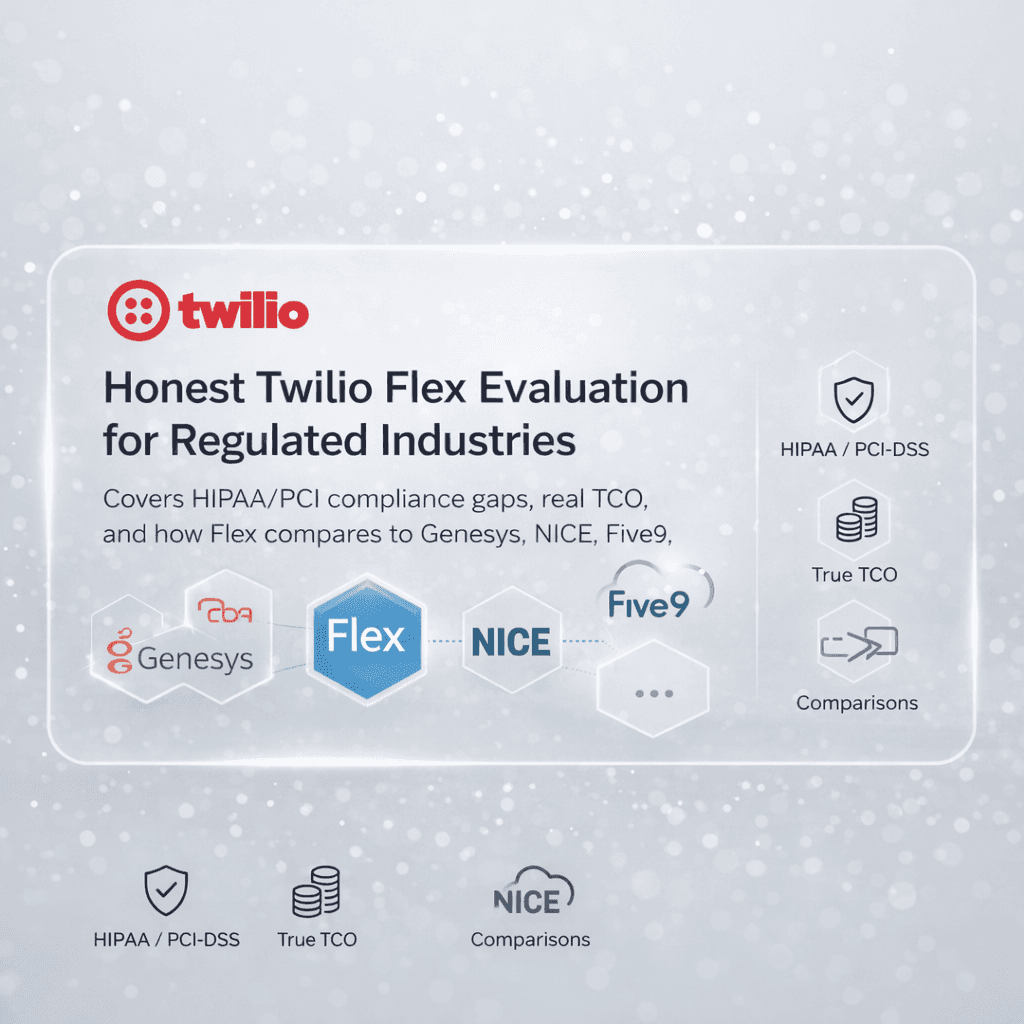
Twilio Flex is one of the most customizable contact center platform on the market. It is also the most misunderstood. Flex ships as programmable infrastructure — not finished software — which means organizations that treat it like a traditional CCaaS product will spend months discovering they purchased building materials when they wanted a finished house. This guide provides an honest, compliance-focused evaluation for healthcare and financial services contact centers, including a critical finding that most Flex content ignores: the platform's flagship AI features are not HIPAA-eligible or PCI-compliant.
What Is Twilio Flex, and What Isn't It?
Twilio Flex is a cloud contact center platform built on three core Twilio primitives: TaskRouter (routing logic), Conversations (unified messaging), and Sync (real-time state management). Everything visible on the agent desktop — the task list, customer panel, channel switching — is a React application consuming APIs from these underlying services.
This architecture makes Flex fundamentally different from platforms like Genesys Cloud, NICE CXone, or Five9. Those platforms are configured. Flex is built. The distinction matters more than any feature comparison.
Flex Is a CPaaS Leader, Not a CCaaS Leader
This is a point of confusion worth clearing up immediately. Twilio was named a Leader in the 2025 Gartner Magic Quadrant for CPaaS (Communications Platform as a Service). It does not appear in the Gartner Magic Quadrant for CCaaS, where the Leaders are NICE, Genesys, and Five9. This distinction reflects reality: Flex provides communications infrastructure that can become a contact center, while traditional CCaaS platforms provide contact centers out of the box.
For organizations with development capacity, this is a strength. For organizations expecting a turnkey solution, it is a warning.
What Flex Gives You
Flex provides genuine omnichannel capability through its Conversations API. Voice, SMS, WhatsApp, Facebook Messenger, web chat, and email are handled through a single interface. When a customer messages on WhatsApp and then calls in, the agent sees both interactions in the same view. Most competitors still treat channels as separate products bolted together.
The React-based plugin architecture means you can modify anything — agent UI, routing logic, channel handling, integration patterns. Every user interaction (AcceptTask, HoldCall, CompleteTask) emits before- and after-events that plugins can intercept. You can require disposition codes before task completion, validate CRM sessions before task acceptance, or log transfers to external systems automatically.
TaskRouter handles routing through JSON expression matching rather than drag-and-drop designers. This is more flexible than Genesys or NICE routing — and more fragile. A misplaced quotation mark in a workflow expression can send your entire queue to the wrong team. There is no visual validator. You find out in production.
What Flex Does Not Give You
Flex does not include workforce management, quality management, speech analytics, or advanced reporting as native features. You integrate those capabilities or you build them. The APIs exist. The pre-built connectors mostly do not.
Flex Insights provides basic operational dashboards — handle time, queue wait, abandonment rate — but real-time dashboards update every 60 minutes by default. If you need accurate real-time visibility into calls currently in queue or agents presently available, you need to build it yourself using TaskRouter Statistics APIs. Insights is also limited to 20 dashboards per workspace and degrades in performance beyond 8 filters per report tab.
Supervisor tooling is basic compared to mature CCaaS platforms. Real-time monitoring dashboards, quality evaluation tools, and coaching workflows most require custom development or third-party integration.
Changes require deployments. Adding a new IVR option, modifying a routing rule, or changing the agent UI all require code changes and deployment cycles. There is no admin panel where a supervisor can add a new skill and have it take effect immediately.
How Much Does Twilio Flex Actually Cost?
Flex pricing is transparent at the license level and opaque everywhere else. The license is the floor, not the ceiling.
License Models
Flex offers two pricing tiers:
Per-hour pricing: $1 per active user hour, charged when agents are logged in. This works for variable or part-time workforces where agents are not working standard 40-hour weeks.
Per-user pricing: $150 per named user per month, regardless of hours logged. This works for full-time agents on standard schedules.
The breakeven sits at approximately 150 hours per month. Below that, per-hour pricing is cheaper. Above it, per-user saves money. At 160 hours/month (40 hours/week), per-hour pricing equals $160 — slightly more than per-user.
The Costs Beyond the License
Voice costs vary by geography and number type. Inbound runs $0.0085–$0.02 per minute. Outbound runs $0.014–$0.05 per minute. Phone numbers cost $1–$2 each per month. A 100-agent center handling 70,000 voice minutes monthly will spend approximately $2,000–$3,500 on telephony alone.
Messaging costs include SMS at $0.0079 per message (US), WhatsApp at $0.005–$0.08 per message depending on conversation type, and MMS at $0.02 per message.
AI add-on costs for Agent Copilot are $0.035 per voice minute and $0.005 per digital message. For a center processing 70,000 voice minutes monthly, that adds $2,450/month — before considering whether those AI features are even usable in your compliance environment.
Recording storage costs $0.0025 per minute stored. Organizations recording every call at high quality discover this adds up quickly. One common surprise: three months of unrestricted recording at a 100-agent center can generate $15,000+ in storage costs that were not in the original budget.
Development costs are the hidden line item that determines whether Flex is affordable or expensive. Based on typical implementation patterns:
Initial implementation: $25,000–$100,000 depending on complexity
Timeline: 3–6 months for regulated industry deployments
Ongoing maintenance: 0.5–1 FTE for a 100-agent deployment
Annual maintenance costs: 15–20% of initial development investment
Organizations underestimate implementation costs by 40–60% on average, according to industry analyst data. Flex is not a product that runs itself. It is a platform that requires continuous engineering attention.
Three-Year TCO Model: 100-Agent Healthcare Contact Center
Component | Monthly | Year 1 | Years 2-3 (Annual) |
|---|---|---|---|
Flex licenses (per-user, 100 agents) | $15,000 | $180,000 | $180,000 |
Voice (70,000 min/mo) | $2,200 | $26,400 | $26,400 |
Phone numbers (50) | $150 | $1,800 | $1,800 |
SMS (10,000 messages/mo) | $100 | $1,200 | $1,200 |
Recording storage | $200 | $2,400 | $2,400 |
Twilio platform subtotal | $17,650 | $211,800 | $211,800 |
Implementation (one-time) | — | $75,000 | — |
Ongoing development (0.75 FTE) | $10,000 | $120,000 | $120,000 |
Third-party integrations (WFM, QM) | $3,000 | $36,000 | $36,000 |
Monitoring/infrastructure | $1,000 | $12,000 | $12,000 |
Total | $31,650 | $454,800 | $379,800 |
Per agent/month | $316.50 | — | — |
This TCO is competitive with enterprise CCaaS pricing if development stays within budget. If implementation runs over — and it usually does — or if you need partner implementation services, adjust upward accordingly. The three-year total of approximately $1.21M compares to $1.1–$1.5M for equivalent Genesys Cloud or NICE CXone deployments, depending on feature requirements.
HIPAA and PCI Compliance: What Is Covered and What Is Not
This section addresses the single most important consideration for healthcare and financial services organizations evaluating Flex — and the one that existing evaluation guides consistently fail to cover with adequate specificity.
The Critical Finding: Agent Copilot Is Not HIPAA-Eligible or PCI-Compliant
Twilio's documentation states explicitly: Agent Copilot and Unified Profiles in Flex are not HIPAA Eligible Services or PCI-compliant and should not be used in Flex or Segment workflows that are subject to HIPAA or PCI requirements.
This means healthcare contact centers cannot use Flex's headline AI features — auto-generated wrap-up notes, customer highlights, real-time suggested responses, or knowledge base search — in any workflow involving protected health information. Financial services contact centers face the same restriction for interactions involving payment card data or other PCI-scoped information.
There is no public timeline for when Agent Copilot or Unified Profiles might become HIPAA-eligible or PCI-compliant. This is not a roadmap item that Twilio has committed to publicly.
This creates a paradox: the AI features that justify much of Flex's value proposition in demos and sales presentations are unavailable to the regulated industries where contact center performance matters most.
What Is HIPAA-Eligible in Flex
The core Flex platform is HIPAA-eligible when configured correctly under Twilio's Security or Enterprise Edition with a signed Business Associate Agreement. HIPAA-eligible components include:
Flex UI (the agent desktop)
Voice (Programmable Voice)
SMS (Programmable Messaging)
Conversations API
Webchat 3.x.x (added March 2025)
ConversationRelay (added March 2025)
TaskRouter
Proxy
Flex Insights (with limitations — PII attributes are automatically stripped)
Conversational Intelligence for Voice (added September 2025)
This means the contact center itself — routing, voice, messaging, the agent interface — can handle PHI. But the AI layer that sits on top of it cannot.
HIPAA Configuration Requirements
Enabling HIPAA-eligible operation requires specific configurations: encrypted connections (TLS 1.2+), access controls with unique user identification, audit logging enabled, recording encryption at rest, and ensuring no PHI flows into non-eligible services. Flex Insights requires particular attention — custom attributes containing PHI must be excluded, and default reporting behavior needs modification to prevent PHI exposure in dashboards.
Healthcare organizations should also be aware that HIPAA enforcement is intensifying. OCR collected over $9.9 million in HIPAA fines in 2024 with an average penalty of $579,003. A third phase of compliance audits was confirmed underway as of March 2025.
PCI DSS Compliance in Flex
Twilio maintains PCI DSS Level 1 certification — the highest level of compliance. The <Pay> verb enables PCI-compliant payment processing within the contact center, allowing agents to collect payment information without that data touching the agent desktop.
For financial services organizations, the key constraint mirrors the healthcare situation: core Flex voice and messaging infrastructure is PCI-compliant, but Agent Copilot and Unified Profiles are not. Any interaction involving payment card data or financial account information cannot leverage AI-assisted features. PCI DSS non-compliance penalties range from $5,000 to $100,000 per month, yet Verizon's PCI DSS report found that 80% of organizations are still not fully compliant — a statistic that underscores the stakes of getting this right.
What This Means in Practice
If you are evaluating Flex for a healthcare or financial services contact center, your AI strategy must account for two parallel tracks: one for interactions involving regulated data (PHI, PCI-scoped data) where Agent Copilot cannot be used, and one for non-regulated interactions where it can. This adds architectural complexity, training complexity, and monitoring complexity that pure-play CCaaS platforms with natively compliant AI features do not impose.
Alternatively, you build your own compliant AI layer on top of Flex's infrastructure — which is possible given Flex's extensibility, but adds significant development investment beyond the standard implementation scope.
How Flex Compares: Genesys, NICE, Five9, Amazon Connect, and Talkdesk
Every platform evaluation guide includes a comparison table. Most of those tables are produced by one of the vendors being compared. This one is not.
The Comparison That Matters for Regulated Industries
Capability | Twilio Flex | Genesys Cloud | NICE CXone | Five9 | Amazon Connect | Talkdesk |
|---|---|---|---|---|---|---|
Pricing model | $1/hr or $150/user/mo + usage | $75–$155/user/mo | Custom enterprise | $119–$229/user/mo | $0.018/min (pay-per-use) | $75–$125/user/mo |
Implementation timeline | 3–6 months | 4–8 weeks | 4–8 weeks | 4–8 weeks | 2–4 weeks (basic) | 4–8 weeks |
UI customization | Unlimited (React/plugins) | Configuration options | Limited | Moderate | Build your own (custom) | Limited |
Routing flexibility | Code-based expressions | Visual designer | Admin configuration | Visual designer | Lambda functions | Studio designer |
Omnichannel | Native, unified API | Integrated | Integrated (acquisitions) | Integrated | Separate products | Integrated |
WFM | Integration required | Native | Native (industry-leading) | Native | Integration required | Native (basic) |
QM/Speech analytics | Integration required | Native | Native (Enlighten AI) | Native | Contact Lens (native) | Native |
HIPAA-eligible | Yes (core platform) | Yes | Yes | Yes | Yes | Yes |
AI features HIPAA-eligible | No (Agent Copilot excluded) | Yes (native AI) | Yes (Enlighten AI) | Yes | Yes (Contact Lens) | Yes |
PCI DSS compliant | Yes (core + | Yes | Yes | Yes | Yes | Yes |
AI features PCI-compliant | No (Agent Copilot excluded) | Yes | Yes | Yes | Yes | Yes |
Healthcare industry cloud | No | No | Healthcare-specific modules | No | Healthcare-specific lens | Yes (Healthcare Experience Cloud) |
Financial services industry cloud | No | No | Financial-specific modules | No | No | Yes (Financial Services Experience Cloud) |
Ongoing dev requirement | Continuous (0.5–1 FTE/100 agents) | Minimal | Minimal | Minimal | Moderate | Minimal |
Gartner CCaaS position | Not in MQ | Leader | Leader | Leader | Visionary | Leader |
Gartner Peer Insights | 4.2 ★ (12 reviews) | 4.6 ★ (906 reviews) | 4.5 ★ (800+) | 4.4 ★ (600+) | 4.4 ★ (200+) | 4.5 ★ (600+) |
Where Flex Wins
Customization depth is unmatched. If your contact center requires a workflow, integration, or agent experience that no off-the-shelf platform supports, Flex can build it. Source code access, plugin architecture, and API-first design mean there are very few technical limitations on what you can create.
Omnichannel architecture is genuinely unified. Add WhatsApp in weeks, not quarters. Maintain conversation context across channel transitions. Most competitors are still integrating acquisitions from the last decade.
Usage-based economics work for organizations with variable demand. Seasonal healthcare enrollment periods, financial services tax-season surges, or BPOs with fluctuating client volumes benefit from paying only for active agent time.
Platform convergence matters if you already use Twilio. If your organization runs on Twilio for SMS notifications, voice in mobile apps, or Segment for customer data, adding Flex reduces integration complexity and may unlock volume pricing.
Where Flex Loses
Time to value is significantly longer. Traditional CCaaS platforms launch in 4–8 weeks. Flex implementations take 3–6 months for regulated industries. If you need a contact center operational by next quarter, Flex is probably not the answer.
AI compliance gap is the elephant in the room. Every major competitor offers AI-powered agent assist, speech analytics, and automated quality management that operate within HIPAA and PCI boundaries. Flex's AI features do not. For healthcare and financial services organizations, this is not a minor limitation — it eliminates a primary value driver.
Out-of-box completeness is far behind. Genesys and NICE include WFM, QM, speech analytics, workforce engagement management, and sophisticated reporting as standard features. Flex provides APIs to integrate those capabilities. The work, cost, and maintenance burden differ substantially.
Industry-specific solutions do not exist. Talkdesk offers pre-built Healthcare Experience Cloud and Financial Services Experience Cloud with compliance controls, EHR integrations, and industry-specific workflows built in. NICE offers regulated-industry modules. Flex provides general-purpose infrastructure you can build upon, but the building is your responsibility.
What Healthcare Contact Centers Need to Know
Healthcare contact center performance increasingly drives revenue. CMS methodology changes now weight customer experience measures at approximately 57% of overall Medicare Star Ratings, up from 32% in 2020. A one-star improvement in Star Ratings can translate to millions in Quality Bonus Payments. This creates genuine urgency around contact center platform decisions.
The Healthcare Evaluation Checklist
HIPAA compliance is the first filter, not the last. Confirm BAA availability, identify exactly which components are and are not HIPAA-eligible, and map your PHI data flows against those boundaries. With Flex specifically, this means understanding that Agent Copilot and Unified Profiles cannot participate in PHI workflows.
EHR integration is make-or-break for provider organizations. If your agents need to access or update Epic, Cerner, or other EHR systems during interactions, evaluate how that integration works. Flex provides the API infrastructure to build CRM screen pops and bidirectional data sync, but you are building and maintaining that integration yourself. Genesys and Talkdesk offer pre-built healthcare integrations that reduce this burden.
Agent turnover in healthcare contact centers runs at approximately 60% annually. Time-to-proficiency for new agents is a critical metric. Platforms with native AI agent assist, knowledge management, and guided workflows reduce ramp time. With Flex, these capabilities require custom development — and as noted, AI features like Agent Copilot cannot be used in HIPAA-scoped workflows.
Abandonment rates have direct financial impact. An average 7% abandonment rate on 2,000 daily calls translates to approximately 140 abandoned interactions per day. In healthcare, each abandoned call represents a potential missed appointment, delayed authorization, or member who calls back (doubling handle cost) — or switches providers. Patients experiencing negative phone interactions are four times more likely to switch providers.
Where Flex Can Work for Healthcare
Flex excels when healthcare organizations need deeply customized patient engagement workflows that off-the-shelf platforms cannot support. Examples include custom appointment scheduling integrations with proprietary systems, multi-language IVR flows with culturally-specific routing, member onboarding journeys that span voice, SMS, and web chat with persistent context, and integration with care management platforms that require bidirectional data exchange during live interactions.
If your healthcare contact center requirements are standard — skills-based routing, CRM screen pop, call recording, quality monitoring, WFM — a traditional CCaaS platform will deliver faster, with less development investment, and with AI features that actually work within HIPAA boundaries.
What Financial Services Contact Centers Need to Know
Financial services contact centers operate under a regulatory framework that includes PCI DSS, SOX, FINRA, and state-level regulations. The average consumer expects their financial institution to protect them — 92% consider this essential — while $7.3 billion was lost to robocall scams in 2023 alone. Platform security is not a feature checkbox; it is a risk management decision.
The Financial Services Evaluation Checklist
PCI DSS compliance scope must be precisely understood. Flex's <Pay> verb enables PCI-compliant payment collection, but Agent Copilot cannot operate on PCI-scoped interactions. If your agents handle both payment processing and general service inquiries, you need routing logic that distinguishes between interaction types and enables or disables AI features accordingly. PCI DSS non-compliance penalties range from $5,000 to $100,000 per month.
Fraud prevention is becoming a contact center responsibility. Voice biometrics, AI-powered caller authentication, and real-time fraud detection are increasingly evaluated alongside traditional contact center capabilities. Flex's Media Streams API enables real-time audio streaming to external fraud detection services, but the integration is custom. Amazon Connect and Genesys offer native fraud detection capabilities.
Channel consistency matters more in financial services. 73% of consumers expect seamless transitions between channels, but only 13% believe their financial institution delivers this. Flex's Conversations API provides genuine channel unification — one of its strongest capabilities. A customer starting on web chat can continue via phone without repeating information. This is a real advantage over platforms where channels remain siloed.
Compliance recording and archival requirements vary by regulation. FINRA requires retention of communications records for specific periods. Flex supports dual-channel recording (separating agent and customer audio) and SIPREC integration for external recording platforms. Recording storage costs need to be modeled against retention requirements — financial services regulations may require years of storage, and at $0.0025 per minute, costs compound.
Where Flex Can Work for Financial Services
Flex's API-first architecture is strong for financial institutions building differentiated digital experiences — real-time transaction alerts that seamlessly transition to live agent support, authenticated customer portals with embedded communications, or custom lending workflows that combine automated document collection with human underwriting review.
Twilio's broader platform strength in financial services is notable. The company was named to the IDC FinTech Rankings 2025 Enterprise Top 50, and its customer data platform (Segment) is widely used in financial services for customer journey analytics. If your organization already uses Segment, the integration with Flex Unified Profiles provides genuine value for non-PCI interactions.
Flex AI Capabilities: What You Actually Get (and When You Can Use It)
Twilio's AI strategy centers on what it calls "CustomerAI" — the convergence of its CPaaS infrastructure, Segment CDP, and generative AI capabilities. At SIGNAL 2025, Twilio unveiled the next generation of its customer engagement platform. For Flex specifically, the AI capabilities now available are significant in scope, if constrained in applicability.
Agent Copilot
Agent Copilot provides auto-generated wrap-up notes (reducing after-call work by an estimated 13–38%), real-time suggested responses, topic and subtopic detection, and knowledge base search where agents type questions and receive answers sourced from uploaded content. Pricing is $0.035 per voice minute and $0.005 per digital message. The quality of knowledge base responses depends entirely on the quality and coverage of content you upload via Twilio's Knowledge API.
Unified Profiles
Powered by Segment's CDP, Unified Profiles pull customer data from digital properties into the agent interface — website activity, purchase history, previous interactions, and predictive scores. This reduces questions agents need to ask and enables personalized service. Implementation requires a Segment workspace, configured data sources, and the Flex-Segment connection. For organizations already using Segment, this is genuinely valuable. For those who are not, it represents an additional platform to implement and maintain.
ConversationRelay and Conversational Intelligence
ConversationRelay (GA as of 2025) enables voice AI agents using any LLM — a framework for building automated voice interactions that can hand off to human agents with full context. Conversational Intelligence for Voice (also GA) converts calls into structured data including transcripts, sentiment, and key topics. Notably, Conversational Intelligence for Voice became HIPAA-eligible in September 2025, making it the only AI-adjacent Flex capability usable in healthcare workflows.
The Compliance Constraint, Again
Agent Copilot and Unified Profiles remain outside HIPAA and PCI compliance boundaries. This means the features most visible in demos — AI-generated summaries, customer highlights, real-time suggestions — are unavailable for regulated interactions. Organizations can build their own compliant AI layer using Flex's extensible architecture, Media Streams API, and external AI services. But this adds six-figure development costs and ongoing maintenance overhead to what the demo presented as a product feature.
Implementation Reality: What Actually Happens
Typical Timeline for Regulated Industries
Weeks 1–4 (Foundation): Development environment setup across separate Twilio accounts for dev, staging, and production. Basic voice IVR with queue routing. Minimal viable agent desktop. Initial CRM screen pop. Compliance configuration (BAA execution, HIPAA/PCI-eligible service activation, encryption verification). If your team is new to Twilio, add two weeks. If your CRM has a complex API, add two more.
Weeks 5–12 (Core Functionality): Complete routing logic including skills-based routing, escalation paths, time-of-day rules, and language-specific routing. Bidirectional CRM integration. Recording configuration with compliance-appropriate retention settings. Supervisor dashboards (custom-built, since native capabilities are limited). WFM integration via webhooks on worker activity events. QM system integration for recordings and metadata export.
Weeks 13–20 (Hardening and Launch): Load testing (this is where you discover that the webhook timeout, the Sync rate limit, and the routing expression bug have been waiting for you). Compliance audit and penetration testing. Agent training and change management. Phased rollout — never big bang. Performance optimization based on production traffic patterns.
Ongoing: Feature development based on operational feedback. Platform updates and plugin compatibility testing. Monitoring for routing distribution anomalies, webhook response time degradation, and task completion rate drops. Bug fixes for the edge cases that only appear under production load.
Common Failure Modes
Webhook timeouts under load. The CRM lookup that worked in testing takes 8 seconds when the database is under production load. Twilio times out at 15 seconds. Half your calls route without customer context.
Routing expression bugs. The expression intended to route Spanish calls to Spanish-speaking agents instead routes all calls to the Spanish queue because of operator precedence. You discover this when queue wait times spike.
Sync rate limits. Sync enforces 20 read/write requests per second per object. A supervisor dashboard querying a global Sync Map for all agent states hits this limit around 25 concurrent agents. The dashboard updates sporadically, and supervisors lose visibility.
Plugin conflicts. Plugin A modifies task attributes in beforeAcceptTask. Plugin B reads those attributes in the same event. Plugin load order changes between deployments. Agent behavior becomes unpredictable.
Recording storage cost surprises. Unrestricted recording with long retention periods generates storage costs that were never in the original budget model. Healthcare and financial services retention requirements make this particularly acute.
The Build-vs.-Partner Decision
Flex implementations require development resources. The question is whether those resources are internal, external, or some combination.
Building internally gives you control, institutional knowledge, and the ability to iterate quickly. It requires hiring or allocating React developers with Twilio expertise, which is a relatively niche skill set. Plan for 0.5–1 FTE per 100 agents as an ongoing baseline.
Outsourcing to a systems integrator gives you implementation speed and Twilio-specific expertise. It creates dependency — every change, every bug fix, every feature request goes through your SI's queue and pricing model. For regulated industries, this also means your SI must understand HIPAA/PCI requirements and configure accordingly.
The hybrid model that works: Internal product ownership (someone who understands your contact center operations and defines requirements) combined with implementation support (developers who know Twilio's platform). The product owner ensures the platform serves operational needs. The developers ensure it works technically. Neither role can substitute for the other.
What does not work: outsourcing development with no internal technical ownership. You become dependent on your integrator for every change, which is a worse form of vendor lock-in than traditional CCaaS platforms impose. At least with Genesys or NICE, the vendor maintains the platform. With Flex and a detached SI, nobody maintains the platform effectively.
Evaluation Checklist: 10 Questions for Regulated Industries
Before signing a Flex contract, answer these questions honestly:
1. Can you sustain ongoing development investment? Not "hire someone for the initial build" but fund continuous engineering for the life of the platform. If the answer is no, choose a traditional CCaaS platform.
2. Do your requirements genuinely exceed standard CCaaS capabilities? If Genesys or NICE's out-of-the-box features meet 80% of your needs, the development investment in Flex does not make sense. There is no prize for building what you could have bought.
3. Can your AI strategy work without Agent Copilot for regulated interactions? Map which interactions involve PHI or PCI data and which do not. If the majority are regulated, Flex's AI gap affects most of your volume.
4. How long can you wait for a production contact center? If the answer is less than three months, Flex is not the choice.
5. Do you have internal product management for the contact center? Someone who defines requirements, prioritizes features, and translates operational needs into development tickets. Without this role, development efforts drift and operational needs go unmet.
6. What is your integration landscape? List every system the contact center touches — CRM, EHR, claims, WFM, QM, analytics. Each integration is custom work in Flex. Price and timeline each one.
7. Is your organization already invested in Twilio? Existing Twilio usage for SMS, voice, or Segment for CDP reduces integration complexity and may unlock favorable pricing. Starting from zero adds onboarding costs.
8. What is your compliance audit cadence? More frequent audits mean more frequent validation that Flex's configuration remains compliant. This is operational overhead that turnkey platforms handle through built-in compliance controls.
9. Have you modeled three-year TCO including development? License cost comparisons without development costs are meaningless for Flex. Model the full picture before comparing to alternatives.
10. Do you view the contact center as a competitive differentiator or a cost center? Flex rewards investment with capability. If the goal is answering calls as cheaply as possible, the ongoing development investment does not pay off.
The Bottom Line
Twilio Flex is a powerful platform that rewards organizations willing to treat their contact center as a software product. The customization depth is real. The omnichannel architecture is genuinely unified. The API-first design enables integrations that no other platform can match.
But for healthcare and financial services organizations in 2026, Flex presents a specific challenge: the AI features driving the next generation of contact center productivity are unavailable for regulated interactions. Every major competitor — Genesys, NICE, Five9, Amazon Connect, Talkdesk — offers AI capabilities that operate within HIPAA and PCI boundaries. Flex does not.
This does not make Flex the wrong choice for every regulated organization. It makes Flex the right choice only for organizations that have a clear, funded plan for either building their own compliant AI capabilities on Flex's infrastructure or operating effectively without AI assist for regulated interactions while the platform's compliance coverage catches up.
The organizations that thrive with Flex commit development resources, establish product management discipline, and view the contact center as a strategic investment. The organizations that struggle expect configuration instead of construction, outsource development without internal ownership, and treat the contact center as a cost line to minimize.
Be honest about which organization you are. The flexibility is real. So is the complexity. In regulated industries, the compliance constraints make that calculus even more consequential.
InflectionCX operates unified customer experience operations combining AI agents with human agents for healthcare and financial services organizations. We evaluate contact center platforms based on operational outcomes, not vendor relationships. To discuss your platform evaluation, visit inflectioncx.com.
More in Analysis


Ready for Better CX?

Whether you're selecting your CX technology stack or evaluating outsourcing options, InflectionCX is your go-to-partner. Contact us today.
AI Readiness Assessment
We map where AI fits in your operation. What's working, what's hype, what's actually worth doing.

Unified CX Outsourcing
InflectionCX runs contact centers where humans and AI operate as one system.